
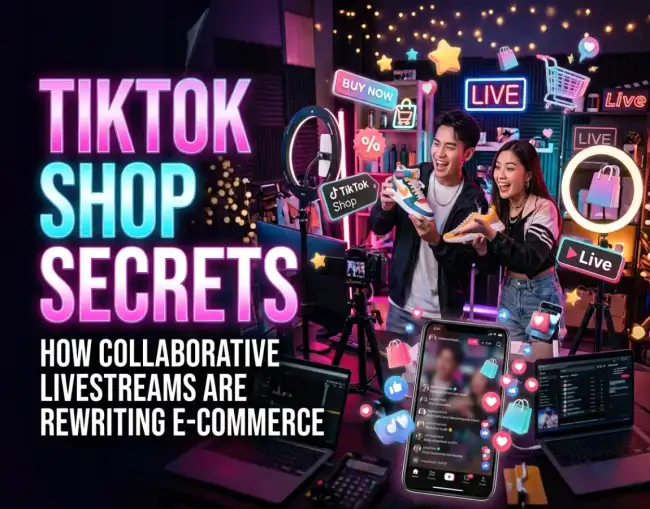
The traditional digital storefront is experiencing a profound, irrecoverable transformation. For decades, e-commerce relied heavily on static imagery, optimized landing pages, and search-engine-driven intent. Consumers looked for products; they did not stumble upon them while being entertained by a dynamic, multi-person digital broadcast. Today, that paradigm has been entirely upended by the convergence of real-time video and native purchasing architecture. At the epicenter of this shift sits TikTok Shop, a platform that has transformed passive social media scrolling into an active, frictionless shopping bazaar where physical goods are bought and sold within seconds, all without ever leaving the application interface.
Yet, the most lucrative evolution within this ecosystem is not the individual creator going live to pitch a single brand's SKU. The true bleeding edge of digital retail is the collaborative livestream—a strategic co-broadcasting format where multiple creators, or brands paired with high-converting influencers, unite on a single split-screen or co-hosted session. By pooling audiences, cross-pollinating follower bases, and introducing unscripted, dynamic social friction, these collaborative events are routinely shattering historical sales records. They convert casual viewers into hyper-engaged buyers at conversion rates that traditional digital advertising pipelines can only envy. For brands and digital publishers alike, understanding the mechanics of these joint streams is no longer an optional tactic; it is the definitive blueprint for capturing modern consumer attention and wallet share.
To master this high-stakes environment, one must look beyond the surface-level metrics of view counts and superficial likes. Behind every successful multi-creator broadcast lies an intricate web of logistical coordination, real-time affiliate split-tracking, psychological pacing, and algorithmic optimization. As social commerce continues to blur the lines between entertainment and retail, this exhaustive analysis unpacks the definitive playbook for leveraging TikTok Shop collaborative livestreams. Whether you are an independent creator looking to maximize your monetization or an enterprise brand scaling your direct-to-consumer revenue, the strategies detailed below will chart your course through the most disruptive economic shift in modern digital history.
Understanding the Architecture of Social Commerce on TikTok
The Evolution from Discovery Engine to Transactional Ecosystem
To fully grasp why collaborative livestreams perform so exceptionally well, one must first deconstruct the underlying architecture of the platform. TikTok began its ascent as a pure discovery engine, leveraging an algorithmic "For You" feed that prioritized interest-based content over social graph connections. This meant a creator with zero followers could achieve millions of views overnight if their content resonated with the initial sample cohort. When TikTok introduced TikTok Shop, it grafted a fully functional, end-to-end checkout infrastructure directly onto this discovery engine. Consumers no longer had to click an external link, load a slow third-party mobile website, and input credit card information. Instead, saved payment methods and one-click purchasing transformed impulse entertainment into immediate impulse buying.
This structural shift fundamentally altered consumer psychology. Users are conditioned to consume short-form video in a state of high receptivity and relaxation. When a creator seamlessly transitions from a lifestyle narrative or comedic sketch into demonstrating a physical product—and pinning it directly to the bottom of the live screen—the friction of acquisition drops to near zero. Furthermore, the platform's proprietary algorithm actively favors live content that demonstrates high user retention, active chat engagement, and rapid gross merchandise value (GMV) generation. By keeping users inside the application ecosystem for extended durations, TikTok rewards high-performing streams with massive organic distribution boosts, feeding a self-sustaining loop of visibility and sales.
The Psychology of the Shared Screen and Co-Presence
Human beings are deeply social creatures wired to respond to group dynamics, social proof, and communal excitement. When a single creator goes live, viewers experience a one-to-many dynamic that mimics traditional television or infomercials. However, when two or more creators enter a collaborative livestream via split-screen, the psychological dynamic instantly transforms into a dynamic, interactive talk show or live-action game show. The presence of multiple personalities creates organic banter, friendly competition, and real-time validation of product claims. If Creator A demonstrates a skincare serum and Creator B interjects with genuine amazement at the texture, the psychological weight of the endorsement doubles instantly through social proof.
Moreover, collaborative streams leverage the "halo effect" of audience cross-pollination. When Creator X (with a dedicated community of 500,000 beauty enthusiasts) goes live alongside Creator Y (with 400,000 fashion-forward followers), both communities bleed into one another. Viewers who may have never encountered Creator X are suddenly exposed to their charisma, expertise, and product recommendations under the warm endorsement of Creator Y. This reduces skepticism, builds instant authority, and creates a high-energy, FOMO-driven (fear of missing out) environment where limited-time inventory drops and exclusive live-only discounts generate explosive transactional velocity.
Strategic Blueprint: Pre-Stream Planning and Talent Pairing
Identifying and Vetting Complementary Co-Hosts
The foundation of any successful collaborative livestream is established long before the "Go Live" button is ever pressed. The most catastrophic mistake brands and creators make is pairing influencers together based solely on massive follower counts rather than audience alignment and complementary energy profiles. To maximize conversion, co-hosts should share an adjacent niche while possessing distinct personalities or areas of expertise. For example, pairing a technical gadget reviewer with a lifestyle aesthetic creator allows them to address both the hard specifications and the everyday utility of a smart home device, satisfying two entirely different segments of the buyer persona.
Vetting a co-host also requires rigorous data auditing. Before finalizing a collaborative agreement, partners must review historical livestream analytics, including average concurrent viewership (ACV), peak viewer retention times, audience demographics, and historical GMV-per-viewer metrics. It is frequently more profitable to partner with a mid-tier micro-creator boasting a hyper-engaged, niche community than a macro-influencer whose audience is broad, fatigued, and unresponsive. Establishing clear communication channels, shared content outlines, and alignment on brand voice ensures that the broadcast flows naturally without awkward pauses, conflicting messaging, or brand safety violations.
Structuring the Revenue Split and Affiliate Infrastructure
Money talks, and poorly structured financial agreements will quickly sabotage even the most creatively aligned partnerships. TikTok Shop operates on a robust native affiliate system, allowing creators to link products directly to their showcases and live sessions while earning predefined commission percentages set by the merchant. In collaborative settings, financial mechanics become more complex. Brands, primary stream hosts, and guest co-hosts must establish transparent attribution models well in advance of the broadcast. Utilizing custom creator discount codes, pinned product rotation schedules, and clear affiliate link-sharing agreements prevents post-campaign disputes and keeps all parties motivated.
Professional creators must also treat these collaborations with the same legal rigor as traditional endorsement deals. Navigating intellectual property rights, exclusivity clauses, and deliverables is critical to long-term digital business sustainability. For an in-depth framework on safeguarding your creative assets, monetization terms, and partnership parameters, review The Ultimate 2025 Creator Contract Checklist: Protecting Your IP and Profits to ensure your backend operations remain airtight. Clear contracts protect both parties, establish performance benchmarks, and build a foundation of trust necessary for repeating successful multi-stream campaigns.
Logistical Technical Dry Runs and Hardware Setup
Technical failures during a live broadcast are conversion killers. When thousands of dollars worth of inventory are moving per minute, a dropped internet connection, distorted audio, or a lagging split-screen feed can halt momentum instantly. Prior to going live, collaborative partners must execute mandatory technical dry runs. This involves testing the TikTok Live Studio desktop software versus mobile streaming setups, verifying dual-audio synchronization to prevent echo chambers, and ensuring high-speed, hardwired internet connections or robust 5G redundancies.
Furthermore, lighting, framing, and product staging must be synchronized so that the visual aesthetic of the stream remains professional and cohesive. If Creator A is broadcasting from a dimly lit bedroom and Creator B is broadcasting from a professional ring-lit studio setup, the visual disparity can subconsciously diminish the perceived value of the products being sold. Establish a unified checklist covering audio levels, lighting color temperatures, product placement angles, and emergency troubleshooting protocols to ensure a flawless execution on game day.
Choreographing the Broadcast: Pacing, Scripting, and Engagement
Mastering the First 90 Seconds: The Hook and Retention Playbook
The algorithmic success of a TikTok Shop livestream is heavily determined by its initial velocity. When users swipe into a live broadcast, the host has roughly three to five seconds to convince them not to swipe away. In a collaborative stream, this opening moment requires synchronized energy and immediate value communication. Rather than starting with a sluggish housekeeping introduction or waiting for viewers to trickle in, co-hosts must drop immediately into high-energy banter, tease an upcoming exclusive giveaway or deep discount, and visually display the hero product within the frame.
The script for the first 90 seconds should be tightly choreographed. Creator A welcomes the audience and introduces the core theme of the stream, while Creator B immediately chimes in by pinning the first flash-sale product to the screen and announcing a limited stock warning. By establishing urgency right out of the gate, you train the incoming audience that your stream is fast-paced, high-value, and unmissable. Maintaining this breakneck momentum requires seamless handoffs between hosts, utilizing call-and-response techniques to keep viewer attention glued to the screen.
The Art of the Product Demonstration and Live Q&A Integration
Unlike traditional television shopping networks where hosts talk *at* the audience, TikTok Shop livestreams thrive on radical authenticity and real-time interaction. The most successful collaborative streams treat the live chat as an active third co-host. When viewers ask questions regarding sizing, material durability, or side effects, the co-hosts must immediately pull the product closer to the camera, physically demonstrate the answer, and shout out the username of the commenter.
This creates an intense psychological feedback loop of validation and personalization. When a consumer hears their name read aloud by two influential creators who are actively stress-testing the exact pair of shoes or electronic gadget they are considering buying, the hesitation barrier evaporates. Co-hosts should split duties dynamically: while one creator is actively demonstrating a product feature or unboxing a bundle, the other is monitoring the chat feed, fielding questions, pinning new inventory items, and orchestrating real-time flash discounts to spike transaction velocity.
Psychological Triggers: Scarcity, Urgency, and Social Proofing
To convert passive viewers into active buyers during a collaborative stream, hosts must master the deployment of scarcity and urgency triggers. Because TikTok Shop allows merchants to manage real-time inventory counts, creators can visually display exact stock levels remaining for a discounted item. Phrases like "We only have 47 units left at this 50% off bundle price, and once they're gone, the price goes back to retail" create an immediate, visceral sense of urgency.
Additionally, co-hosts should continually amplify social proof throughout the broadcast. Whenever a viewer makes a purchase—which often triggers native platform notifications across the screen—the hosts should celebrate the buyer by name. Hearing "Shout out to Jessica M. who just grabbed the ultimate skincare bundle, you are going to glow girl!" prompts copycat behavior among other viewers who want that same public acknowledgment and validation. This community-driven momentum is what propels collaborative streams to six-figure GMV milestones in a matter of hours.
Cross-Platform Amplification and Funnel Integration
Pre-Streaming Promotion Across Ecosystems
Relying solely on TikTok’s native live notification system to build your audience is a rookie mistake. To maximize concurrent viewership, brands and creators must build a multi-channel pre-streaming funnel that drives warm traffic directly into the live room the moment the broadcast commences. This requires leveraging short-form video content, Instagram Stories, YouTube Community posts, and email newsletters days in advance of the scheduled event.
Furthermore, creators can repurpose highlights from past successful streams into punchy, high-converting short clips that tease upcoming collaborative events. For sophisticated brands looking to scale their digital footprint, understanding how to transition long-form narrative media into bite-sized, high-retention social assets is essential. To master this multi-channel synergy, review Cross-Platform Scaling: Transforming a YouTube Docuseries Into TikTok Micro-Content to discover how top-tier publishers build omni-channel momentum that feeds directly into live commerce conversions.
Post-Stream Monetization and Content Recycling
The financial lifecycle of a collaborative livestream does not end when the broadcast is signed off. In fact, a staggering percentage of total campaign revenue is frequently generated *after* the live session concludes, provided the creators and brands know how to properly recycle and capitalize on the VOD (Video on Demand) asset. TikTok automatically saves live broadcasts to the creator's profile archive, allowing users who missed the live event to still purchase pinned products directly from the recorded video.
To maximize this long-tail revenue, editors should immediately comb through the multi-hour recording to extract the top 5 to 10 most engaging moments—such as a dramatic product demonstration, a hilarious co-host disagreement, or a massive reaction to a surprise giveaway. These micro-clips should then be posted as standard TikTok feed videos, complete with the product anchor links attached. This transforms a single collaborative livestream into an evergreen traffic engine that continues generating passive affiliate commissions and brand sales for weeks or even months after the initial broadcast.
Real-World Case Studies & Execution Scenarios
Scenario A: The Beauty Brand Triumph (High Execution)
Consider the recent campaign executed by an emerging indie cosmetics brand partnering with two mid-tier beauty creators with overlapping follower demographics of roughly 600,000 users each. Instead of running separate, isolated streams, the brand orchestrated a weekly "Beauty Battle" collaborative livestream where the two creators tested the brand's new waterproof foundation line under extreme conditions—including high-humidity facial steamers and stress tests.
- Pre-Stream Strategy: Teaser short-form videos were posted 5 days prior, generating over 1.2 million combined organic views and driving 15,000 users to click the live registration reminder button.
- Execution: During the 90-minute live session, the co-hosts utilized split-screen co-broadcasting, interacting seamlessly while fielding chat questions. They unlocked exclusive TikTok Shop-only voucher coupons every 20 minutes to maintain viewer retention spikes.
- Results: The stream achieved a peak concurrent viewership of 4,200 users, maintained an average watch time of 8.5 minutes, and generated over $84,000 in gross merchandise value within a single session, yielding a stellar 14x Return on Ad Spend (ROAS).
Scenario B: The Tech Gadget Flop (Common Failure Modes)
Conversely, consider a cautionary tale from an electronics accessories brand that attempted a collaborative livestream with two tech reviewers who possessed zero prior chemistry and disparate audience bases.
- The Breakdown: The hosts failed to execute a technical dry run. Creator A's microphone suffered from severe audio feedback, while Creator B's internet connection dropped for 15 minutes in the middle of the product unboxing.
- Strategic Missteps: There was no structured outline or product rotation schedule. Both creators talked over each other, promoted competing brand ecosystems, and neglected the live chat feed entirely.
- The Outcome: Viewer drop-off exceeded 75% within the first eight minutes. Total GMV for a two-hour broadcast limped to a meager $1,200, resulting in damaged brand reputation, strained creator relationships, and wasted marketing expenditure. The lesson is unequivocal: professional preparation and genuine interpersonal chemistry are non-negotiable prerequisites.
Critical Mistakes to Avoid in Collaborative Livestreams
Navigating the complex waters of social commerce requires eternal vigilance. Even experienced digital publishers and veteran influencers routinely fall into avoidable traps that depress conversion rates and alienate audiences. Here are the top five most costly mistakes practitioners make during TikTok Shop collaborative livestreams, paired with exact countermeasures to safeguard your campaigns.
- Mistake 1: Treating the Stream Like a Traditional Infomercial. Pushing hard-sell scripts without organic entertainment, banter, or audience interaction causes immediate audience fatigue and massive swipe-aways. Countermeasure: Adopt a "content-first, commerce-second" philosophy. Entertain, educate, and engage the audience for 80% of the duration, weaving product integration naturally into lifestyle demonstrations and humorous banter.
- Mistake 2: Ignoring Chat Moderation and Viewer Engagement. Letting fast-moving chat comments fly by without acknowledgment makes viewers feel invisible and unvalued. Countermeasure: Assign a dedicated chat moderator or split host duties so one person is constantly reading questions, shouting out usernames, and pinning products while the other presents.
- Mistake 3: Poor Technical Synchronization and Audio Clashes. Mismatched audio volumes, laggy split-screen feeds, and poor lighting erode perceived brand and product value. Countermeasure: Conduct mandatory hardware and software dry runs 24 hours prior to going live, utilizing dedicated microphones, hardwired internet, and standardized lighting kits.
- Mistake 4: Vague Financial Terms and Attribution Disputes. Failing to establish crystal-clear affiliate commission splits and contract deliverables beforehand leads to broken partnerships and post-stream resentment. Countermeasure: Formalize all revenue-sharing agreements, product sampling terms, and promotion schedules in writing using comprehensive legal contracts before stepping in front of the camera.
- Mistake 5: Neglecting Post-Stream Content Recycling. Ending your marketing efforts the moment the live session concludes leaves immense amounts of VOD traffic and passive revenue on the table. Countermeasure: Immediately edit the archive recording into high-converting micro-clips, attaching product anchor links and publishing them as evergreen organic feed content.
Comprehensive Comparison Matrix: Solo vs. Collaborative vs. Brand-Hosted Livestreams
| Metric / Strategy | Solo Creator Stream | Collaborative Co-Hosted Stream | Brand-Hosted Corporate Stream |
|---|---|---|---|
| Audience Reach Potential | Limited to existing follower base and algorithmic push. | Exponential (Cross-pollinates multiple distinct follower bases). | Restricted to the brand's own corporate follower account. |
| Average Viewer Retention | Moderate (relies entirely on single-host charisma). | Extremely High (Dynamic banter and social friction maintain attention). | Low to Moderate (often feels sterile and overly corporate). |
| GMV Conversion Rate | Good for established niche authorities with high trust. | Industry-Leading (Driven by FOMO, social proof, and urgency). | Low unless heavily subsidized by steep discount vouchers. |
| Logistical Complexity | Low (single person setup and execution). | High (Requires multi-party scheduling, contracts, and tech checks). | Medium (internal coordination of corporate staff and products). |
| Long-Tail VOD Value | Moderate organic discoverability via creator profile. | High (Archived clips drive ongoing multi-creator sales). | Low (archives rarely generate substantial organic replay views). |
Frequently Asked Questions
What makes collaborative livestreams outperform solo creator streams on TikTok Shop?
Collaborative livestreams outperform solo broadcasts primarily due to audience cross-pollination and the psychological power of social dynamics. When two or more creators broadcast together, their distinct follower bases merge into a single live room, instantly doubling or tripling initial reach. Furthermore, the presence of multiple hosts introduces unscripted banter, friendly competition, and organic social proof. Viewers are far more convinced to purchase when they witness two trusted authorities passionately validating a product's utility in real-time, creating a high-energy, FOMO-driven environment that dramatically accelerates transactional velocity.
How are affiliate commissions split during multi-creator collaborative TikTok Shop broadcasts?
Affiliate commission splits in collaborative settings are typically negotiated and structured prior to the event via direct brand partnerships or custom TikTok Shop affiliate agreements. Brands can configure multi-creator attribution links, tiered commission rates, or flat-rate appearance fees supplemented by performance bonuses. It is vital to establish these financial parameters in writing before the stream to ensure transparent tracking, prevent post-campaign attribution disputes, and maintain long-term trust between brands and creators.
What is the ideal duration for a high-converting TikTok Shop collaborative livestream?
While livestreams can technically run for hours, the optimal sweet spot for high-converting collaborative sales events is between 60 to 120 minutes. This duration provides enough runway for the algorithm to push notifications out to users, allows sufficient time for audience members to trickle in from cross-platform promotions, and maintains peak energy levels from the co-hosts without leading to vocal fatigue or viewer drop-off. Pacing within this timeframe should include structured flash sales every 20 to 30 minutes to continually reset attention spans and spike purchase urgency.
How can brands prevent technical failures during split-screen co-hosted broadcasts?
Preventing technical failures requires rigorous pre-stream planning and mandatory dry runs 24 hours prior to going live. Both co-hosts must test their hardware setups—including dedicated external microphones, ring lights, and high-speed hardwired internet connections or robust 5G redundancies. Additionally, hosts should align on streaming software configurations (such as TikTok Live Studio vs. mobile app setups) and establish emergency communication channels (like a secondary WhatsApp group chat) to troubleshoot any lagging feeds or audio echoes instantly without disrupting the live audience.
How do you maximize revenue after a collaborative livestream concludes?
Post-stream monetization relies on aggressive content recycling and VOD optimization. Because TikTok automatically archives live sessions to creator profiles, viewers who missed the live event can still purchase pinned products directly from the recording. To maximize this long-tail revenue, teams should immediately comb through the broadcast, extract the top 5 to 10 most engaging demonstration moments, edit them into punchy short-form clips with native product anchor links attached, and publish them as evergreen organic feed videos to drive ongoing passive sales.
Strategic Roadmap and Final Takeaway
The transformation of digital retail from static search-and-click e-commerce to dynamic, interactive social shopping is accelerating at an unprecedented pace. As TikTok Shop continues to refine its native checkout architecture and algorithmic distribution models, collaborative livestreams have firmly established themselves as the apex predator of digital marketing strategies. They bridge the gap between entertainment and transaction, weaponizing social proof, community cross-pollination, and real-time urgency to convert casual scrollers into loyal, high-intent buyers at scale.
Looking ahead over the next 2 to 5 years, we will see this format evolve even further with the integration of augmented reality try-on features during live broadcasts, AI-driven real-time translation for global cross-border selling, and increasingly sophisticated multi-brand co-hosting conglomerates. For digital publishers, independent creators, and ambitious brand operators, the directive is clear: master the art of collaborative broadcasting now. By pairing meticulous pre-stream planning, rigorous technical execution, transparent financial contracts, and authentic audience engagement, you can unlock unprecedented revenue streams and position your brand at the absolute forefront of the social commerce revolution.
Be the first creator to share your take on this story.