
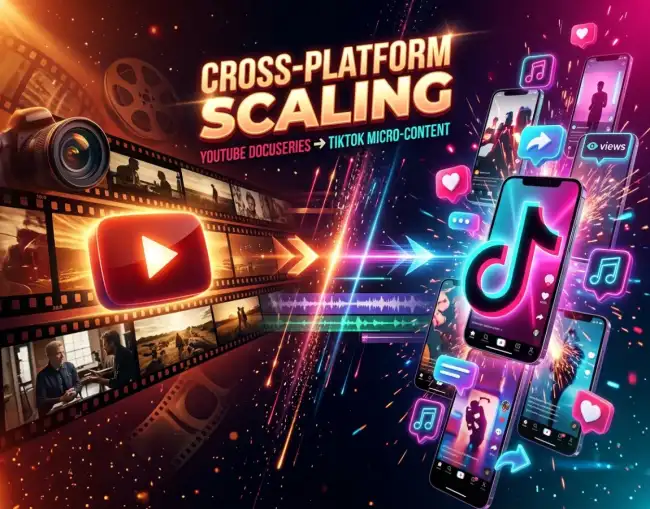
The digital media ecosystem has experienced a seismic shift in how audience attention is captured, retained, and monetized. For years, long-form YouTube docuseries represented the pinnacle of digital video production—combining high cinematic production value, deep investigative narrative arcs, and extended watch times. However, as vertical short-form feeds like TikTok, YouTube Shorts, and Instagram Reels emerged as the primary discovery engines for younger demographics, traditional long-form creators faced a critical dilemma: produce massive multi-month investigative projects that risk getting buried by platform algorithms, or adapt to hyper-accelerated content formats.
The solution is not choosing one format over the other, but rather mastering the discipline of cross-platform content scaling. Converting a complex, high-production 45-minute YouTube documentary into high-velocity 9:16 micro-content requires far more than basic video cropping. It demands a systematic process of structural deconstruction, psychological hook engineering, and platform-native contextual recalibration. When executed correctly, this strategy turns short-form platforms into algorithmic funnels that drive top-of-funnel reach while feeding long-form view duration and subscriber conversion back on YouTube.
This flagship guide breaks down the precise methodology, workflows, sound engineering techniques, and editorial mechanics required to transform cinematic long-form docuseries into viral TikTok micro-content without sacrificing narrative depth, editorial integrity, or brand equity.
Foundational Principles & Mechanics of Cross-Platform Translation
To successfully translate high-budget horizontal video into high-velocity vertical micro-content, digital media teams must master five core architectural principles. Treating vertical short-form as an afterthought or a simple distribution channel routinely fails because vertical platforms operate under fundamentally different cognitive processing speeds and user behaviors.
- Narrative Deconstruction: The structural process of dissecting a macro-narrative (a 30- to 60-minute episode) into self-contained micro-conflict modules. Each module must contain its own inciting incident, escalating tension, and resolution within 30 to 90 seconds.
- Contextual Recalibration: Tailoring tone, visual rhythm, and pacing to match the behavioral psychology of the target platform. While YouTube rewards slow-burn storytelling and atmospheric world-building, TikTok requires immediate cognitive engagement within the first 500 milliseconds.
- Dynamic Motion Reframing: Moving beyond automated center-cropping. Dynamic reframing utilizes manual keyframing or AI-assisted pan-and-scan tech to ensure the active subject remains framed within optimal visual zones, accounting for vertical mobile screen geometry.
- Sonic Priming & Speech Equalization: Sound engineering specifically optimized for small mobile phone speakers. This includes tight dynamic range compression, aggressive vocal EQ boosting around 2kHz–5kHz for clarity, and integrating native audio trends to ride platform discovery algorithms.
- Open-Loop Visual Scripting: Constructing micro-videos around unresolved narrative loops that trigger high user retention, repeated loops, and active comment section debate.
Understanding these principles ensures that your team approaches video repurposing as a specialized post-production art form rather than a lazy cut-and-paste job. Every frame, sound effect, and visual caption must serve the specific mechanical realities of the vertical feed.
1. Narrative Audit & Micro-Story Arc Identification
Isolating Self-Contained Narrative Kernels
The primary reason long-form documentary clips fail on short-form platforms is that editors often cut arbitrary 60-second fragments that rely heavily on prior context. On TikTok, every video operates as an isolated entry point. To fix this, conduct a comprehensive narrative audit during the post-production phase of your YouTube docuseries. Identify "narrative kernels"—standout scenes, investigative revelations, intense character conflicts, or shocking historical reveals that require zero preliminary background information to understand.
When auditing a scene, ask three specific questions: First, does this 45-second segment present a clear character goal or problem? Second, is there a visual or emotional turning point within the clip? Third, does the resolution leave the viewer asking a deeper question about the broader subject? If a segment checks all three boxes, it qualifies as an ideal candidate for micro-content extraction.
Once identified, log these segments in a centralized asset sheet tagged by emotional trigger (e.g., outrage, awe, mystery, tactical utility). Categorizing clips by emotional frequency allows social strategy teams to schedule dynamic content rotations that keep platform feeds diverse and engaging.
Heatmap Analytics & Retention Mapping
Rather than relying purely on editorial intuition, leverage hard user data from YouTube Studio’s retention graph. Open the analytics for existing episodes and examine the continuous watch-time line for sharp retention spikes, sudden re-watches, and chapter dips. A sharp upward spike on a YouTube retention curve almost always signals an extraordinarily compelling quote, visual reveal, or unexpected plot twist.
"Data-driven clipping removes subjective bias from post-production. When your YouTube audience repeatedly rewinds a 15-second window, they are explicitly handing you your next viral TikTok hook."
Isolate those exact timestamp ranges and extract them as raw candidates. Overlay these high-retention segments against your narrative audit. The intersection of analytical retention spikes and editorial narrative kernels represents your highest-probability viral assets.
2. Technical Re-Framing & Aspect Ratio Optimization
Dynamic Frame Re-Centering vs. Split-Screen Architectures
Converting a 16:9 cinematic shot into a 9:16 vertical video presented across modern smartphones requires strict attention to visual hierarchy. The simplest approach—slapping black bars above and below a horizontal video—wastes over 60% of vertical screen space and immediately signals to users that the content is non-native, resulting in rapid drop-offs.
For two-person interviews or wide documentary shots, implement dynamic keyframing. Use your editing software (DaVinci Resolve, Premiere Pro, or Final Cut Pro) to active-track speaker movements, panning smoothly between characters as dialogue shifts. If two subjects interact in rapid back-and-forth dialogue, utilize a stacked 9:16 split-screen layout: place Subject A in the top frame and Subject B in the bottom frame. This preserves cinematic reaction shots and maintains high visual tension without jarring jump cuts.
When displaying high-detail documents, archivals, or map animations originally designed for desktop monitor resolution, do not scale the entire image down to fit mobile width. Instead, apply a digital pan-and-scan camera move, zooming into specific highlight regions while scrolling across the graphic to guide the viewer’s focus seamlessly.
Safe-Zone Layout Mechanics & Native UI Protection
A frequent mistake in YouTube-to-TikTok video repurposing is placing essential graphics, lower thirds, or hardcoded text over platform interface elements. TikTok’s native user interface features right-side engagement icons (like, comment, bookmark, share), a bottom text description block with music attribution, and top-of-screen status headers.
Establish strict "Safe-Zone Templates" across your editing timeline. Keep critical visual elements, primary faces, and main caption lines centered within a mid-screen box—specifically bounded between 20% from the top margin and 35% from the bottom margin. Keep the rightmost 15% clear of vital graphic overlays to ensure action items are not obscured by platform interactive buttons.
(Center-weighted focal points & kinetic typography)
Right-Side Like/Share Icons
3. Audio Engineering & Sound Design for Short-Form Velocity
Voiceover Isolation & Frequency Equalization
Mobile device speakers lack the sub-bass warmth and wide stereo dispersion of studio headphones or home theater setups. Documentary sound mixes built for YouTube often feature deep orchestral scores, subtle ambient soundscapes, and wide dynamic ranges. When played on an iPhone or Android speaker, these mixes turn muddy, causing vocal tracks to be drowned out by heavy background music.
Isolate your master vocal tracks into clean stem files. Apply an aggressive high-pass filter cutting off frequencies below 90Hz to eliminate low-end rumble. Apply a targeted bell-curve EQ boost between 2.5kHz and 4.5kHz—the fundamental frequency band for speech clarity and intelligence on micro-transducers. Finish the vocal chain with a fast optical compressor to lock dialogue levels within a narrow dynamic band, ensuring voice-over remains crystal clear even at low phone volumes.
When producing multi-subject investigative pieces featuring guest commentators or co-creators, consistent vocal balance is critical. In multi-party projects, strategic asset alignment prevents acoustic mismatches across clips. For deeper insights on managing multi-talent productions, read our comprehensive guide on Mastering the Multi-Creator Collab: Logistics, Egos, and Viral Masterpieces.
Integrating Native Sound SFX & Dynamic Music Beds
While cinematic orchestral scores work exceptionally well for YouTube, TikTok algorithms heavily favor clips that incorporate native trending audio beds or platform-native sound effects (whistles, pops, low impacts, digital glitches). Cut the volume of your original long-form background score by 40% to 60% relative to dialogue.
Layer micro-sound effects directly underneath visual cutaways, text pop-ups, and key archival reveals. A subtle riser swell leading into a critical interview reveal, accompanied by a sharp tactile audio click on text overlays, dramatically increases visual sensory feedback. This subtle audio design creates a high-velocity sensation that prevents viewers from swiping away.
4. Scripting the 3-Second Visual & Textual Hook
Open-Loop Copywriting & The 500-Millisecond Trigger
On horizontal video platforms, viewers have already committed to clicking a thumbnail; you have roughly 15 to 30 seconds to hook them. On vertical short-form platforms, user swiping is subconscious and instantaneous. You must deliver a psychological visual or audio trigger within the first 500 milliseconds (0.5 seconds).
Re-structure the opening of your repurposed micro-clip using open-loop copywriting techniques. Never start a short-form clip with long intros, title cards, or slow voiceovers like: "In episode three of our series, we looked into..." Instead, strip away context and open directly at the peak point of tension or mystery:
"This single line of code wiped out $400 million in four seconds—and nobody realized it for three months."
Combine this spoken audio hook with a high-motion visual element—a rapid document zoom, an intense facial expression, or high-contrast archival footage. This creates an immediate open loop in the viewer's brain. To resolve the tension, they must continue watching the clip.
Kinetic Typography & Micro-Pacing Captions
Over 70% of short-form mobile videos are viewed either with sound disabled or in environments where audio clarity is compromised. Consequently, dynamic, animated burn-in captions are essential for user retention rather than optional features.
Static subtitle tracks placed at the bottom of the screen do not capture attention effectively. Instead, employ kinetic typography—displaying text word-by-word or in short 2-to-3-word phrase clusters centered directly on or near the main visual subject. Use color-coded text highlighting (e.g., bright yellow or neon green for key verbs, metrics, and names) to create visual rhythm.
Maintain high caption micro-pacing: text pop-ups should trigger every 200 to 400 milliseconds to match the speed of spoken dialogue. This rapid visual update rhythm keeps the viewer's eye focused on the center of the screen, creating a continuous visual cadence that increases complete watch-through rates.
5. Multi-Creator Synergy & Collaborative Amplification
Co-Branded Short-Form Distribution Strategies
Scaling a docuseries using short-form content becomes exponentially more powerful when leveraging multi-creator distribution networks. If your YouTube documentary features guest experts, investigative partners, or featured influencers, build a co-branded syndication pack containing tailored 9:16 cuts optimized for their individual platform channels.
Provide collaborators with pre-cut 9:16 clips alongside customized video copy, platform-native tags, and optimized posting times. By enabling featured guests to post high-value micro-snippets directly to their personal TikTok and Instagram profiles, you tap into established target audiences while driving cross-platform traffic back to your master YouTube release.
Furthermore, use TikTok’s native "Duet" and "Stitch" features strategically. Publish deliberate hot-takes or provocative investigative clips designed to invite responses from niche subject experts. When established creators stitch your docuseries clip to add their commentary, your organic reach expands exponentially across new algorithmic nodes.
Cross-Funnel Call-to-Action (CTA) Architecture
The ultimate goal of short-form video repurposing for docuseries creators is converting transient feed scrollers into long-form subscribers. However, blaring a generic "Subscribe to our YouTube channel for the full documentary!" at the end of every TikTok clip actively kills completion rates and harms your algorithmic reach.
Instead, employ passive and curiosity-driven CTA architectures. End your micro-clip at the structural peak of unresolved narrative tension—a classic cliffhanger format. In the closing two seconds, use a quick screen overlay paired with subtle voiceover: "Part 2 is live now on our channel," or "Search 'The Dark Web Heist Episode 1' on YouTube for the full investigation."
Additionally, pin a comment at the top of your TikTok video's comment section detailing exactly where to find the full-length documentary, accompanied by a short trackable link in your channel bio. This frictionless conversion path captures audience intent right at the moment of highest curiosity.
Real-World Case Studies & Performance Scenarios
To understand the practical impact of advanced video repurposing, consider the contrasting outcomes of two digital media companies adapting identical 45-minute investigative documentary footage for short-form platforms.
Scenario A: The Traditional Legacy Re-Render (Failure Model)
Media Company A produced a six-part environmental docuseries. To build short-form awareness, their editing team simply rendered 60-second horizontal clips with top and bottom black letterboxes. They left the original wide orchestral sound mix intact and added basic static horizontal subtitles across the lower margin. The clips opened with the docuseries title card and logo animation lasting 4 seconds.
- Average Watch Time: 3.2 seconds out of 60 seconds (5.3% retention).
- First-3-Second Drop-off: 82% of viewers swiped away before hearing the main vocal premise.
- YouTube Funnel Conversion: Fewer than 40 long-form views attributed across 30 published short-form clips.
- Algorithmic Verdict: TikTok suppressed the content due to low watch-through rates and non-native framing.
Scenario B: The Native Micro-Doc Masterclass (Success Model)
Media Company B took the same underlying investigative footage and executed a dynamic cross-platform translation pipeline. They audited the long-form master to isolate 15 high-retention micro-stories. Using dynamic keyframing, they tracked speaker movements in split-screen layouts, boosted speech frequencies for clear mobile audio, added kinetic word-by-word captions, and engineered 500-millisecond visual open-loop hooks.
| Performance Metric | Company A (Legacy Cut) | Company B (Native Re-build) |
|---|---|---|
| Total Short-Form Views | 42,000 (across 30 clips) | 18,400,000 (across 30 clips) |
| Average Completion Rate | 4.1% | 68.4% |
| Comment Engagement Ratio | 0.08% | 4.2% |
| Attributed YouTube Long-Form Views | < 40 views | 412,000 views |
Company B's approach proved that treating short-form channels as dynamic storytelling mediums rather than static promotional billboards yields massive viewer acquisition. Dynamic interactive design is essential for success in modern social distribution networks. To explore why traditional content formats are rapidly losing traction, check out our analysis on The Death of the Static Post: Why Dynamic Interactive Content Wins in 2025.
Critical Mistakes & How to Avoid Them
Even seasoned video editors frequently fall into common technical and narrative traps when transitioning long-form content into vertical micro-content. Below are five costly mistakes along with actionable countermeasures.
-
Lazy 9:16 Center-Cropping Without Subject Tracking:
The Mistake: Applying a global 9:16 crop to a 16:9 master video without keyframing subject movements. This often cuts off speakers, crops out key visual actions, or leaves half a character's face dangling at the screen edge.
The Solution: Perform manual keyframe reframing or leverage AI pan-and-scan tools. Ensure the active focal point always stays securely centered within the safe viewing zone. -
Retaining YouTube Macro-Hooks on Short-Form Feeds:
The Mistake: Keeping long intro titles, channel stingers, slowly building atmospheric wide shots, or verbal intros like "Welcome back to episode four..."
The Solution: Ruthlessly slice away introductory footage. Open on the absolute micro-peak of action, high narrative tension, or a provocative statement within the initial 500ms frame. -
Ignoring UI Overlays and Text Obscuration:
The Mistake: Placing hardcoded captions or graphic titles low on the screen, where they get covered by TikTok's username captions, sound labels, or right-side engagement buttons.
The Solution: Import standard platform Safe-Zone overlay guides into your editing timeline project files. Keep all primary typography within the middle 45% horizontal band of your video canvas. -
Failing to Remix the Audio Track for Small Speakers:
The Mistake: Exporting cinematic 5.1 or wide stereo audio mixes without compressing dialogue dynamic ranges or applying high-pass vocal filtering.
The Solution: Build a dedicated short-form audio mastering preset: high-pass cut at 90Hz, 3dB EQ vocal clarity boost at 3kHz, dynamic vocal compression, and duck background music by -6dB to -10dB below speech stems. -
Treating Micro-Content purely as an Ad for Long-Form Video:
The Mistake: Cut-off clips mid-sentence paired with obnoxious pop-ups demanding: "Go to YouTube to see what happens next!" This frustrates short-form users, driving negative signals and immediate swipes.
The Solution: Provide a complete micro-story arc that delivers standalone entertainment value, then use a subtle curiosity cliffhanger or pinned comment to invite interested viewers to dive deeper into the full-length YouTube docuseries.
Comprehensive Strategy & Tooling Comparison Table
Selecting the right post-production approach depends heavily on your team's budget, technical capacity, and scale goals. Below is a detailed breakdown comparing three distinct cross-platform video workflows.
Be the first creator to share your take on this story.