
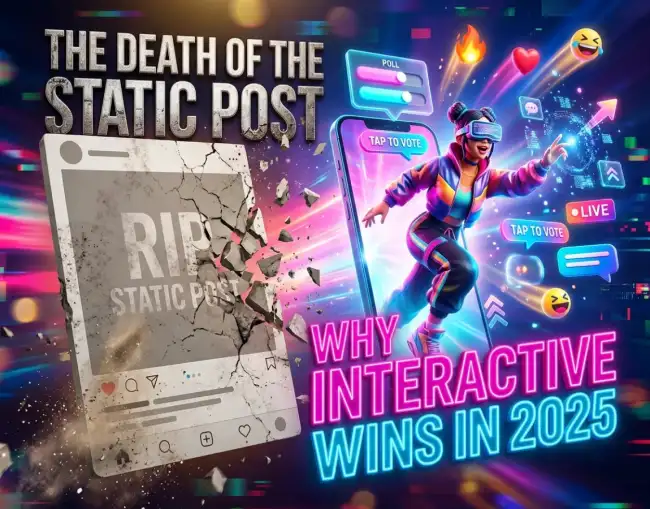
For more than a decade, the architecture of social media marketing rested upon a comfortable, predictable pillar: the static post. Creators curated pristine, high-resolution photography, brands designed polished flat graphics, and social networks rewarded aesthetic perfection with millions of impressions. However, as we navigate the digital ecosystem of 2025, that era has come to an undeniable end. The static post is not merely declining in performance; algorithmically and behaviorally, it is functionally dead. Modern audiences no longer open social apps to passively spectate; they log on to participate, manipulate, co-create, and immerse themselves in real-time digital environments.
This seismic transformation is fueled by a confluence of evolving platform algorithms, severe passive consumption fatigue, and the rapid maturation of generative and interactive technologies. Major networks—including Instagram, TikTok, YouTube Shorts, and emerging spatial social spaces—have completely restructured their ranking engines to prioritize dynamic engagement vectors. A static image offers a brief, two-second visual touchpoint before a user swipes past. Conversely, interactive content—ranging from real-time poll-driven video narratives and augmented reality (AR) try-ons to branchable carousels and live shoppable micro-streams—holds user attention hostage in the best possible way. It transforms passive scrollers into active participants.
To survive and dominate in 2025, creators and digital publishers must execute a total paradigm shift. This comprehensive analysis unpacks the algorithmic realities, psychological mechanics, and technical frameworks driving the social media shift toward dynamic experiences. Below, we break down the exact strategies required to transition from flat media to high-converting interactive content, ensuring your brand stays ahead of modern 2025 influencer trends.
Foundational Principles: The Mechanics of Dynamic Interactivity
Understanding why interactive content dominates 2025 requires examining the underlying mechanics of modern social media engines. At its core, the transition from passive to dynamic content relies on a fundamental shift in user psychology and algorithmic measurement. Passive consumption relies on linear viewing—a user looks at an image or watches a static video without making direct inputs. Dynamic interactivity, by contrast, relies on a continuous feedback loop between the user, the content, and the platform engine.
From an algorithmic standpoint, networks have largely replaced generic "likes" with high-intent signal metrics. In 2025, search engines and social recommendation systems prioritize three critical behavioral metrics:
- Dwell Time Depth: The exact duration a user remains paused over a specific piece of content, active screen interactions, and repeat frame revisits.
- Micro-Interaction Velocity: The frequency and speed with which users click stickers, manipulate dynamic sliders, choose branching pathways, or trigger AR parameters.
- Bidirectional Conversation Loops: The density of direct messages (DMs), voice replies, and real-time audio/visual responses generated straight from interactive content prompts.
Psychologically, interactive content activates cognitive agency. When users are granted the ability to influence the outcome of a video, customize a product visual in real time, or test their knowledge through native micro-assessments, their brain releases dopamine not just from consuming information, but from exerting control over their media environment. This active choice architecture yields significantly higher memory retention, brand recall, and purchase intent compared to legacy static posts.
1. Architectural Blueprint for Interactive Short-Form Video
1.1 Engineering Dynamic Micro-Taps and Choice Nodes
Short-form video is no longer a linear monologue; it is a digital pick-your-own-adventure experience. To capitalize on dynamic mechanics within short-form formats (such as TikTok, Reels, and Shorts), creators must integrate physical interactive touchpoints directly into the visual grid. This involves designing dynamic micro-taps—visual overlays that prompt users to tap, pause, or hold down on specific quadrants of the screen to reveal hidden outcomes, alternative narrative paths, or secret discount triggers.
For instance, building dynamic choice nodes requires mapping out your video production with multi-branch logic. Creators film multiple micro-scene variations and use native platform features (like sticker prompts, stitch calls, or hyperlinked interactive overlays) to let the viewer decide what happens next. If you are developing a personal brand channel, mastering these mechanics early is essential. In fact, aspiring influencers can scale their visibility by integrating these interactive framework patterns alongside our foundational guide, From Zero to 100K: The Step-by-Step Personal Branding Playbook for New Creators.
To implement dynamic choice nodes successfully, structure your video with a strict 3-second hook, followed immediately by an interactive prompt at second 5. Require the user to make a physical input (such as selecting an onscreen option via comments or sticker polls) before proceeding to the payout sequence. This structural design spikes retention curves and signals to recommendation algorithms that your video is retaining active user focus.
1.2 Implementing Gamified Visual Overlays
Gamification is the most potent lever for transforming mundane content into high-converting media. Gamified visual overlays leverage custom graphics, real-time counters, and physics-based interactions natively supported within modern mobile interfaces. Instead of presenting a standard product review, creators embed interactive visual challenges directly onto the screen—such as "Tap the moving target to reveal the price" or "Hold the screen to pause the randomizer wheel."
When engineering gamified overlays, maintain strict visual hierarchy. The interactive graphic must occupy the central focal zone of the screen, clearly offset by high-contrast visual cues that indicate touch functionality. Always accompany gamified prompts with explicit audio directions and native caption overlays. When executed correctly, gamified short-form videos produce dwell times up to 300% longer than standard static image posts.
2. Interactive Live Commerce and Real-Time Feedback Loops
2.1 Synchronous Engagement Funnels
Live streaming in 2025 has evolved far beyond basic Q&A sessions. Today’s high-performing live content functions as an interactive, real-time commerce engine powered by synchronous feedback funnels. In these environments, creators and audience members co-create the broadcast live. Viewers cast votes in real-time polls to decide which products are demonstrated, trigger dynamic pricing discounts based on aggregate audience visual milestones, and unlock exclusive digital bundles live on screen.
Building a successful synchronous funnel requires precise technical orchestration. Broadcasters utilize dynamic live overlays that update inventory counts, display real-time buyer tickers, and spawn temporary flash-sale popups based on chat velocity. This creates intense social proof and fear of missing out (FOMO). Creators looking to commercialize these sessions effectively should study industry benchmarks; as explored in our deep-dive article, Brand Founders Reveal: What Separates a Profitable Collab From a Total Waste of Money, real-time interactive clear-outs produce dramatically higher return-on-ad-spend (ROAS) than traditional static sponsored posts.
To maximize conversions during synchronous live streams, establish clear milestone targets for your audience. For example, set up an onscreen dynamic progress bar: "When chat triggers 1,000 poll responses, the brand unlocks a 30% discount link for 5 minutes." This transforms viewers from passive spectators into an active sales force working together to unlock rewards.
2.2 Conversational AI Interactivity in DMs
The interaction doesn't end when the live stream or video reel stops; it transitions directly into private messaging channels through automated conversational AI interfaces. In 2025, dynamic creators use interactive comment triggers (e.g., "Comment VIP to test your personalized skincare match") that immediately initialize an intelligent conversational flow inside the user's Direct Messages.
Rather than dropping a static external website link—which causes severe drop-off—conversational AI bots deliver multi-step interactive quizzes natively inside the chat UI. The bot gathers user preferences, analyzes responses, and provides tailored recommendations instantly. This creates a friction-free, interactive bridge between top-of-funnel content and bottom-of-funnel conversion, yielding click-through rates that dwarf legacy link-in-bio setups.
3. Augmented Reality (AR) and Immersive Spatial Try-Ons
3.1 Spatial Brand Filters as Engagement Drivers
Augmented Reality has migrated from a novelty filter tool into a mandatory channel for product discovery and consumer engagement. Spatial brand filters allow users to visualize products, environments, or digital avatars within their immediate real-world environment using their smartphone cameras or wearable spatial headsets.
Creators leveraging spatial AR filters provide utility alongside entertainment. For cosmetics, fashion, home design, and fitness industries, dynamic AR filters allow audiences to virtually "try on" apparel, preview furniture scale inside their living rooms, or execute interactive workouts guided by 3D holographic overlays. The key to maximizing engagement with spatial filters is low friction: the filter must load within sub-500 milliseconds and require zero manual calibration by the end user.
3.2 User-Generated Virtual Assets and Collectibles
Beyond spatial visualization, leading brands in 2025 empower audiences to unlock and customize digital assets directly within interactive feeds. By engaging with interactive stories or dynamic posts, users collect digital badges, wearable AR accessories, or tradeable community perks. These digital assets incentivize continuous, daily interaction with creator feeds, cultivating deep brand loyalty through digital ownership and personal expression.
4. Branching Storytelling and Modular Carousel Micro-Apps
4.1 Frictionless Gamification via Micro-Assessments
The standard multi-image carousel has undergone a dramatic transformation. In 2025, top-tier creators construct carousels designed as self-contained micro-applications. By utilizing strategic slide layouts, visual decision trees, and interactive swipe paths, carousels function as interactive diagnostic tools, skill tests, or personality assessments.
For sustainable brands and mission-driven creators, interactive micro-assessments serve as powerful educational instruments. Instead of publishing flat infographics, creators present multi-slide interactive diagnostic quizzes. If you are developing campaigns centered on ethical messaging, cross-referencing your dynamic creative strategy with insights from Eco-Influencing Without Greenwashing: Authentic Sustainability Campaigns That Work ensures your interactive content maintains absolute transparency while maximizing audience participation.
When building micro-assessments within carousel structures, dedicate Slide 1 strictly to a personalized diagnostic query ("What is your digital burnout score? Swipe to calculate"). Each subsequent slide provides conditional scoring logic, forcing the user to swipe back and forth between slides to calculate their ultimate score, which is revealed alongside a custom solution on the final slide.
4.2 Multi-Option Interactive Swipe Pathways
Multi-option dynamic carousels utilize visual branching to mimic dynamic web applications. Creators post carousels where each panel acts as an interface screen containing visual buttons pointing toward designated upcoming slides (e.g., "If you chose Option A, swipe directly to Slide 4; if Option B, swipe to Slide 7").
This nonlinear consumption model disrupts default scrolling behavior. Because users must pay close attention to slide index markers and navigation instructions, attention signals skyrocket. The native platform algorithm detects these extended interactions and repeated slide revisits, interpreting them as high-quality engagement and boosting the post into broader recommendation feeds.
5. Dynamic Audience Co-Creation and Community-Driven Content
5.1 Real-Time Prompt Engineering with Followers
In the contemporary digital landscape, audience members demand a seat in the writer's room. Real-time prompt engineering with followers represents the apex of community-driven content. Creators publish preliminary video prompts, interactive story polls, or live streams asking their audience to specify key variables for their next project—such as selecting script parameters, choosing challenge locations, or voting on real-time editing styles.
Once the audience submits their variables, the creator produces and uploads the final output within hours, directly tagging and calling out the specific followers whose inputs shaped the content. This rapid co-creation feedback loop transforms passive followers into invested co-producers who aggressively share the final asset across their own networks.
5.2 Crowdsourced Product & Campaign Iteration
For brands and agency marketers, dynamic interactivity serves as an instantaneous focus group. Rather than spending months conducting market research for a product launch, brands partner with creators to execute real-time interactive testing campaigns. Creators use interactive stickers, sliders, and open-ended text fields to test packaging designs, product names, price thresholds, and feature preferences directly within the social feed.
This dynamic feedback model minimizes product development risk while building immense pre-launch anticipation. Audiences who participate in voting for a product's design feel personal ownership over the final outcome, resulting in dramatically higher baseline sales conversion rates upon official launch.
Real-World Case Studies: Static vs. Dynamic Execution
To fully grasp the financial and operational impact of this shift, let us examine two controlled campaign scenarios executed within the consumer lifestyle space in early 2025.
Scenario A: The Legacy Static Campaign (Failure Model)
A premium skincare brand launched a major product lineup utilizing traditional influencer publishing strategies. The campaign deployed 20 top-tier creators to post high-resolution, static studio photographs featuring the product bottle alongside written, promotional captions in the feed. The campaign targeted standard reach and click-through goals via link-in-bio placements.
- Total Campaign Reach: 1,200,000 Impressions
- Average Dwell Time: 1.4 seconds per post
- Click-Through Rate (CTR): 0.42%
- Conversion Rate: 0.8%
- Campaign ROAS: 0.65x (Net Negative)
- Diagnostic Insight: Users rapidly scrolled past static photos without reading the written caption. The lack of interactive elements offered zero algorithmic reason for platform recommendation engines to distribute the content beyond a fraction of the creators' baseline followers.
Scenario B: The Dynamic Interactive Campaign (Triumph Model)
The exact same skincare brand launched a parallel product campaign with a matched cohort of 20 creators, but pivoted the strategy entirely toward dynamic interactive content. Creators deployed branching video stories featuring interactive skincare diagnostic quizzes, AR try-on filters for skin tone matching, and live shoppable streams featuring real-time price unlocks driven by audience poll milestones.
- Total Campaign Reach: 4,800,000 Impressions (4x Increase)
- Average Dwell Time: 14.8 seconds per experience (10x Increase)
- Click-Through Rate (CTR): 3.85% (9x Increase)
- Conversion Rate: 4.1% (5x Increase)
- Campaign ROAS: 4.2x (Highly Profitable)
- Diagnostic Insight: The interactive diagnostic tools forced high screen retention. Platform algorithms detected deep engagement metrics (poll taps, filter activations, screen holds) and organically pushed the content into main recommendation engines, driving down user acquisition costs.
Critical Mistakes & How to Avoid Them
"Interactivity is not a cosmetic layer you slap onto a post after production; it is the fundamental framework around which the narrative must be engineered."
Despite the overwhelming efficacy of dynamic content, many creators and brand marketers fail during execution due to key strategic missteps. Here are the top five most costly errors and their exact technical countermeasures:
1. Over-Engineering Interactivity at the Expense of Narrative Clarity
Adding too many dynamic stickers, complex branching pathways, or interactive prompts simultaneously causes cognitive overload. When users feel confused about what action to take next, they instantly scroll past. Countermeasure: Adhere strictly to the "Single Interactive Action" (SIA) rule per screen frame. Every slide or video segment must contain exactly one clear, intuitive visual call-to-action (e.g., "Tap the poll below to choose Scene B").
2. Ignoring Technical Latency and Native Render Constraints
Building high-fidelity AR filters or complex dynamic overlays that require heavy data processing leads to loading latency. If an interactive asset takes longer than 800 milliseconds to initialize on mobile networks, drop-off rates exceed 60%. Countermeasure: Optimize all visual assets, AR textures, and interactive overlays for low-bandwidth environments. Prioritize native platform tools over external web views to ensure instant execution.
3. Treating Interactivity as Cosmetic Rather Than Data Capture
Using generic interactive stickers (e.g., "Happy Friday? Yes/No") yields hollow engagement signals that fail to collect actionable user insights or advance the sales funnel. Countermeasure: Frame every interactive node as a zero-party data collector. Design polls, quizzes, and sliders that reveal direct consumer preferences, pain points, or buying velocity vectors.
4. Failing to Auto-Route Interactive Engagements into Funnels
Generating high sticker engagement or video poll responses without automated backend triggers wastes valuable intent. Countermeasure: Connect interactive triggers directly to automated conversational AI workflows. When a user taps an interactive sticker or leaves a poll response, automate a direct, personalized follow-up in their inbox within 30 seconds.
5. Neglecting Real-Time Moderation and Dynamic Iteration
Publishing an interactive campaign and walking away leaves engagement money on the table. Interactive campaigns require live, active monitoring. Countermeasure: Assign dedicated community moderators during the first 4 hours post-publishing to respond to comments, pin top user inputs, and adjust real-time stream parameters based on early interactive data.
Comprehensive Strategy & Metric Comparison Table
The following dynamic evaluation matrix compares traditional media formats against modern interactive architectures across key operational metrics in 2025:
| Content Architecture Format | Avg. Dwell Time | Algorithmic Priority Score | Primary Engagement Metric | Conversion Rate Range | Production Complexity |
|---|---|---|---|---|---|
| Legacy Static Post (Single Photo/Graphic) | 1.0 - 2.2 Seconds | Low (Bottom 15%) | Passive Likes / Save Count | 0.2% - 0.8% | Low |
| Linear Carousel (Static Images) | 3.5 - 6.0 Seconds | Moderate (Middle 40%) | Swipe-Through Depth | 0.9% - 1.5% | Low-Moderate |
| Interactive Short-Form Reel / TikTok | 12.0 - 22.0 Seconds | High (Top 10%) | Micro-Taps / Sticker Polls / Rewinds | 2.5% - 4.8% | Moderate-High |
| Dynamic Branching Micro-App Carousel | 18.0 - 35.0 Seconds | Very High (Top 5%) | Non-Linear Navigation / Quiz Inputs | 3.2% - 5.5% | Moderate-High |
| Augmented Reality (AR) Spatial Filter | 25.0 - 60.0+ Seconds | Extremely High (Top 3%) | Camera Interaction / Share Velocity | 4.0% - 7.2% | High |
| Live Shoppable Synchronous Stream | 8.0 - 25.0+ Minutes | Maximum System Priority | Real-Time Chat / Co-Creation Tickers | 5.0% - 12.5% | Very High |
Frequently Asked Questions (FAQ)
1. Are static posts completely useless in 2025, or do they still serve a specific purpose?
Static posts are no longer effective for audience acquisition, algorithmic reach, or performance-driven conversions. Recommendation algorithms across major platforms actively suppress flat images in favor of dynamic media formats. However, static posts can still serve niche administrative functions—such as publishing official legal announcements, text-heavy regulatory statements, or clean aesthetic catalog galleries pinned to a profile grid.
For growth, engagement, and direct revenue generation, static posts should account for no more than 5% to 10% of your total publishing volume. Transitioning your core output to dynamic videos, interactive carousels, and AR experiences is mandatory if you want to maintain organic reach in 2025.
2. How can small creators with limited budgets create dynamic interactive content?
Creating interactive content does not require expensive production studios or complex software coding. Modern social platforms offer powerful, zero-cost native features designed specifically for interactive dynamic publishing. Small creators can leverage native poll stickers, quiz elements, open-ended question prompts, screen-pause video loops, and dynamic carousel navigation structures using basic mobile editing software.
Focus on creative narrative engineering rather than high-cost visual effects. A simple video reel that asks the audience to vote on a decision via the comment section or tap-to-pause a cycling image wheel costs nothing to produce, yet generates high engagement and dwell time signals.
3. What tools are best for building automated conversational AI funnels from interactive posts?
To capture direct messages and automate interactions triggered by dynamic posts, platforms like ManyChat, Chatfuel, and MobileMonkey remain industry standards in 2025. These software tools integrate natively with Meta platforms (Instagram and Facebook) and TikTok to trigger automated DM sequences the moment a user comments a specific keyword, votes on a story poll, or tags a creator in an interactive sticker frame.
When selecting a software tool, prioritize platforms that support conditional logic, real-time webhooks to your CRM (such as Klaviyo or HubSpot), and generative natural language processing (NLP) to ensure messaging flows feel personal, dynamic, and contextually accurate.
4. How do platform algorithms detect and reward interactive content over passive media?
Modern recommendation algorithms utilize real-time telemetry data captured from the client application UI. When a user interacts with a post—by tapping a sticker, pausing a frame with their thumb, swiping back and forth between slides, or loading an AR mask—the app records exact touch coordinates, screen timestamps, and hardware sensor inputs.
These dynamic interaction signals are fed immediately into the network's short-term recommendation model. If a post demonstrates high micro-interaction density within its initial test seed group (e.g., 100 views), the algorithm automatically flags the content as high-quality, escalating its distribution priority and serving it to wider cold-audience recommendation feeds.
5. Is dynamic interactive content effective for B2B brands, or is it strictly for B2C consumer products?
Dynamic interactivity is exceptionally effective for B2B marketing, often outperforming traditional B2C results due to the high monetary value of B2B lead generation. B2B decision-makers experience severe content fatigue from dense PDF whitepapers and monotonous static slide graphics. Replacing these flat formats with interactive LinkedIn carousels, dynamic ROI calculation tools, and video-based choice matrices yields dramatic increases in qualified lead capture.
Strategic Roadmap & Final Takeaways for 2025 and Beyond
As we look toward the next 2 to 5 years, the line between social media content and digital software applications will blur completely. We are rapidly transitioning into an era of spatial computing, AI-driven personal dynamic feeds, and hyper-personalized real-time media rendering. In this imminent future, static content will be viewed as an artifact of the early web, replaced by immersive social experiences that adapt instantaneously to user behavior, physical location, and explicit intent.
To execute this transition seamlessly over the next 90 days, adopt the following actionable roadmap:
- Days 1–30 (Content Audit & Tooling Setup): Conduct an audit of your publishing assets. Immediately phase out single-image static posts. Implement baseline automation platforms (e.g., ManyChat) to link interactive comment triggers to automated direct-message funnels.
- Days 31–60 (Format Standardization): Restructure your visual workflows. Convert all standard educational slide decks into non-linear, micro-assessment carousels. Re-engineer short-form video hooks to include physical tap/hold interactive mechanics within the first 5 seconds.
- Days 61–90 (Advanced Immersive Integration): Launch custom AR filters tailored to dynamic try-ons or interactive brand experiences. Initialize weekly live shoppable streams incorporating synchronous poll-driven discount unlocks and real-time community co-creation.
The digital ecosystem of 2025 does not reward passive observers—it belongs entirely to those who build active, participatory media architectures. By abandoning the static post and leaning aggressively into dynamic interactive experiences, your brand will dominate algorithm feeds, build deeper community trust, and capture market share in an increasingly competitive landscape.
Be the first creator to share your take on this story.