
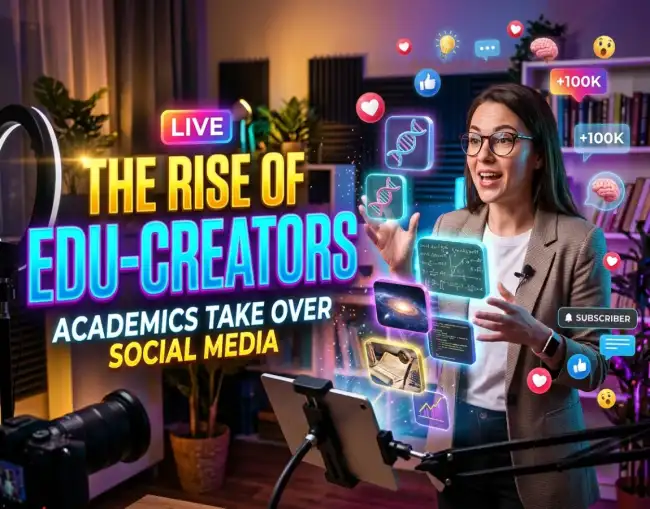
For over a decade, digital media platforms were dominated by lifestyle vloggers, pranksters, and hyper-sensationalized entertainment networks. Success in the creator economy was historically measured by visual flash, viral trends, and broad, low-friction entertainment. However, a seismic structural shift is currently underway. A new class of digital authorities—dubbed edu-creators—is systematically dismantling the traditional media landscape. From tenured astrophysics professors broadcasting quantum mechanics on TikTok to PhD economists dissecting supply-chain fragilities on YouTube, subject-matter experts are converting academic rigor into multi-million-dollar digital empires.
This transition marks a critical evolutionary phase in the future of creator economy dynamics. Audiences are experiencing acute digital fatigue from superficial content and are actively seeking high-utility, research-backed intellectual depth. Concurrently, traditional higher education faces skyrocketing tuition fees, rigid administrative bureaucracies, and geographical constraints, creating an unprecedented supply-and-demand mismatch. As a result, educational influencers are stepping into the void, operating at the intersection of pedagogy, media production, and digital entrepreneurship to democratize advanced learning at scale.
To thrive in this new paradigm, academic experts cannot simply copy-paste university lectures onto social networks. Navigating this landscape requires a deep understanding of algorithmic pacing, pedagogical translation, diversified monetization, and strategic brand building. This definitive guide delivers an exhaustive, evidence-based blueprint for professors, researchers, subject-matter experts, and digital strategists looking to master the mechanics of educational content creation and dominate the modern attention economy.
1. The Architecture of the Edu-Creator Ecosystem
Understanding the rise of educational creators requires analyzing the structural forces that govern algorithmic discovery, consumer behavior, and information processing on modern media platforms. The era of passive media consumption has given way to active skill acquisition and intellectual self-actualization online.
The Pedagogical-Algorithmic Convergence
Social media algorithms have fundamentally evolved. Where platforms once optimized purely for click-through rates and brief session durations, current recommendation engines prioritize deep engagement metrics: repeat views, commentary density, bookmark rates, and external shares. Educational content inherently excels across these vector parameters. When an expert explains complex macroeconomics or molecular biology in an accessible format, users save the video for future reference and share it within peer networks to signal social capital.
This convergence means high-information-density content gets rewarded by algorithms designed to maximize platform retention. Rather than competing with entertainment creators on raw shock value, edu-creators leverage information asymmetry. They translate dense academic literature into high-retention visual narratives, turning complex research papers into engaging digital stories.
The Credibility Premium and The Death of Surface-Level Content
The ubiquity of generative AI has lowered the marginal cost of generic content creation to near zero. Search engines and social feeds are saturated with automated, surface-level articles and videos. Consequently, audience trust in unverified digital commentary has plummeted. Credibility has become the ultimate currency in digital media.
Academic credentials, lab experience, institutional affiliations, and primary-source citations now serve as powerful economic moats. Educational influencers who hold legitimate domain expertise command higher trust metrics, leading to premium advertising rates, elevated conversion metrics for digital products, and resilient audience loyalty that outlasts platform trend cycles.
2. Translating Academic Rigor into High-Velocity Digital Content
The single greatest barrier academic experts face when entering the digital space is the "curse of knowledge." Specialists often struggle to communicate complex ideas without relying on dense academic jargon that alienates mainstream digital audiences.
The De-Jargonization Methodology
De-jargonization is not about dumbing down content; it is an exercise in conceptual clarity. The primary objective is to strip away institutional gatekeeping language while preserving technical accuracy. To execute this, experts must map complex theories to intuitive analogies drawn from everyday human experiences.
When introducing a technical term—such as epigenetic methylation or liquidity preference theory—introduce the concept using an accessible mental model before naming the specific term. This sequence ensures the viewer's brain builds a cognitive hook prior to processing unfamiliar vocabulary, preventing drop-off during the initial 15 seconds of a video or article.
Visual Storytelling and Cognitive Load Optimization
Human information processing capacity is constrained by cognitive load. In a classroom, a professor relies on social accountability to keep students focused through long lectures. On social media, where a user can scroll away in milliseconds, managing cognitive load becomes vital for viewer retention.
- Dual-Coding Theory Implementation: Pair complex auditory explanations with precise visual diagrams, dynamic typography, or real-world footage simultaneously to reinforce memory retention.
- Pattern Interrupts: Introduce strategic visual shifts every 8 to 12 seconds—such as camera angle changes, onscreen graphic callouts, or sound effects—to reset viewer attention spans without interrupting narrative continuity.
- Scaffolded Information Architecture: Structure content linearly from foundational premises to advanced conclusions, ensuring each concept logically builds on the previous point.
3. Mastering Platform-Specific Algorithms for Knowledge Distribution
Different social platforms function under distinct distribution mechanics. An educational strategy optimized for YouTube long-form will fail on TikTok or LinkedIn if platform-specific user expectations are ignored.
Designing for the "Save" and "Share" Index
While entertainment creators optimize for likes and comments, educational influencers must structure their media to maximize saves and shares. These two metrics are the most powerful signals of high-value utility to modern recommendation algorithms.
To drive maximum bookmarks, create structural reference assets within your content—such as step-by-step frameworks, data visualizations, annotated reading lists, or actionable decision trees. When a viewer recognizes that a video contains more actionable value than they can process in a single viewing, they immediately save it. Similarly, structuring content to answer controversial industry debates encourages users to share your work within their professional networks.
Pacing, Hooks, and Retention Trajectory Design
The retention graph is the single most critical feedback loop for digital video creators. Analyzing audience retention reveals exact timestamps where viewer interest drops, offering valuable insights for refining content structure.
The first 3 to 5 seconds must bypass standard preamble. Never begin with self-introductions, channel intros, or broad context. Open directly with the core problem, an unexpected thesis statement, or a high-stakes question. For instance, instead of saying, "Hello, welcome back, today we are discussing central banking policy," open with, "This single Federal Reserve decision altered global real estate valuations for the next thirty years—here is the mathematical breakdown."
4. Building a High-Margin Monetization Architecture
Relying purely on platform ad revenue (such as YouTube AdSense or Creator Funds) is a flawed financial strategy for academic creators. Broad entertainment creators rely on massive view volumes to generate ad revenue, whereas specialized edu-creators often operate in niche verticals with smaller, highly targeted audiences. Monetization must focus on maximizing revenue per viewer through high-value digital products and services.
Cohort-Based Courses (CBCs) and Premium Communities
As asynchronous online video courses face declining completion rates, Cohort-Based Courses (CBCs) have emerged as the gold standard for digital educational monetization. CBCs combine pre-recorded technical curriculum with live, interactive workshops, peer-to-peer accountability, and direct instructor feedback.
By leveraging structured community models, academic creators can scale their impact without sacrificing student engagement. To study how modern digital brands cultivate hyper-engaged digital ecosystems, explore Inside Glossier’s Playbook: How Community-Led Growth Built a Beauty Empire for key strategies on converting casual followers into dedicated community members.
Corporate Advisory, B2B Sponsorships, and Live Broadcasts
Monetizing deep expertise often extends into enterprise channels. Corporations frequently sponsor educational content to position themselves alongside credible domain experts. However, creators must maintain editorial independence to retain audience trust.
Navigating brand deals requires extreme caution. Experts must carefully evaluate incoming agreements to avoid predatory terms, intellectual property lock-ups, or conflicts of interest. For detailed frameworks on negotiating fair commercial terms, review The Dark Side of Sponsorships: Avoiding Predatory Brand Deals and Scams.
Additionally, hosting real-time interactive masterclasses or high-stakes digital events provides a immediate revenue stream while deepening audience relationships. For execution guidelines on managing large-scale real-time digital broadcasts, consult our breakdown on How to Host a Charity Livestream That Breaks Internet Records.
5. Managing Academic Ethics, IP, and Institutional Friction
Transitioning from traditional academia to public digital publishing involves navigating legal, ethical, and institutional challenges. Universities often maintain strict policies regarding intellectual property, outside employment, and public statements.
Intellectual Property Protocols for University Faculty
Before launching a commercial digital publishing entity, academic researchers must examine their employment contracts, institutional handbook policies, and technology transfer office (TTO) guidelines. Generally, research conducted using university grants, facilities, or proprietary labs remains subject to institutional IP claims.
To mitigate risk, edu-creators should ensure that all digitally published content, online courses, and commercial media are produced using personal equipment, outside institutional hours, and without utilizing university-owned software licenses or grant resources. Clear separation between academic research duties and independent digital publishing entities is essential for long-term IP protection.
Preserving Institutional Credibility While Scaling Social Reach
A common fear among academics is that creating social media content will undermine their standing among research peers. This concern can be addressed by maintaining rigorous standards of scholarly integrity across all digital channels:
- Transparent Citations: Provide comprehensive reading lists, DOI links, and primary-source attribution in video descriptions or pinned comments.
- Peer Review Integration: Clearly distinguish between established scientific consensus, emerging peer-reviewed literature, and personal working hypotheses.
- Public Error Correction: Maintain absolute transparency when correcting factual errors or updating statements based on new data.
6. Multi-Platform Content Syndication Blueprint
To maximize return on time invested, specialized creators must implement an efficient content engine. Creating long-form, highly researched media requires significant effort; this core asset should then be repurposed across multiple platforms using a systematic workflow.
The Pillar Content Waterfall Methodology
Start by creating a single piece of long-form, high-density pillar content—such as a 20-to-30-minute YouTube video analysis, a comprehensive research paper, or a deep-dive podcast episode. This master asset serves as the foundation for multi-platform distribution.
- Primary Asset: 25-Minute YouTube Masterclass analyzing a scientific breakthrough.
- Derivative Asset A (LinkedIn/Substack): A 1,500-word written technical breakdown highlighting key data points and strategic industry implications.
- Derivative Asset B (Short-Form Media): Three to five 60-second clips focusing on specific sub-topics, optimized for TikTok, Instagram Reels, and YouTube Shorts.
- Derivative Asset C (Newsletter): A direct-to-inbox summary featuring key charts, actionable key takeaways, and references to relevant study materials.
7. Comparative Analysis: Edu-Creator Platforms & Monetization Models
Selecting the optimal platform architecture and monetization blend depends on target demographic, content density, and technical complexity. The table below compares the primary channels utilized by top-tier educational influencers in the market today.
| Platform / Model | Primary Audience Demographic | Algorithmic Growth Engine | Dominant Monetization Channels | Production Lift & Friction |
|---|---|---|---|---|
| YouTube (Long-Form) | Broad (Ages 18–45+), High Intent | Search Indexing + Watch Time Retention | AdSense, Integrated Sponsors, Course Sales | High (Scripting, Editing, Motion Graphics) |
| LinkedIn Publishing | B2B Executives, Professionals, Investors | Professional Network Shares + High Engagement | Enterprise Consulting, B2B Subscriptions, Keynotes | Medium (Writing, Data Visualization) |
| TikTok / IG Reels | Gen Z & Millennials (Ages 15–35) | Interest-Graph Velocity + Save Metrics | Brand Sponsorships, Creator Funds, Funnel Leads | Medium-Low (Short-Form Scripting, Mobile Video) |
| Substack / Beehiiv | Niche Intellectuals, Researchers, Power Users | Direct Email Delivery (Zero Algorithmic Intermediary) | Paid Monthly/Annual Subscriptions | High Conceptual Lift (In-Depth Writing & Analysis) |
| Cohort-Based Courses | Dedicated Learners, Career Transitioners | Direct Conversion from Social Funnels | High-Ticket Tuition ($500 - $3,000+) | Very High (Live Facilitation, Curriculum Design) |
8. Real-World Case Studies & Scenarios
To demonstrate how these strategies perform in practice, consider two real-world scenarios illustrating successful execution versus common operational pitfalls in educational content creation.
Scenario A: The Successful Transition of a Computer Science Professor
Dr. Elena Rostova, an Associate Professor of Computer Science specializing in machine learning, launched a digital media initiative to translate modern AI research papers into clear, accessible visual guides.
Execution Strategy: She established a weekly 20-minute YouTube video series breaking down recent machine learning pre-prints. She used concise code walk-throughs, clear visual animations of neural network architectures, and linked directly to original open-source repositories. Every video pointed viewers to an owned newsletter on Substack detailing advanced mathematical proofs.
Results: Within 18 months, her channel scaled to 450,000 subscribers. By launching an annual cohort-based advanced deep learning workshop priced at $1,200 per seat with 250 students per cohort across three cohorts a year, she generated $900,000 in gross annual business revenue while retaining her university research post. Crucially, her digital profile led to invitations as a keynote speaker at top tech industry summits worldwide.
Scenario B: The Failed Launch of an Economics Researcher
Dr. Marcus Vance, an economist with 15 years of policy experience, launched a digital strategy to monetize his macro market forecasts via short-form video content.
Flawed Execution: Dr. Vance uploaded unedited 60-minute university lecture recordings directly to YouTube without adapting them for digital formats. Thumbnails were plain text, intro segments lasted 4 minutes with administrative details, and audio quality was poor. When viewers dropped off within the first 30 seconds, he pivoted to sensationalized, clickbait headlines on short-form platforms, abandoning scientific nuance for inflammatory political takes to chase view counts.
Results: While short-form views surged briefly, conversion rates on his digital resources remained under 0.01%. His academic peers publicly challenged the clickbait framing of his video titles, damaging his reputation in economic policy circles. Unable to monetize effectively or retain his institutional authority, he shut down the operation within nine months.
Key Takeaway: Modern educational publishing requires balancing accessibility with rigorous factual integrity. Succumbing to cheap clickbait destroys credentialed authority, while ignoring digital production standards limits reach and impact.
9. Critical Mistakes & How to Avoid Them
Building a sustainable educational publication requires avoiding key strategic errors that frequently trap subject-matter experts entering the space.
1. Over-Academicizing Language and Presentation
Failing to adapt academic delivery for digital audiences creates high bounce rates. Viewers will not remain engaged through long-winded academic disclaimers. Countermeasure: Lead with the most compelling core insight immediately, then provide background context and methodology later in the video.
2. Relying Exclusively on Platform Ad Revenue
AdSense payouts fluctuate based on advertiser budgets and platform policy updates. Countermeasure: Build an owned audience ecosystem immediately using an email newsletter and launch high-ticket monetization channels like courses, consulting, or exclusive memberships early in your growth.
3. Ignoring Platform-Specific Production Values
Poor lighting and substandard audio immediately signal a lack of production effort, driving high viewer drop-off. Countermeasure: Invest in a dedicated dynamic or condenser microphone, softbox lighting, and clean backdrop design before scaling up your publishing schedule.
4. Failing to Secure Owned Audience Data
Building an audience exclusively on third-party platforms creates platform risk. If an algorithm shifts or an account gets suspended, access to your audience disappears overnight. Countermeasure: Consistently direct platform traffic to an owned email list using high-value lead magnets, such as downloadable research briefs or workflow templates.
5. Sacrificing Academic Integrity for Viral Metrics
Chasing short-term view counts by using misleading titles or oversimplifying complex topics compromises academic credibility. Countermeasure: Maintain strict standards for accuracy. Treat your social media content with the same analytical care as a professional academic publication.
10. Frequently Asked Questions (FAQ)
How do edu-creators balance academic research with full-time digital publishing?
Achieving balance requires building an efficient content creation workflow. Top-tier educational creators treat content generation as an extension of their ongoing research rather than a separate operational task. By establishing automated recording setups, outsourcing post-production editing to professional agencies, and batch-producing media during academic breaks, creators can maintain consistent publishing output in under 8 to 10 hours per week.
Additionally, creators should focus on evergreen topics that retain search value over multi-year horizons, minimizing the need to continuously chase short-lived breaking news cycles.
Can experts without formal PhD credentials succeed as educational influencers?
Yes. While formal academic credentials provide an initial trust advantage, digital audiences ultimately reward domain mastery, pedagogical clarity, and documented practical success. Industry practitioners with deep operational experience—such as software engineers, financial analysts, or senior product managers—frequently outperform traditional academics by offering actionable insights based on real-world execution.
The key requirement is absolute transparency regarding your background. Clearly communicate where your practical experience originates and cite authoritative primary sources when presenting theoretical concepts.
What are the most effective strategies for protecting intellectual property online?
Protecting IP requires combining digital rights management with clear brand registration protocols. Educational creators should trademark primary brand names, course titles, and unique framework terms. When publishing proprietary slide decks, analytical code, or research papers, release materials under defined creative commons licenses or secure digital rights management platforms.
If unauthorized distribution or re-uploading occurs on major video platforms, utilize official DMCA takedown procedures to safeguard your original intellectual property rights.
How can creators effectively transition short-form followers into high-ticket course buyers?
Transitioning casual, short-form viewers into high-value course students requires a multi-stage conversion funnel. Short-form videos (such as TikToks or Shorts) serve primarily as awareness channels to attract new top-of-funnel audiences.
These short-form touchpoints should direct viewers to long-form YouTube masterclasses or Substack newsletters where they can engage with deeper analytical content. Once trust is established on these primary channels, creators can introduce lead magnets—such as specialized research templates—to capture email contact details. Educational nurture sequences can then introduce cohort-based courses or premium learning subscriptions directly to interested subscribers.
What equipment is essential for launching a high-quality educational channel?
High-quality production does not require expensive television studio equipment. The core priority must be clear, high-fidelity audio capture, followed by proper lighting design.
A standard high-grade launch setup includes a high-quality USB or XLR microphone (such as the Shure SM7B or Elgato Wave:3), a key light with a softbox diffuser to eliminate harsh shadows, and a camera capable of uncompressed 4K output (such as a modern mirrorless camera or high-end smartphone on a stabilized tripod). Clean visual framing combined with crisp audio creates an authoritative presentation that keeps viewers engaged.
11. Strategic Roadmap: The Next 2–5 Years in Educational Publishing
The convergence of artificial intelligence, decentralized learning networks, and direct-to-consumer media is opening up a new phase for the future of creator economy infrastructure. Over the next five years, educational creators will transition from standard video producers to directors of personalized learning ecosystems.
1. AI-Driven Personalization and Adaptive Learning Interfaces
Static linear video will increasingly be supplemented by interactive, AI-assisted learning frameworks. Leading edu-creators will deploy fine-tuned AI models trained on their personal video archives, research libraries, and course materials. Subscribers will interact directly with these personalized assistants to ask follow-up questions, request customized real-world examples, or solve tailored problem sets, enhancing the overall educational value of the creator's portfolio.
2. Decoupling Higher Education Credentials from Traditional Universities
As the cost of traditional university degrees increases, corporate employers are increasingly recognizing alternative micro-credentials, portfolio projects, and specialized cohort certificates issued by recognized subject-matter experts. Educational creators who establish rigorous assessment frameworks will offer respected alternative credentials in fast-evolving fields like artificial intelligence, quantitative finance, and biotechnology.
3. Actionable Next Steps for Aspiring Edu-Creators
- Define Your Core Domain Moat: Identify the specific intersection of your deep professional expertise, academic background, and personal interest where content competition is low but information demand is high.
- Establish Your Master Distribution Engine: Select one primary long-form platform (YouTube or Substack) to serve as your central intellectual repository before expanding to secondary distribution channels.
- Secure Your Owned Audience Assets: Set up a custom landing page and newsletter infrastructure from day one to ensure direct audience ownership independent of social media platform algorithms.
- Implement Strict Quality Control Workflows: Establish repeatable templates for script writing, visual assets, citation management, and post-production to ensure consistent quality across all published media.
The transformation of the modern attention economy creates an unprecedented opportunity for credentialed experts, researchers, and specialists. By bridging the gap between rigorous academic research and engaging digital media, edu-creators are democratizing access to high-value knowledge while building sustainable, high-impact digital enterprises.
Be the first creator to share your take on this story.