
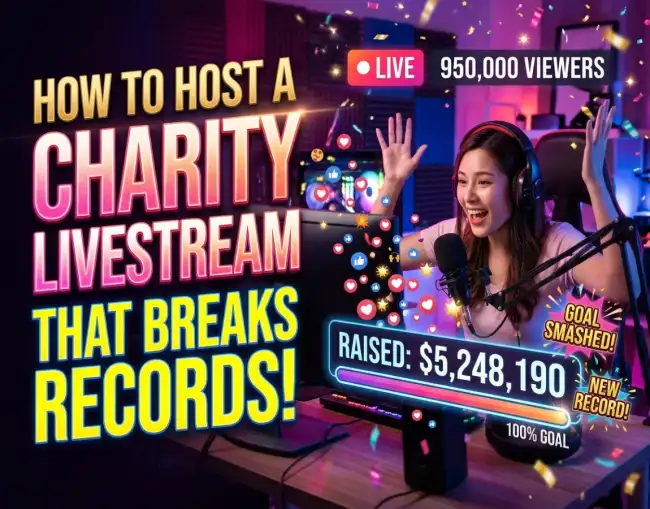
In the digital age, philanthropy has undergone a radical, decentralized revolution. No longer confined to black-tie galas, silent auctions, or telethons dominated by institutional gatekeepers, modern charitable giving lives and breathes on digital screens. When a single creator can mobilize millions of dollars in a matter of hours from a bedroom studio, the entire architecture of global social impact shifts. Yet, moving an audience from passive viewership to active, high-ticket generosity during a live broadcast is an intricate science. It demands a sophisticated blend of television-grade production pacing, behavioral psychology, real-time community moderation, and ironclad technical infrastructure.
The digital landscape of streaming for a cause has matured far beyond simple "donate links" dropped into a chat box. Audiences today are discerning, skeptical of performative activism, and inundated with content. To break internet records—whether in concurrent viewership, total funds raised, or community engagement metrics—organizers must treat their broadcast not merely as a stream, but as a live-produced media event. This requires careful alignment with the algorithms of platforms like Twitch, YouTube, and TikTok, while maintaining the raw, unscripted authenticity that digital-native audiences crave. Whether you are an independent creator with a tight-knit community or an enterprise organization orchestrating a multi-creator collaborative summit, the path to record-breaking success is paved with meticulous planning and flawless execution.
This comprehensive guide dismantles the anatomy of historic charity streams, offering an exhaustive, step-by-step roadmap for producers, influencers, and nonprofit leaders. By examining the foundational mechanics, structural blueprints, audience psychology, and common pitfalls of large-scale digital philanthropy, you will learn how to transform casual viewers into passionate donors and community advocates. Dive deep into the strategies that separate a standard broadcast from an unforgettable cultural moment that redefines what is possible through online giving.
Foundational Principles and Mechanics of Digital Philanthropy
To successfully execute a massive charity livestream, one must first master the underlying mechanics that govern digital attention and financial transactions. At its core, a charity stream is a convergence of live-entertainment broadcasting and peer-to-peer fundraising. Unlike traditional corporate philanthropy, where donations are driven by tax incentives or brand positioning, digital donations are fueled by emotional resonance, social proof, and gamification. Understanding how these psychological triggers interact within a live chat environment is the first step toward building a sustainable and high-yielding broadcast framework.
The technical architecture supporting these events has also evolved exponentially. Modern fundraising tools—such as Tiltify, DonorDrive, and specialized platform extensions—integrate directly into broadcasting software like OBS Studio or Streamlabs. These integrations allow for real-time alerts, dynamic progress bars, and automated milestone unlocks that turn giving into an interactive video game. When a donor sees their name instantly flash across the screen, accompanied by custom audio and visual effects, they receive an immediate dopamine hit that encourages peer mimicry, sparking cascading donation waves across the audience.
Furthermore, navigating the operational side of digital philanthropy requires strict adherence to legal and financial compliance. From 501(c)(3) verification to cross-border tax considerations and platform revenue-sharing splits, organizers must ensure complete transparency. Trust is the ultimate currency of the creator economy; the moment an audience suspects financial opacity, engagement plummets. Establishing direct payout methods where funds flow securely from the payment processor straight to the beneficiary organization is non-negotiable for maintaining absolute credibility.
Step 1: Conceptualization, Theme Development, and Narrative Arc
Crafting a Compelling Core Hook
Every record-breaking broadcast begins with a singular, magnetic premise that cuts through the noise of the daily content stream. A generic title like "Streaming to Help People" will fail to capture imaginations. Instead, your hook must be specific, ambitious, and inherently shareable. It should answer the viewer's subconscious question: Why must I tune in right now, and why is my presence vital to this mission?
Develop a narrative framework that connects the host's personal brand to the cause. If you are raising funds for clean water initiatives, consider streaming continuously until a specific financial goal is met, effectively tying your physical endurance directly to the charity's mission. The narrative must be easily digestible for short-form teaser clips posted to TikTok, Instagram Reels, and YouTube Shorts in the weeks leading up to the main event.
Structuring the Broadcast Timeline
A multi-hour or multi-day stream cannot rely on improvised momentum alone; it requires a carefully orchestrated broadcast schedule. Divide your timeline into distinct operational acts: an explosive opening hour designed to capture peak concurrent viewers, a high-engagement mid-section featuring structured segments, special guests, or challenges, and a climactic closing push where urgency peaks.
Within this schedule, build in mandatory producer-led operational breaks. Creator fatigue is real, and cognitive decline on camera leads to diminished donor enthusiasm. Rotate co-hosts, schedule pre-recorded intermission packages, and outline buffer activities to keep the energy high even during technical lulls or slower donation periods.
Aligning Beneficiaries with Audience Demographics
The charity you choose must authentically resonate with your specific viewer demographic. Do not select an organization simply because it has a recognizable name; choose a cause where your community's unique culture can tangibly move the needle. Conduct audience surveys, analyze chat sentiment, and partner with transparent intermediary organizations that provide dedicated creator support teams to help you craft messaging that connects.
Step 2: Securing Strategic Partnerships and Corporate Matching
Leveraging Corporate Matching Funds
The secret weapon of multi-million-dollar charity streams is the corporate match. Securing a corporate sponsor willing to match viewer donations up to a specified cap instantly doubles the psychological value of every dollar contributed by your audience. When viewers realize their twenty-dollar donation becomes forty dollars instantly, conversion rates skyrocket.
When pitching corporate partners, present your livestream as a high-value media property with demonstrable reach, demographic data, and brand safety guarantees. Position them not just as financial donors, but as active co-conspirators in a historic social impact event. Ensure all brand integrations feel organic to the broadcast rather than jarring commercial intrusions, maintaining the trust your audience places in your recommendations.
Collaborating with Co-Hosts and Special Guests
No creator is an island, especially when attempting to break records. Collaborative streams pool distinct audiences, cross-pollinate fanbases, and maintain high entertainment value over extended broadcasting hours. When inviting guest creators, look for individuals who share your alignment with the cause and bring complementary hosting styles—such as comedic relief, expert commentary, or high-energy hype.
As you scale these collaborations across different regions or linguistic communities, you will often encounter unique organizational dynamics. For deeper insights into managing complex multi-party arrangements, review our guide on Cross-Border Collabs: Bridging Cultural Divides for Global Social Impact, which outlines best practices for international creator synergy.
Engaging Platform Executives and Advocacy Teams
Major streaming platforms—including Twitch, YouTube, and Meta—often provide backend promotional support, front-page carousel placement, or specialized fundraising badges for certified charity events. Reach out to platform creator relations managers months in advance. Providing them with a comprehensive media kit, projected milestone goals, and a list of high-profile participants can secure vital algorithmic amplification that turns a standard stream into a front-page global event.
Step 3: Advanced Technical Architecture and Production Polish
Redundant Streaming Systems and Fail-Safes
Technical disasters during a record-breaking attempt can kill momentum in seconds. A professional charity stream demands enterprise-grade redundancy. This includes dual-encoding streaming rigs, backup internet fiber or 5G cellular bonding routers, and secondary audio routing configurations to ensure that if a primary computer crashes, the broadcast transitions seamlessly without dropping connection.
Your technical director should run stress tests simulating peak chat velocity, heavy API donation alerts, and rapid media switching at least one week prior to going live. Identifying audio desyncs, overlay lag, or widget timeout issues in a controlled environment prevents catastrophic failures when tens of thousands of dollars are moving in real time.
Dynamic Overlays, Alerts, and Gamification Widgets
The visual interface of your stream is your digital telethon stage. Invest in custom-designed overlays that reflect the branding of the charity campaign while maintaining high legibility. Implement tier-based donation alerts where larger contributions trigger distinct, memorable audio-visual events on screen.
Incorporate interactive widgets such as live progress thermometers, rolling contributor leaderboards, and goal-triggered soundboards. These elements transform the chat from a passive text feed into an active arena of collective achievement, driving healthy competition among viewers to push milestones across the finish line.
Audio Engineering and Broadcast Pacing
Crisp audio is infinitely more important than high-resolution video. Viewers will tolerate a 720p stream, but they will instantly close a tab plagued by clipping microphones, room echo, or unbalanced game-to-voice audio ratios. Use dedicated hardware audio interfaces, dynamic range compression, and noise suppression plugins to ensure broadcast-quality voice transmission throughout lengthy broadcast hours.
Maintain tight pacing by utilizing a dedicated off-camera producer or moderator lead who communicates directly with the host via an in-ear monitor or auxiliary display. This producer monitors chat sentiment, tracks milestone pacing, and feeds urgent updates to the talent without breaking the on-air flow.
Step 4: Gamification, Milestones, and Incentive Engineering
Designing Progressive Milestone Unlocks
Milestones are the psychological engine of modern fundraising events. Instead of asking for a lump-sum target, break the fundraising journey into chronological or financial tiers, each unlocking a specific community reward or host challenge. This creates a cascading sense of urgency; as the stream approaches a milestone boundary, donation velocity naturally accelerates.
Unlocks should range from the humorous (eating increasingly spicy chips, dyeing hair on camera) to the community-focused (unlocking a matching donation hour, releasing exclusive merchandise where 100% of proceeds go to the charity). Every milestone must be clearly displayed on screen at all times to keep the audience oriented toward the next collective goal.
Implementing Bounties and Creator Challenges
Gamifying viewer contributions through direct challenge bounties allows individuals or pooled communities to dictate elements of the broadcast. For instance, establish a mechanic where every $1,000 raised adds 10 minutes to an endurance stream, or where a specific threshold allows chat to vote on an in-game penalty for the host.
Balancing these challenges requires careful risk management. Ensure all physical or digital challenges comply with platform Terms of Service, prioritize personal safety and health during long endurance runs, and maintain a respectful tone that honors the dignity of the charity's core mission.
Exclusive Incentive Merchandise and Perks
Physical and digital rewards can dramatically increase average donation sizes. Partner with fulfillment platforms to create limited-edition charity t-shirts, digital badges, or custom Discord roles available exclusively to donors during the broadcast window. The scarcity and social status associated with these items provide tangible value that incentivizes higher-tier contributions.
Step 5: Pre-Event Marketing, Hype Generation, and PR Strategies
Multi-Platform Teaser Campaigns
A successful charity stream requires weeks of deliberate audience priming. Launch your teaser campaign at least four to six weeks prior to the live date. Utilize short-form video platforms—TikTok, YouTube Shorts, and Instagram Reels—to drop episodic previews, behind-the-scenes preparation footage, and announcements of special guest appearances.
Build anticipation by treating the announcement like a major motion picture trailer. Highlight the personal stories of the individuals or communities impacted by the charity, establishing an emotional baseline that viewers will carry with them into the live broadcast.
Activating Creator Networks and Community Ambassadors
Mobilize your community to become active evangelists for the event. Provide your Discord members, subreddit moderators, and super-fans with media toolkits containing pre-written promotional tweets, banner graphics, and countdown widgets. Empower them to spread the word across their own social networks.
Furthermore, secure commitments from peer creators within your network to raid your channel at the start of the event or host secondary co-streams that feed into the central fundraising dashboard. Cross-community coordination is the single most effective catalyst for exponential viewer growth.
Press Releases and Mainstream Media Outreach
Do not limit your marketing to digital endemic spaces. Craft a professional, newsworthy press release targeted at tech journalists, gaming media, and local news outlets. Highlight unique angles—such as breaking previous community records, leveraging innovative tech integrations, or supporting timely social causes.
When pitching media, emphasize the human impact and scale of the digital community mobilization. Traditional media outlets are increasingly fascinated by the immense philanthropic power of the creator economy and are often eager to cover major milestones.
Step 6: Live Execution, Community Management, and Real-Time Optimization
Deploying and Training Moderation Strike Teams
As a livestream scales in concurrent viewership, chat toxicity and spam increase exponentially. A chaotic, unmoderated chat destroys the welcoming environment required for major donor generosity. Deploy a specialized moderation strike team equipped with advanced automod tools, custom keyword filters, and direct communication lines with the broadcast producers.
Moderators must be briefed on the sensitivity of the charity cause, trained to handle disruptive actors swiftly, and instructed to highlight positive community engagement and high-value donor contributions in the chat feed to encourage sustained momentum.
Real-Time Analytics and Pivot Strategies
A live broadcast is a dynamic, fluid media environment. Your production team must continuously monitor real-time analytics—including average watch time, chat velocity, viewer drop-off points, and donation conversion rates. If audience engagement dips during a specific segment, the team must be prepared to execute a pre-planned pivot—such as introducing a surprise guest, launching an impromptu milestone challenge, or shifting topic focus.
Agility separates legendary streams from mediocre ones. Treat the control room like a live television broadcast suite where decisions are made instantly based on hard data and audience feedback loops.
Maintaining Host Energy and Physical Well-Being
For long-form or endurance streams, the host's physical and mental stamina is the ultimate limiting factor. Implement strict pacing protocols: mandate 10-minute breaks every two hours, ensure proper hydration and nutritional intake, and utilize co-hosts to carry conversational weight during moments of host fatigue.
An exhausted, irritable host alienates viewers and stifles generosity. Protecting the host's well-being is not just a matter of health; it is a critical operational imperative for maintaining an inviting, high-energy broadcast atmosphere.
Step 7: Post-Stream Momentum, Impact Reporting, and Gratitude Loops
Immediate Post-Stream Wrap and Celebration
The moment the stream ends marks the beginning of the conversion and retention phase. Close the broadcast with a powerful, emotional wrap-up segment celebrating the final tally. Express profound, specific gratitude to top donors, corporate matching partners, platform staff, moderation teams, and the community at large.
Keep the donation page open for a designated post-stream grace period (typically 24 to 48 hours). Many community members who missed the live broadcast will tune into the video-on-demand (VOD) and contribute during this secondary window, often pushing final totals past initial milestone targets.
Publishing Comprehensive Impact Transparency Reports
Trust is cemented in the days and weeks following the event. Within a month of the stream's conclusion, publish a transparent impact report detailing the exact funds raised, platform fees deducted, transfer confirmations from the beneficiary charity, and visual evidence of how the funds were deployed on the ground.
For creators seeking long-term brand health and sponsor safety, avoiding opaque financial dealings is paramount. To understand the broader implications of financial transparency and brand safety in digital partnerships, explore our analysis on The Dark Side of Sponsorships: Avoiding Predatory Brand Deals and Scams to protect both your community and your reputation.
Recycling Content for Evergreen Engagement
A record-breaking charity stream generates hundreds of hours of raw media assets. Do not let this content sit idle. Edit highlight reels, emotional testimonial clips, and humorous outtakes into optimized vertical videos for TikTok, YouTube Shorts, and Instagram. These pieces serve as evergreen proof of your community's philanthropic power, laying the groundwork for your next major campaign.
Real-World Case Studies & Scenarios
To fully grasp the mechanics of record-breaking charity streams, examining real-world operational models reveals the stark contrast between meticulous execution and preventable failure. Consider two contrasting scenarios from recent digital fundraising history.
Scenario A: The Meticulously Orchestrated Collaborative Summit
In late 2023, a coalition of mid-tier and macro creators banded together to host a 48-hour continuous streaming marathon for pediatric cancer research. Rather than improvising, the organizing committee spent four months securing a $250,000 corporate matching grant, built redundant streaming setups with secondary fiber lines, and coordinated a rotating roster of twenty guest co-hosts.
By implementing tier-based milestone unlocks—such as live musical performances, community game tournaments, and chef-led cooking segments—they kept audience retention remarkably high. Their moderation strike team maintained a welcoming chat atmosphere, and real-time analytics allowed producers to inject high-energy challenges whenever viewer counts dipped. The result? They shattered their $100,000 baseline goal within six hours and ultimately closed the broadcast at over $1.2 million raised, setting a new platform record for independent creator philanthropy.
Scenario B: The Unprepared Solo Stream Disaster
Conversely, consider the cautionary tale of a popular solo entertainer who decided to host an impromptu 24-hour charity stream with zero technical rehearsal or corporate backing. Operating on a single computer without backup internet connections, the stream suffered a catastrophic encoder crash four hours in, wiping out the live chat history and resetting donation trackers.
Compounding the technical failure, the host had no structured schedule or milestone incentives, leading to long periods of silence and disjointed gameplay. Viewers trickled out in frustration, and the final fundraising total barely scraped $1,500—less than the host's own out-of-pocket expenses for equipment setup. The failure underscored an immutable truth of modern digital philanthropy: passion alone cannot override poor infrastructure and lack of strategic planning.
Critical Mistakes and How to Avoid Them
Even seasoned creators fall prey to recurring operational traps when attempting large-scale charitable broadcasts. Recognizing these pitfalls before going live is essential for protecting your reputation, community trust, and financial goals.
- Neglecting Technical Redundancy: Relying on a single streaming PC and domestic internet connection invites disaster. Countermeasure: Always establish secondary encoding hardware, backup internet fail-safes, and pre-tested audio routing chains.
- Failing Financial Transparency: Directing funds through ambiguous personal accounts or delayed payout structures instantly destroys audience trust. Countermeasure: Utilize platform-integrated direct-to-charity fundraising tools (like Tiltify or official platform charity extensions) where money flows directly to the nonprofit entity.
- Poor Pacing and Creator Burnout: Attempting a multi-hour endurance stream without scheduled breaks leads to cognitive decline and low-energy broadcasting. Countermeasure: Build a strict operational schedule featuring co-host rotations, intermission packages, and mandatory rest periods for the primary talent.
- Inadequate Chat Moderation: Leaving chat unmonitored during high-traffic moments invites toxic actors, spam, and hostility. Countermeasure: Deploy a trained moderation strike team equipped with advanced automod filters and direct lines to the production control room.
- Weak Pre-Event Hype and Marketing: Dropping a charity stream announcement 24 hours before going live guarantees low turnout. Countermeasure: Launch a multi-week teaser campaign across short-form video platforms, engage community ambassadors, and coordinate cross-channel raids with peer creators.
Comprehensive Comparison Table
Choosing the right tools, strategies, and approaches is critical for operational success. Below is a semantic comparison of key fundraising platforms and broadcast strategies utilized in top-tier charity streams.
| Platform / Tool | Best Suited For | Key Strengths | Potential Limitations |
|---|---|---|---|
| Tiltify | Multi-creator summits & enterprise charity streams | Advanced polling, milestone unlocks, corporate matching integrations, direct-to-charity routing. | Steeper initial setup curve; requires nonprofit onboarding verification. |
| Twitch Charity Tool | Native Twitch streamers & solo creators | Zero-friction setup, direct platform payout, native chat badge integrations. | Limited customization options for advanced overlay gamification. |
| DonorDrive | Large-scale institutional & hybrid events | Robust donor management, peer-to-peer team fundraising pages, corporate reporting. | Interface can feel corporate and less native to gaming/creator cultures. |
| Custom API / Streamlabs | Tech-forward independent creators | Infinite visual customization, unique gamification triggers, proprietary soundboards. | High technical maintenance risk; requires dedicated engineering oversight. |
Frequently Asked Questions (FAQ)
How do I legally protect myself when raising money for charity online?
Legal protection begins with never touching the funds directly. Always use established fundraising platforms—such as Tiltify or official platform charity tools—that route contributions directly from the payment processor to the verified 501(c)(3) or international equivalent organization. This ensures that you never hold taxable charitable donations in your personal bank account, shielding you from compliance liabilities and maintaining absolute transparency with your audience.
What is the ideal duration for a record-breaking charity livestream?
There is no universal time length, but data shows that successful major events typically run between 12 to 48 hours. Anything shorter struggles to build sustained algorithmic momentum and donor urgency, while events stretching past 48 hours often suffer from severe host fatigue and diminishing audience returns. For multi-day events, a collaborative relay format where creators tag-team broadcasting shifts is far more effective and sustainable than a single exhausted host.
How can smaller creators with low view counts successfully run charity streams?
Scale is relative. While you may not break global multi-million-dollar records, a smaller creator can achieve monumental success relative to their community size by focusing on hyper-engaged intimacy and aggressive local matching. Partner with smaller, regional charities where your donation can instantly fund a specific, tangible project (e.g., funding a specific animal shelter rescue or local food bank delivery). Intimate communities often boast much higher conversion rates per viewer than massive, passive audiences.
What should I do if my fundraising goal stalls midway through the stream?
Stalls are completely normal during long broadcasts, particularly during overnight hours. Combat stagnation by activating pre-planned pivot strategies: introduce an unexpected guest creator via voice or video call, unlock a high-value community matching hour sponsored by a corporate partner, or introduce an impromptu challenge where chat contributions unlock a humorous penalty for the host. Keeping the energy dynamic and changing the broadcast rhythm instantly re-engages dormant viewers.
How do I secure corporate matching grants as an independent influencer?
Securing corporate matches requires treating your channel as a professional media property. Create a comprehensive sponsorship deck that outlines your audience demographics, past fundraising metrics, and brand safety guarantees. Reach out to corporate social responsibility (CSR) departments of brands that align with your content niche several months in advance. Frame the match not as charity, but as a high-visibility marketing partnership that demonstrates authentic corporate citizenship to a passionate digital audience.
Strategic Roadmap and Final Takeaway
Hosting a charity livestream that breaks internet records is an orchestration of art and science. It demands the creative vision to craft an irresistible narrative hook, the technical rigor to maintain flawless broadcast stability, the psychological insight to gamify generosity, and the operational discipline to ensure absolute financial transparency. As the creator economy continues to mature over the next two to five years, audiences will increasingly reject performative or poorly managed fundraising efforts in favor of authentic, highly professionalized social impact events.
Your immediate next steps begin long before you hit the "Go Live" button. Define your core cause, align with verified fundraising infrastructure, secure corporate matching partners, and build a multi-week pre-event marketing campaign that mobilizes your community as active evangelists. By treating your charity stream as a premier media production rather than a casual broadcast, you unlock the profound capacity to move millions of viewers from passive consumption to historic, world-changing generosity.
Be the first creator to share your take on this story.