
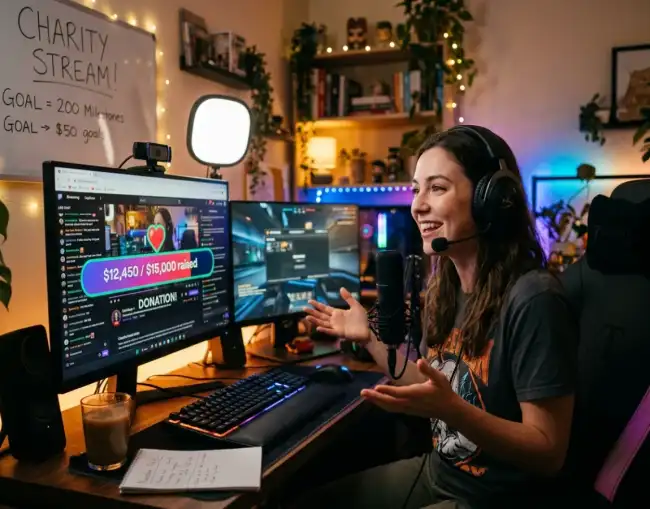
In the digital age, philanthropy has undergone a radical decentralization. No longer confined to black-tie galas, silent auctions, and telephone marathons, social impact is now forged in real-time across digital broadcasting studios, bedroom setups, and multi-stream collaborative hubs. A single digital native sitting in front of a ring light can mobilize an international community of viewers, driving tens of thousands of dollars to critical global causes within a matter of hours. This evolution has transformed online entertainment into a powerhouse for social good, bridging the gap between passive spectatorship and active global citizenship.
However, running a high-yield virtual fundraising event requires far more than simply turning on a webcam and dropping a donation link in the chat. As the digital landscape matures, audiences have grown discerning; they demand transparency, seamless technical execution, high-energy entertainment, and deeply engaging mechanics that make them feel like active participants rather than mere piggy banks. Whether you are an established creator looking to leverage your audience for good, a nonprofit organization aiming to tap into the creator economy, or an agency executing a broader campaign, mastering the anatomy of a successful charity live stream is essential for breaking through the noise.
This comprehensive guide acts as your masterclass. We will dissect the technical architecture, psychological triggers, strategic partnerships, and promotional frameworks required to execute a virtual fundraising event that not only hits its financial targets but leaves a lasting cultural footprint. By synthesizing lessons from top-tier digital campaigns, we will walk you through every phase of production, ensuring your next digital philanthropic endeavor is a resounding success.
Understanding the Mechanics of Digital Philanthropy
The Anatomy of Modern Online Fundraising
At its core, a charity live stream operates on the principle of hyper-engaged community motivation. Unlike traditional fundraising, where donations are often driven by duty or tax incentives, digital donations are fueled by real-time interactivity, social validation, and gamification. Viewers do not just give money; they purchase moments, influence the broadcast, and cement their status within the community.
Understanding this psychological shift is critical. When a donor sees their name flash across a screen, triggers an audio alert, or forces the host to eat a spicy chip or play a game upside down, the transaction transforms from a financial contribution into an experiential exchange. Integrating these interactive elements effectively requires a deep understanding of audience psychology, similar to the foundational strategies required when Mastering Influencer Onboarding: The Checklist Every Brand Needs to ensure brand and creator alignment.
Choosing the Right Cause and Beneficiary Partner
The success of any charity stream hinges on the alignment between the creator, the audience, and the chosen cause. Selecting a charity that resonates authentically with your core demographic is non-negotiable. If your community is heavily gaming-focused, partnering with organizations that support pediatric gaming hospitals or mental health initiatives in gaming can yield staggering results.
Furthermore, vetting the nonprofit partner for digital maturity is vital. You must ensure that the organization can provide direct API integration tools (such as Tiltify or Streamlabs Charity), issue tax receipts efficiently, and offer transparent tracking metrics. A poorly integrated donation backend can bottleneck momentum during peak donation windows, turning a wave of enthusiasm into technical frustration.
Step 1: Building Your Event Strategy and Financial Goals
Defining Realistic and Stretch Targets
Setting financial goals requires a delicate balance between ambition and realism. An overly conservative goal can stall momentum once achieved, while an impossible target can demoralize both the host and the community. Begin by analyzing your average concurrent viewership, historical donation-per-viewer metrics, and the baseline engagement rates of your community.
Once you establish a baseline goal, design a tiered milestone structure. For example, if your baseline goal is $5,000, structure your milestones at $1,000 increments. Each milestone should unlock a specific piece of content, a physical challenge, a giveaway, or a matching donation from a corporate sponsor, keeping the community motivated throughout the broadcast lifecycle.
Structuring Corporate Matching and Sponsorships
To truly scale a virtual fundraising event into the tens of thousands of dollars, relying solely on grassroots viewer donations is rarely enough. Securing corporate matching partners acts as an immediate financial multiplier. Pitch brands by demonstrating the immense value of aligning their corporate social responsibility (CSR) initiatives with your engaged digital audience.
When pitching sponsors, present a clear package: brand visibility on screen overlays, verbal shoutouts during peak concurrency windows, and joint PR opportunities. When brands agree to match viewer donations up to a specific cap (e.g., "$10,000 matched dollar-for-dollar"), it creates an immediate sense of urgency, inspiring viewers to donate sooner because their individual impact is instantly doubled.
Step 2: Technical Infrastructure and Broadcast Setup
Platform Selection and Ecosystem Optimization
Choosing where to broadcast is one of the most critical decisions in your event architecture. While Twitch remains the undisputed heavyweight for interactive charity streams due to its robust extension ecosystem, platforms like YouTube Live and specialized vertical formats explored in discussions on Platform Power Clash: Instagram vs. YouTube vs. TikTok Monetization Models offer unique advantages depending on your target demographic and content style.
Evaluate each platform's built-in monetization tools versus third-party widgets. Ensure that your streaming software (such as OBS Studio or Streamlabs Desktop) is configured with redundant encoders, stable bitrate settings, and backup internet protocols to prevent catastrophic mid-stream crashes.
Integrating Donation Engines and Overlay Widgets
The visual feedback loop on screen is what drives sustained giving. Your donation engine—whether using Tiltify, DonorDrive, or Streamlabs Charity—must be seamlessly integrated into your broadcast graphics. Set up custom alert boxes, real-time progress bars, and ticker tapes that display top donors and recent contributions.
Test your API connections extensively prior to going live. Run dry runs where test donations are sent through the pipeline to verify that alerts fire instantly, audio levels are balanced, and ledger updates reflect accurately on your public campaign page without lag.
Step 3: Crafting Engaging Content and Gamification Mechanics
Designing Incentive-Driven Milestones
Passively asking for money rarely yields record-breaking numbers. You must gamify the broadcast experience through creative, high-energy incentives. Create a visible "Reward Menu" on screen or via chatbot commands that maps specific dollar amounts or cumulative milestones to entertaining actions.
Examples of effective gamification mechanics include:
- The Torture Stream: Eating increasingly spicy hot sauces, wearing funny costumes, or playing horror games in complete darkness for every $500 raised.
- Skill-Based Challenges: Playing a notoriously difficult game (like *Elden Ring* or *Kaizo Mario*) blindfolded or using unconventional controllers (like a dance pad) until a milestone is met.
- Creative Creation: Writing and recording an original song on the spot, drawing portraits of top donors in MS Paint, or coding a basic game live on stream.
Co-Streaming and Multi-Creator Collaboration
Scaling reach requires bringing in external voices. Coordinate a multi-creator relay or a concurrent co-streaming event where several influencers broadcast simultaneously, routing their audiences to a centralized hub or raid train. Raiding—the act of transferring your entire live audience to another creator's channel at the end of a segment—is the single most powerful organic growth engine in digital broadcasting.
Establish a rigorous run of show (ROS) schedule for multi-creator events. Assign clear time slots, guest handover protocols, and shared communication channels (such as a dedicated Discord server or backstage green room) to ensure seamless transitions between hosts without dead air.
Step 4: Marketing, PR, and Pre-Event Momentum
Building the Pre-Event Hype Train
An exceptional stream means nothing if nobody shows up. Your marketing campaign should kick off at least three to four weeks prior to the live event. Utilize a multi-platform content blitz across X (formerly Twitter), Instagram Reels, TikTok, and Discord to seed the narrative.
Release announcement trailers that highlight the beneficiaries, showcase the ridiculous challenges you have planned, and introduce your guest line-up. Leverage short-form video clips to tease the most exciting aspects of the event, driving urgency and directing traffic to your pre-registration and campaign landing pages.
Leveraging Email Lists and Community Hubs
Do not rely solely on algorithmic feeds to notify your audience. Organic algorithms are notoriously unpredictable. Direct communication channels—such as email newsletters, SMS marketing lists, and dedicated Discord announcement channels—are your most reliable conversion tools.
Send a sequence of three emails leading up to the event: an initial announcement with the "Save the Date," a middle reminder highlighting the corporate matching partners and incentive menu, and a final "We Are Live" dispatch with a direct one-click viewing link.
Step 5: Execution, Moderation, and Real-Time Crisis Management
Managing Moderation and Chat Safety
High-visibility streams inevitably attract trolls, spam, and bad actors attempting to disrupt the broadcast or exploit donation alerts for malicious purposes. Your moderation team is the unsung hero of your event. Equip them with strict guidelines, updated AutoMod filters, and direct communication lines to you and your producers.
Ensure your donation alert system has filters for profanity and chargeback protection enabled. If a malicious user attempts a fraudulent chargeback wave or uses offensive text-to-speech triggers, your mods must have the immediate authority to ban, purge, and pause alerts without halting the broader broadcast.
Maintaining Energy Through Long-Form Broadcasts
Charity streams often span 6, 12, or even 24 hours. Physical and mental fatigue is your greatest enemy. Designate structured shift changes, schedule mandatory offline breaks (where pre-recorded community spotlight segments or sponsor reels play), and keep heavy hydration and nutritional supplies on hand.
Remember that your energy dictates the room's energy. Pace yourself during the opening hours, lean on your co-hosts during fatigue valleys, and save your highest-intensity moments for the final push when donor urgency peaks.
Real-World Case Studies & Scenarios
Case Study A: The Collaborative Powerhouse (Success)
In late 2023, a collective of mid-tier gaming creators banded together for a 48-hour relay stream supporting clean water initiatives. By partnering with Tiltify, securing a $15,000 corporate matching grant from a gaming peripheral manufacturer, and utilizing a rolling raid train across five channels, the campaign generated over $68,000.
Key Takeaways: The success hinged on rigorous pre-planning, clear branding across all participating channels, and the psychological impact of the corporate match, which triggered rapid-fire donations during the final six hours of the broadcast.
Case Study B: The Isolated Broadcast (Failure)
Conversely, a solo creator with 50,000 followers attempted an unannounced 12-hour charity stream with no corporate backing, no gamification menu, and a generic donation link dropped into chat. The result? A meager $342 raised and severe creator burnout.
Key Takeaways: Without pre-event marketing, interactive milestones, or corporate matching multipliers, passive audiences treat streams as routine entertainment rather than mobilization events. Structure and collaboration are non-negotiable.
Critical Mistakes & How to Avoid Them
| Common Mistake | The Impact | The Corrective Countermeasure |
|---|---|---|
| Zero Technical Testing | Donation alerts fail, audio sync drops, or streams crash mid-broadcast, killing momentum. | Run a full dress rehearsal 48 hours prior with simulated donations and multi-cam handoffs. |
| Vague Impact Messaging | Donors don't understand where their money goes, leading to decision fatigue. | Use concrete metric translations (e.g., "$25 provides clean water for a child for a year"). |
| Ignoring Post-Event Stewardship | Donors never hear about the final total or impact, reducing lifetime community value. | Publish a transparent wrap-up video and thank-you post within 72 hours of event conclusion. |
| Over-Reliance on Organic Reach | Low initial viewership because the audience wasn't notified across multiple channels. | Execute a 3-week multi-platform marketing blitz utilizing email, Discord, and short-form video. |
| Burnout Without Shifts | Host exhaustion leads to low energy, awkward interactions, and early stream termination. | Build a rotational roster of co-hosts and schedule mandatory offline rest intervals. |
Frequently Asked Questions (FAQ)
What is the best platform to host a charity live stream?
The "best" platform depends heavily on your existing audience and content genre. Twitch remains the gold standard for long-form interactive charity streams due to its mature extension ecosystem, robust API integrations with platforms like Tiltify, and native community raiding features. However, YouTube Live offers superior archiving and long-tail discoverability, while multi-streaming tools allow you to broadcast across multiple platforms simultaneously to maximize your top-of-funnel reach.
How do I secure corporate sponsors for a small or mid-tier stream?
Corporate sponsors look for brand alignment, audience demographics, and professional presentation rather than raw subscriber counts alone. Create a polished one-pager media kit that highlights your audience engagement rates, past philanthropic success, and specific brand visibility packages. Approach endemic brands—companies that naturally fit your niche, such as hardware manufacturers, software developers, or lifestyle brands—and pitch them on corporate matching grants as a tax-advantaged CSR initiative.
How should I handle taxes and donation receipts for virtual fundraisers?
The safest and most legally compliant method is to use established third-party fundraising APIs such as Tiltify, Streamlabs Charity, or DonorDrive. These platforms integrate directly with recognized 501(c)(3) or international equivalent nonprofits. When a viewer donates through these tools, the funds go directly to the charity's bank account, and the platform automatically issues tax receipts, completely shielding the creator from handling taxable charitable donations.
What is a reasonable financial goal for a first-time charity stream?
For first-time streamers, setting an achievable baseline goal—such as $1,000 to $2,500—is recommended. It is far better to crush a conservative goal by 200% and unlock stretch milestones than to set an arbitrary $10,000 target and stall out at $800. Use your average concurrent viewership and typical donation conversion rates to calculate a realistic figure, then scale up exponentially for future events.
Strategic Roadmap & Final Takeaway
Running a virtual charity stream that raises thousands of dollars is both an art and a rigorous science. It requires moving beyond casual broadcasting into professional event production, community psychology, and strategic partnership management. By establishing clear financial targets, integrating seamless technical overlays, gamifying the donor experience, and executing a robust pre-event marketing campaign, you transform a standard broadcast into an unforgettable cultural moment.
As the digital landscape evolves over the next few years, the integration of immersive technologies, cross-platform co-streaming networks, and sophisticated corporate matching structures will only accelerate. Creators and brands that master these principles today will not only drive unprecedented social impact but cement their status as trusted, influential leaders in the digital economy. Take these blueprints, assemble your team, and start planning your most impactful broadcast yet.
Be the first creator to share your take on this story.