
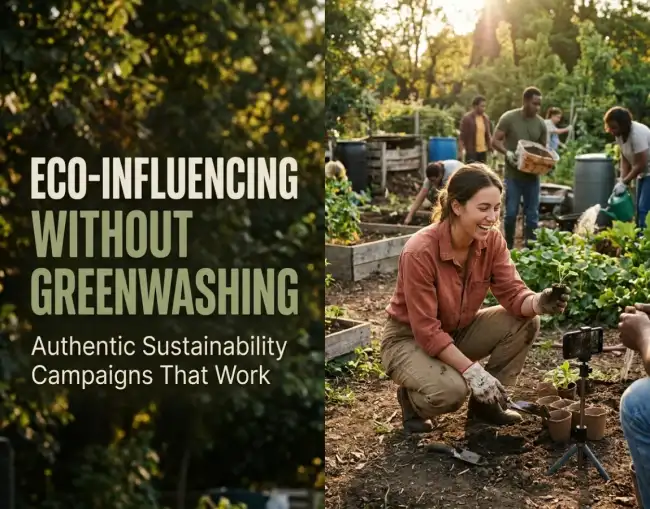
The digital landscape is currently experiencing a profound ideological reckoning. For over a decade, influencer marketing operated as an engine of relentless consumption—a hyper-accelerated cycle of unboxings, fast-fashion hauls, and fleeting trends designed to convert digital attention into immediate retail transactions. However, as ecological degradation accelerates and planetary boundaries face unprecedented strain, modern audiences have grown radically discerning. Today’s digital consumers do not merely buy products; they invest in worldviews, ethical alignment, and systemic accountability. This seismic shift has birthed a new category of digital leadership: the eco-influencer. Yet, stepping into this role introduces complex ethical minefields where the line between genuine environmental advocacy and exploitative corporate PR blurs dangerously.
At the heart of this tension lies greenwashing—the deceptive practice where companies or creators use marketing, PR, and superficial imagery to present an environmentally responsible facade while engaging in ecologically harmful practices. In the creator economy, greenwashing manifests when an influencer with a carbon-heavy travel lifestyle suddenly promotes a fast-fashion brand's "conscious collection," or when unverified corporate sustainability claims are amplified to millions of followers for a high-paying sponsored fee. The fallout from these misaligned partnerships is swift and devastating. Audiences equipped with digital literacy and investigative tools readily call out hypocrisy, leading to immediate public backlash, damaged reputations, and alienated communities. As digital changemakers, mastering the art of authentic sustainability campaigns is no longer optional; it is an absolute prerequisite for long-term influence and trust.
This comprehensive publication serves as the definitive manual for creators, brands, and agencies aiming to navigate environmental messaging with unshakeable integrity. We will dissect the mechanics of true eco-influencing, deconstruct step-by-step strategic blueprints for ethical campaigns, expose critical industry pitfalls, and provide actionable methodologies that turn climate anxiety into measurable, systemic impact. By anchoring our practices in radical transparency, rigorous auditing, and collaborative storytelling, we can redefine what it means to wield influence on a fragile planet.
Foundational Principles and Mechanics of Eco-Influencing
To understand how to practice sustainable advocacy without falling into the trap of corporate greenwashing, one must first deconstruct the core mechanics of modern environmental communication. Eco-influencing is not merely a niche category of content creation; it is an intersection of investigative journalism, behavioral psychology, and systems thinking. Unlike traditional lifestyle content that emphasizes aesthetic perfection and individual consumer choices, true eco-influencing highlights systemic challenges, structural changes, and the complex trade-offs inherent in modern living.
The operational framework of authentic sustainability rests upon three fundamental pillars: transparency, accountability, and proportionality. Transparency demands that every partnership, sponsorship, and supply chain detail be laid bare for community scrutiny. Accountability requires creators and brands to measure the actual ecological footprint of their initiatives, moving away from vague, feel-good buzzwords like "eco-friendly," "natural," or "green" toward quantifiable metrics like life-cycle assessments (LCAs), carbon offsets, and closed-loop manufacturing. Proportionality ensures that the scale of the campaign matches the ecological impact of the product or service being promoted, avoiding hyperbolic claims that inflate minor operational tweaks into planetary salvation.
Furthermore, mastering this space requires creators to understand the ecosystem of tools and collaborative platforms that support ethical business operations. For example, when scaling collaborative campaigns with purpose-driven brands, creators often rely on structured digital workflows and organizational frameworks similar to those outlined in The Tech Stack of Top Creators: 10 Tools You Need to Manage Collabs Like a Pro to ensure that every partner aligns with rigorous ethical and administrative standards before a contract is signed.
Step-by-Step Strategic Blueprint for Authentic Sustainability Campaigns
1. Establishing Radical Transparency and Ethical Vetting Protocols
The foundation of any credible sustainability campaign begins long before the content is filmed or published; it starts at the vetting desk. Creators must implement a rigorous due diligence protocol that treats potential brand partners with the same skepticism an investigative journalist applies to a corporate press release. Accepting a partnership solely based on a brand's media kit or glossy landing page is a guaranteed recipe for greenwashing exposure.
To execute this effectively, creators should design an internal "Sustainability Audit Questionnaire" that must be completed by every prospective brand partner. This questionnaire should probe deeply into raw material sourcing, labor practices, end-of-life disposal, and corporate lobbying activities. If a fast-fashion conglomerate or fossil-fuel-adjacent entity approaches you for an eco-campaign, your vetting protocol should immediately flag the inherent contradiction, regardless of the financial compensation offered.
Once a brand passes the initial vetting phase, transparency must be extended to the audience. When publishing sponsored content, creators should explicitly articulate *why* this specific brand was chosen, what trade-offs were acknowledged during the evaluation process, and where the brand still needs to improve. This level of radical honesty disarms cynicism and builds a profound layer of trust, proving to your audience that your advocacy cannot be bought cheaply.
2. Crafting Impact-Driven Narratives Over Performative Aesthetics
Traditional influencer marketing thrives on perfection: flawless lighting, pristine unboxings, and aspirational lifestyles that subtly pressure viewers into buying things they do not need. Eco-influencing requires a complete stylistic inversion. Authentic sustainability campaigns prioritize education, vulnerability, and systemic context over superficial aesthetic perfection. The narrative must shift from "Buy this reusable water bottle and save the planet" to "Here is the lifecycle of single-use plastics, the structural failures of municipal recycling systems, and how this particular tool fits into a broader reduction habit."
When developing video scripts or written captions, creators should avoid emotional manipulation and greenwashing buzzwords. Instead of saying a product is "100% sustainable"—an scientific impossibility given that all manufacturing has an environmental footprint—use precise, nuanced language like "designed for circularity," "manufactured using closed-loop water systems," or "reduces direct operational emissions by 40% compared to conventional alternatives."
Moreover, creators can look to inspiring youth movements and policy advocates for narrative inspiration. Examining how emerging leaders mobilize communities around systemic issues provides a masterclass in effective messaging, much like the strategies highlighted in Gen-Z Changemakers: Young Creators Using Influence to Rewrite Public Policy, where the focus remains firmly on legislative accountability and collective action rather than passive consumerism.
3. Designing Collaborative Campaigns Centered on Collective Action
A major pitfall in eco-influencing is the over-reliance on individual behavioral changes—such as turning off the tap while brushing teeth or swapping plastic straws—while ignoring massive industrial emissions. Authentic sustainability campaigns pivot away from shaming the individual consumer and toward mobilizing collective power. Campaigns should direct audience energy into community clean-ups, policy advocacy, open-source knowledge sharing, and supporting localized circular economies.
When partnering with brands, creators should negotiate campaign deliverables that include tangible community impact metrics. For instance, rather than a standard pay-per-post model, structure agreements where a percentage of sales directly funds localized rewilding projects, indigenous land rights organizations, or legal defense funds fighting corporate pollution. This transforms a standard advertising campaign into a philanthropic engine, aligning commercial success with demonstrable social good.
Furthermore, creators struggling to reignite stagnant follower growth while maintaining ethical integrity can leverage strategic advocacy partnerships. Revitalizing a disengaged audience often requires tying channel content to a higher, urgent purpose, echoing the turnaround methodologies discussed in Turnaround Tales: How These Creators Revived Their Dead Channels With One Collab, where meaningful collaboration breathes new life into a digital platform.
4. Measuring Real-World Metrics and Avoiding Vanity Greenwashing
In the digital marketing sphere, success has long been measured by vanity metrics: impressions, reach, likes, and click-through rates. In the realm of authentic sustainability, these metrics are completely insufficient. An eco-campaign that generates millions of impressions but encourages mindless consumption or promotes misleading environmental claims is a failure, regardless of how viral the video becomes.
Creators and brands must establish a robust metric framework that tracks qualitative and quantitative ecological impact. This includes measuring tons of waste diverted from landfills, kilowatt-hours of renewable energy generated, liters of water saved through verified supply chain shifts, and engagement depth—such as the number of users who signed a policy petition, joined a local climate action group, or completed a circular economy workshop.
Additionally, creators should partner with independent third-party auditors or environmental scientists to review campaign claims before publication. By publishing impact reports alongside sponsored content, creators elevate their channels from mere entertainment platforms to authoritative hubs of environmental accountability.
5. Cultivating Long-Term Brand Partnerships Versus One-Off Tokenism
Greenwashing often thrives on episodic tokenism—brands engaging an eco-influencer for Earth Month (April) and reverting to extractive, high-waste business practices for the remaining eleven months of the year. Authentic sustainability requires long-term commitment, iterative growth, and mutual accountability between creators and brands.
Creators should reject single-post eco-campaigns in favor of multi-year brand ambassadorships that allow for genuine developmental arcs. A long-term partnership enables the creator to act as an internal corporate critic, holding the brand accountable over time, documenting their sustainability transitions, and openly discussing missteps and corrections. This transparent evolution builds unbreakable audience loyalty because it mirrors the imperfect, ongoing journey of human sustainability.
When negotiating long-term contracts, creators must enshrine clauses that protect their editorial independence. If a brand partner violates its environmental commitments or engages in greenwashing scandals mid-campaign, the creator must retain the contractual right to terminate the agreement without financial penalty and publicly address the dissolution.
Real-World Case Studies and Scenarios
To fully grasp the mechanics of authentic sustainability versus greenwashing, let us examine two contrasting hypothetical scenarios grounded in real-world creator industry dynamics.
Case Study A: The Greenwashing Trap (Brand X & Creator Y)
Creator Y, a lifestyle and fashion vlogger with 2 million followers, is approached by FastFashion Corp to promote their new "Eco-Edit" line. The brand offers a lucrative five-figure payout. The collection features clothing made from 20% recycled polyester, though the remaining 80% relies on virgin synthetic fibers produced in facilities utilizing coal-fired energy.
Creator Y accepts the partnership without conducting a supply chain audit, filming an enthusiastic video claiming the brand is "saving the fashion industry" and encouraging followers to buy the entire collection. Within 48 hours, investigative watchdogs and audience members dissect the supply chain, revealing that FastFashion Corp's overall carbon emissions increased by 15% that year and that factory workers producing the garments faced severe labor abuses.
The Fallout: Creator Y faces an immediate wave of backlash, losing over 50,000 followers in a week, facing scathing call-out videos, and suffering permanent damage to their credibility. Brand X quietly scrubs the campaign, demonstrating the devastating cost of performative greenwashing.
Case Study B: Authentic Eco-Influencing (Brand Z & Creator W)
Creator W, an environmental science communicator with 500,000 followers, is approached by a B-Corp certified home-goods manufacturer specializing in durable, repairable stainless-steel appliances. Creator W implements a strict vetting protocol, reviewing the manufacturer's life-cycle assessments, third-party labor audits, and lifetime warranty policies.
Instead of doing a fast-paced unboxing, Creator W produces a comprehensive mini-documentary exploring the concept of planned obsolescence, visiting the manufacturing plant to interview floor workers, and demonstrating how the appliance can be easily repaired at home using modular replacement parts. The sponsorship agreement includes a clause where 10% of all affiliate sales directly fund a grassroots right-to-repair legal defense fund.
The Fallout: The campaign receives widespread acclaim from the community. Conversion rates are high because the product genuinely solves a systemic consumption problem, and Creator W's reputation as an uncompromising authority on sustainability is firmly cemented.
Critical Mistakes and How to Avoid Them
Navigating the eco-influencing landscape requires vigilance. Even well-meaning creators frequently stumble into traps that compromise their credibility. Here are the top five most costly mistakes practitioners make and the exact countermeasures to prevent them.
- Mistake 1: Relying on Vague Buzzwords. Using terms like "eco-friendly," "natural," or "green" without substantiation.
Countermeasure: Always demand hard data, life-cycle assessments, and verifiable certifications (like B-Corp, Fair Trade, or Cradle to Cradle) before using descriptive environmental claims. - Mistake 2: Promoting Hyper-Consumption Under the Guise of Sustainability. Encouraging followers to buy dozens of "eco-friendly" items they do not need.
Countermeasure: Anchor your messaging in reduction, reuse, and repair. The most sustainable product is always the one already in your closet. - Mistake 3: Failing to Vet Parent Corporations. Partnering with a small, ethical sub-brand owned by a massive multinational conglomerate notorious for ecological destruction.
Countermeasure: Conduct holistic corporate genealogy checks. Understand who ultimately owns the brand and where their profits flow. - Mistake 4: Accepting One-Off Token Partnerships. Engaging in performative advocacy exclusively during Earth Month while ignoring systemic issues the rest of the year.
Countermeasure: Prioritize long-term ambassadorships that track ongoing corporate transformation and maintain continuous accountability. - Mistake 5: Hiding Financial and Material Relationships. Obscuring sponsored partnerships or failing to disclose affiliate commissions on green products.
Countermeasure: Practice radical transparency. Clearly label all sponsored content and maintain strict adherence to regulatory disclosure standards.
Comprehensive Comparison Table
To assist creators and brands in distinguishing between performative greenwashing and authentic sustainability campaigns, review the following strategic comparison framework:
| Strategic Dimension | Performative Greenwashing Campaign | Authentic Sustainability Campaign |
|---|---|---|
| Core Narrative Focus | Individual consumerism, aesthetic perfection, "buying your way green." | Systemic solutions, reduction, reuse, repair, and collective action. |
| Language & Terminology | Vague buzzwords ("all-natural," "eco-friendly," "green"). | Precise, data-backed terms (LCAs, circularity, closed-loop, emissions data). |
| Vetting & Due Diligence | Superficial review of media kits and landing pages. | Rigorous audits of supply chains, labor practices, and parent corporations. |
| Success Metrics | Vanity metrics (impressions, reach, viral likes, short-term sales). | Qualitative and quantitative ecological impact, policy advocacy engagement. |
| Partnership Duration | Episodic tokenism (one-off posts for Earth Month). | Long-term ambassadorships with ongoing accountability and transparency. |
Frequently Asked Questions (FAQ)
What is the exact definition of greenwashing in influencer marketing?
Greenwashing in influencer marketing occurs when a digital creator promotes a brand, product, or service by exaggerating its environmental benefits, omitting critical ecological harms, or using misleading imagery to project a false sense of sustainability. This practice manipulates consumer trust, capitalizing on growing climate consciousness for financial gain without delivering genuine environmental accountability.
How can a micro-influencer with limited resources conduct a proper sustainability audit?
While micro-influencers may not have access to independent investigative teams, they can utilize readily available public databases, corporate registry filings, and consumer advocacy reports. Asking brands direct, probing questions via a standardized questionnaire—such as requesting third-party certifications, labor standards verification, and manufacturing locations—filters out companies unwilling to be transparent. Refusing partnerships when brands fail to provide clear evidence is the most powerful tool a creator possesses.
Is it ever acceptable to partner with non-sustainable legacy brands?
Partnering with high-emitting legacy brands is a nuanced ethical gray area. It can be acceptable *only* if the partnership is structured around deep corporate transition—such as documenting a heavy industry giant's measurable pivot toward renewable energy or zero-waste operations over a multi-year period. However, promoting a legacy brand's superficial "green line" while their core business model remains ecologically destructive constitutes greenwashing and should be strictly avoided.
How do I handle audience backlash if a brand partner is later exposed for environmental misconduct?
Radical accountability is your best defense. If a brand partner is exposed for greenwashing or misconduct after you have promoted them, do not deflect, delete comments, or issue a defensive, generic PR statement. Instead, immediately investigate the claims yourself, issue a transparent public acknowledgment of the oversight, terminate the partnership with the brand publicly, and explain to your community what vetting improvements you are implementing moving forward.
Can eco-influencing be financially viable without compromising ethical standards?
Absolute financial viability is entirely achievable through diversified monetization models that do not rely on pushing hyper-consumption. Sustainable creators successfully monetize through premium educational courses, community memberships, direct audience support (such as Patreon or Substack), ethical brand ambassadorships with verified B-Corps, and affiliate partnerships focused strictly on durability, repair tools, and systemic lifestyle shifts.
Strategic Roadmap and Final Takeaway
The evolution of the creator economy demands a higher standard of digital leadership. As we look ahead over the next two to five years, regulatory scrutiny surrounding greenwashing is set to intensify dramatically, with global trade commissions and consumer protection agencies cracking down on unsubstantiated environmental claims. Creators who cling to superficial, greenwashed brand deals will face not only severe reputational ruin but potential legal liability. Conversely, those who champion radical transparency, rigorous vetting, and systemic advocacy will emerge as the trusted vanguard of a new, resilient digital era.
Your next steps as an eco-influencer or brand collaborator are clear: audit your current partnerships, discard vague buzzwords in favor of precise, data-driven storytelling, and commit to long-term accountability over short-term financial gain. By aligning digital influence with unwavering ecological integrity, we can transform the creator economy from an engine of consumption into a powerful catalyst for planetary healing.
Be the first creator to share your take on this story.