
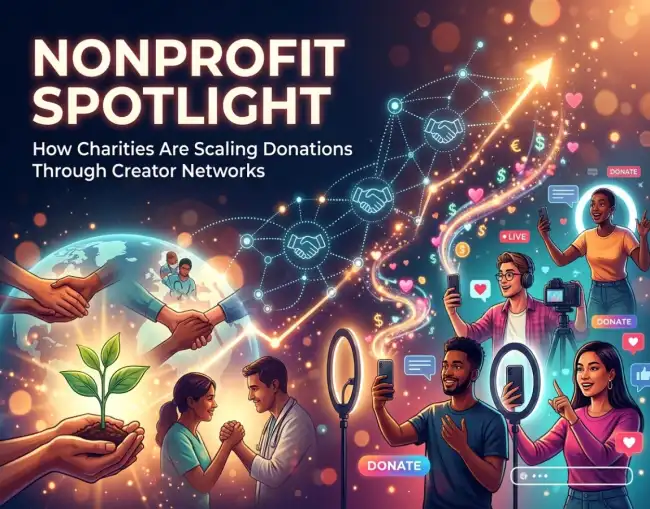
For decades, non-profit organizations relied on a predictable, linear playbook to fund their mission-critical operations: black-tie galas, direct mail appeals, legacy corporate sponsorships, and televised telethons. While these traditional vehicles generated billions for global causes, they faced an inevitable demographic wall. Younger generations—specifically Millennials and Gen Z—do not open direct mail, rarely watch linear broadcast television, and view traditional non-profit appeals with a heightened degree of skepticism. As traditional donor pools age out, social impact organizations face an existential mandate: reinvent how they articulate urgency, build community, and convert empathy into financial support.
Enter the creator economy. Over the past five years, the intersection of digital content creation, live streaming infrastructure, and community leadership has birthed a revolutionary paradigm for social good. Digital creators are no longer merely media channels or paid brand endorsers; they are hyper-engaged community leaders capable of mobilizing millions of dollars in a matter of hours. From multi-million-dollar live-streamed marathons on Twitch to viral TikTok awareness campaigns, creator-led fundraising has transformed philanthropy from a passive, transactional duty into an active, immersive, and participatory cultural event.
This structural shift has given rise to modern nonprofit partnerships that leverage the authenticity, creative autonomy, and technological infrastructure of top-tier digital talent. When executed strategically, charity campaigns powered by creator networks do far more than raise immediate capital; they lower donor acquisition costs, tap into digital-native micro-philanthropy, and build lifetime brand affinity with next-generation donors. This comprehensive guide dissects the operational mechanics, strategic frameworks, real-world case studies, and technological architecture required for modern non-profits to scale their impact through influencer fundraising.
Foundational Principles & Mechanics of Creator-Led Philanthropy
To successfully execute digital creator campaigns, non-profit executives and fundraising directors must first unlearn the rigid conventions of traditional corporate cause-marketing. Modern influencer fundraising relies on specific core mechanisms that govern digital attention, psychological motivation, and community interaction.
At the center of this paradigm is Peer-to-Peer Mobilization 2.0. Unlike traditional peer-to-peer fundraising, where individuals solicit donations from personal friends and family via static landing pages, creator-led mobilization operates at scale. Creators act as trusted intermediaries who bridge the trust gap between large, complex non-profit institutions and everyday donors. The audience is not simply giving to an abstract 501(c)(3) entity; they are participating in a collective movement hosted by a digital personality they interact with on a daily basis.
Furthermore, digital philanthropy thrives on gamified incentives and real-time feedback loops. Platforms like Tiltify, Softgiving, and YouTube Giving have fundamentally changed donor behavior by integrating fundraising directly into live digital experiences. Donors no longer wait for a tax receipt in the mail to feel acknowledged; instead, their names scroll across a broadcast screen in real time, triggering custom alerts, creator voiceovers, or on-stream dares and milestones. This instant gratification transforms giving from an isolated economic sacrifice into a communal entertainment event.
Finally, social impact organizations must grasp the principle of micro-philanthropy aggregation. Rather than relying solely on major gifts or high-dollar individual retainers, creator networks excel at democratizing participation. A live stream that attracts 50,000 concurrent viewers donating an average of $15 can quickly eclipse traditional galas in net profitability, operating with a fraction of the overhead costs. Understanding these principles allows non-profits to design campaigns that honor creator dynamics while fulfilling strict fiduciary and operational standards.
1. Strategic Vetting and Creator Matchmaking
Data-Driven Audience Diagnostics
The most common failure point in modern non-profit creator campaigns is selecting influencers based solely on vanity metrics like raw follower count or surface-level celebrity status. Effective matchmaking requires a granular analysis of audience demographics, psychographics, and geographic distribution. A creator with 10 million followers may yield negligible donations if their audience consists primarily of disengaged international viewers or minors without access to digital payment methods. Non-profits must utilize advanced analytics platforms to evaluate audience age distributions, disposable income indicators, top geographic regions, and active engagement rates.
Furthermore, contextual media consumption patterns must align with the organization’s mission. For instance, an environmental organization targeting ocean conservation should analyze creator content histories to identify organic interest in outdoor activities, sustainability, or eco-conscious lifestyle choices. By leveraging tools designed for deep audience intelligence, non-profit teams can move past superficial talent selection and isolate creators whose communities exhibit a documented propensity for social action. Utilizing sophisticated analytical frameworks, such as those detailed in our analysis of Data-Driven Storytelling: How Analytics Platforms Are Reshaping Content Strategy, ensures that every creator partnership is backed by empirical audience data rather than speculative intuition.
Ethical Alignment and Values Vetting
Beyond numerical metrics, non-profit brands face unique reputational risks that demand rigorous values vetting. Unlike commercial brands that can absorb brief public relations blunders, non-profits trade explicitly on public trust, ethical integrity, and moral authority. A single scandal involving a partner creator can jeopardize relationships with institutional donors, grantmakers, and regulatory bodies. Therefore, non-profits must implement a comprehensive multi-tier vetting protocol prior to initiating contract discussions.
This vetting protocol should encompass a historic audit of social media posts, past commercial brand sponsorships, public statements on controversial topics, and historical community sentiment. Non-profits should establish a risk matrix evaluating prospective creators across parameters such as brand safety, past compliance with FTC guidelines, transparency in prior charity work, and personal brand stability. Selecting creators who genuinely share the organization’s core values ensures long-term authenticity and protects the non-profit from reputational damage.
2. Campaign Architecture and Gamified Incentive Structures
Milestone Mechanics and Reward Ladders
The structural backbone of high-converting creator fundraising campaigns is the strategic deployment of milestone mechanics. Passive requests for donations yield minimal results in live digital environments; donors require clear targets, collective goals, and escalating incentives to push past donation friction. Effective campaign architecture structures fundraising targets into digestible, highly visual milestones that trigger specific events when unlocked.
Reward ladders operate on both individual and community-wide tiers. Community tiers unlock macro-events—such as a creator agreeing to dye their hair, shave their head, stream for an additional 12 hours, or match donations up to a specified dollar amount—when collective thresholds are crossed. Individual tiers reward specific donor contributions with exclusive digital badges, personalized video shoutouts, custom merchandise, or entry into unique experience raffles. To understand how macro-creators structure massive engagement events around psychological thresholds, review our deep dive into Milestone Madness: How Creators Turn 10 Million Subscribers Into Commercial Gold.
Real-Time Engagement Engineering
Live creator activations demand continuous engagement engineering to sustain donor momentum over extended broadcasts. Linear streams that simply show a creator talking in front of a camera quickly suffer from viewer fatigue and declining donation velocity. Non-profits must co-design interactive stream elements that maintain high viewer energy and drive dynamic participation throughout the event lifecycle.
Key tactics include integrating interactive polls, donor-driven stream challenges, live Q&A sessions with program beneficiaries or field experts, and dynamic on-screen graphics that update fundraising totals in real time. Incorporating "power hours"—designated windows where corporate partners match all incoming micro-donations dollar-for-dollar—creates artificial urgency that spikes conversion rates. By engineering these interactive touchpoints, non-profits transform passive viewers into active financial co-producers of the live broadcast.
3. Multi-Channel Activation and Content Co-Creation
Live Stream Event Operations
Live streaming platforms like Twitch, YouTube Live, and TikTok Live represent the frontline of modern digital fundraising events. However, managing a live broadcast charity activation requires meticulous technical and operational coordination. Non-profits cannot simply hand a donation link to a creator and expect seamless execution; they must establish a dedicated broadcast operational command center to support the creator throughout the broadcast.
This command center should include a assigned technical liaison to resolve overlay or overlay-platform sync issues, a live moderation team to manage chat safety and filter inappropriate donor messages, and a field representative available to provide real-time updates on impact statistics. Providing creators with live updates on how their funds are immediately being deployed allows them to speak with compelling authority during the stream, dramatically increasing conversion rates during high-traffic broadcast windows.
Asynchronous Short-Form Storytelling
While live streaming captures high intent and deep engagement, short-form video platforms—such as Instagram Reels, YouTube Shorts, and TikTok—provide the broad top-of-funnel reach necessary to scale campaign awareness. Asynchronous content operates on a different narrative model than live streams; it must hook the viewer within the first three seconds, clearly communicate the non-profit's value proposition, and offer a frictionless call-to-action before the user scrolls past.
Non-profits should empower creators to produce short-form visual content that highlights human-centric stories, direct field impact, or behind-the-scenes campaign preparation. Rather than distributing generic PR scripts, organizations should provide creators with key narrative beats, compelling video assets, and verified data points, allowing the talent to synthesize the message in their unique voice. This dual approach—combining long-form live interaction with short-form viral storytelling—ensures full coverage across the entire digital media funnel.
4. Creator Onboarding, Enablement, and Retreat Activation
Building High-Impact Creator Toolkits
To eliminate friction and scale creator participation across dozens or hundreds of channels simultaneously, non-profits must develop comprehensive, professional creator enablement toolkits. Creators are frequently overwhelmed by complex brand guidelines or poorly structured assets; simplifying the onboarding process increases participation rates and ensures consistent brand messaging.
A robust creator toolkit must contain asset packages optimized for major streaming and social software (OBS, Streamlabs, Canva). Key elements include:
- Visual Media Packs: High-resolution vector logos, standardized broadcast overlays, transparent lower-thirds, lower-third impact banners, and official campaign color palettes.
- Messaging Frameworks: Approved impact talking points, statistical callouts, tax deductibility statements, and explicit boundaries regarding sensitive topics.
- Technical Setup Guides: Step-by-step instructions for integrating campaign widgets, payment gateways, and automated donation alerts into standard broadcasting platforms.
- Social Media Swag Kits: Pre-formatted graphics, customizable story templates, and approved hashtag sets for pre-event promotion and post-event follow-up.
Mastermind Summits and Collaborative Retreats
For flagship, multi-million-dollar annual charity campaigns, top-tier non-profits are increasingly moving beyond remote email coordination to host dedicated creator mastermind summits and immersive field retreats. Bringing key creators together in person builds long-term institutional loyalty, fosters peer-to-peer collaboration among influencers, and provides creators with direct experience of the non-profit's work.
During these immersive retreats, non-profits can host strategic visioning sessions, provide exclusive access to field programs, and facilitate collaborative content brainstorming. Creators leave these events deeply invested in the non-profit's mission, transitioning from casual campaign participants to passionate, lifelong brand advocates. To understand the operational structure and strategic value of executing these exclusive gatherings, read our comprehensive industry report on The Art of the Creator Retreat: Why Masterminds Are The Secret Weapon of Top Influencers.
5. Operational Logistics, Tech Integration, and Data Stewardship
Selecting and Deploying the Tech Stack
The technical architecture underpinning modern digital campaigns must handle extreme traffic spikes, process payments rapidly across international jurisdictions, and integrate directly with streaming software overlays. Relying on basic website donation forms during a high-volume creator event frequently leads to server crashes, payment processing timeouts, and massive donor drop-off rates.
Non-profits must deploy dedicated third-party fundraising platforms engineered for creator-led campaigns. Platforms such as Tiltify, Classy, Softgiving, and Givebutter offer direct API integrations with Twitch, YouTube, and Discord. These specialized tools support dynamic donor leaderboards, customizable stream overlays, multi-currency processing, recurring donation upsells, and instant digital tax receipting, ensuring zero operational downtime during high-intensity broadcast campaigns.
Attribution, CRM Integration, and Donor Retention
A fundamental weakness of early influencer fundraising initiatives was the inability to retain modern donors after the live event concluded. Non-profits frequently viewed creator streams as one-off cash injections rather than donor acquisition channels. Modern campaigns require sophisticated attribution tracking and continuous CRM integration to build long-term relationships with new donors.
Every participating creator should be assigned a unique tracking URL, custom promo code, or dedicated platform sub-campaign link to measure precise referral attribution, average donation values, and total conversion volume. This data must feed directly into enterprise non-profit CRMs (such as Salesforce Nonprofit Cloud, Virtuous, or Blackbaud) to trigger personalized email welcome series tailored specifically to donors acquired through creator channels. Retaining these digital-native donors requires customized post-campaign communications that showcase how their dollars directly achieved the specific goals highlighted during the broadcast.
Real-World Case Studies & Scenarios
Case Study A: The Gamified Multi-Streamer Ecosystem (Success Model)
The Scenario: A global pediatric healthcare foundation sought to expand its youth donor base and diversify away from traditional television appeals. The organization partnered with a network of 45 mid-tier and macro gaming streamers on Twitch and YouTube for a weekend-long charity marathon.
Execution: The foundation deployed Tiltify to manage gamified fundraising overlays, allowing viewers to unlock stream milestones—such as streamers playing games while wearing absurd costumes, eating ultra-spicy peppers, or conducting live interviews with hospital pediatric specialists. Corporate partners agreed to match up to $250,000 in micro-donations during strategic "Power Hour" windows across the weekend.
Quantitative Results:
- Total Capital Raised: $2.85 Million in 48 hours.
- Average Donation Size: $22.40 across 127,000 individual transactions.
- Donor Acquisition: 68% of donors were first-time supporters of the foundation.
- Data Retention: 24% of new donors opted into recurring monthly giving programs via automated post-event CRM email sequences.
Key Takeaways: Authenticity, micro-donation accessibility, real-time gamification, and corporate matching funds created a powerful flywheel effect that drastically outperformed traditional broadcast telethons on a cost-per-dollar-raised basis.
Case Study B: The Misaligned Endorsement Campaign (Failure Model)
The Scenario: An environmental conservation charity hired a top-tier lifestyle influencer with 5 million Instagram followers to promote a single-day fundraising drive for wildlife habitat restoration. The non-profit paid the creator a flat $50,000 sponsorship fee to post a single pre-scripted image and caption.
Execution: The creator posted a polished studio photo holding a branded non-profit mug, accompanied by a generic corporate caption directing followers to a standard static website link in bio. The post lacked real-time engagement, interactive milestones, dynamic impact storytelling, or personal creator context.
Quantitative Results:
- Upfront Cost: $50,000 paid creator fee.
- Total Capital Raised: $4,200 from 180 individual donors.
- Campaign ROI: -$45,800 net loss.
- Community Feedback: Highly negative comments criticizing the influencer for an inorganic, transactional post.
Key Takeaways: Treating creators as static billboard inventory produces poor results. Without organic alignment, immersive storytelling, and dynamic tech integration, paid endorsements fail to inspire social action.
Critical Mistakes & How to Avoid Them
| Strategic Failure Point | Operational Impact | Root Cause | Corrective Countermeasure |
|---|---|---|---|
| Scripting Creator Messaging Too Rigidly | Alienates viewer base; drops conversion by 60-80%; destroys creator authenticity. | Over-cautious legal/PR teams treating creators like traditional media buying inventory. | Provide structural guardrails and key impact metrics, but allow creators complete narrative freedom over tone and delivery. |
| Relying on Standard Web Donation Forms | High checkout drop-off; server crashes during traffic spikes; zero stream integration. | Using legacy non-profit payment infrastructure not designed for high-concurrency live events. | Integrate specialized fundraising engines (e.g., Tiltify, Softgiving) built for real-time overlay alerts and micro-payments. |
| Paying High Upfront Creator Fees | Negative ROI; misaligned financial incentives; public backlash if fees are disclosed. | Treating charity campaigns like standard corporate influencer marketing agreements. | Utilize pro-bono partnerships, revenue-share models on custom merch, or compensate creators using dedicated corporate sponsor stipends separate from public donation pools. |
| Ignoring Post-Campaign Nurture Pipelines | High donor churn; 90%+ one-time donor drop-off within 30 days of campaign close. | Treating digital fundraising as a transactional event rather than long-term donor acquisition. | Automate instant digital tax receipts, custom email welcome series, and impact reports tailored explicitly to digital-native supporters. |
| Legal Disclosures & FTC Non-Compliance | FTC fines; regulatory investigations; loss of 501(c)(3) public trust and reputation. | Failure to train participating creators on federal disclosures regarding sponsored/matched posts. | Mandate explicit clear language (e.g., #CharityPartner, #Ad, or live broadcast disclosures) across all video descriptions, overlays, and stream titles. |
Comprehensive Platform Strategy Comparison
| Platform / Channel | Primary Audience Demographic | Engagement Model | Technical Infrastructure | Donor Conversion Rate | Best Suited Cause Categories |
|---|---|---|---|---|---|
| Twitch / Live Streaming | Gen Z & Millennials (18–34); Gaming & Tech Focused | Synchronous, highly gamified, interactive live broadcasts | Tiltify, Streamlabs overlay widgets, Twitch charity tools | High (4.5% – 8.2%) | Youth Health, Crisis Relief, Mental Health, Animal Welfare |
| YouTube Mainframe & Shorts | Broad Cross-Demographic (13–54); Global Reach | Hybrid: Long-form storytelling mixed with live events & Shorts | YouTube Giving native button, linked external landing pages | Moderate-High (2.8% – 5.1%) | Global Infrastructure, Environmental, Education, Human Rights |
| TikTok Live & Short-Form | Gen Z & Gen Alpha (13–24); Short Attention Span | Hyper-short viral challenges, rapid trend-jacking, live sessions | TikTok Donation Stickers, link-in-bio aggregators | Moderate (1.5% – 3.2%) | Climate Action, Social Justice, Animal Rescue, Micro-Granting |
| Instagram (Reels / Stories) | Millennials & Gen X (25–45); Lifestyle & Visual Focused | Asynchronous aesthetic storytelling, curated brand narrative | Instagram Donate Button, story sticker integrations | Moderate (2.1% – 3.8%) | Arts & Culture, Local Community Relief, Humanitarian Aid |
Frequently Asked Questions
Should non-profits pay creators flat fees to lead charity campaigns, or rely strictly on pro-bono talent?
This decision depends heavily on campaign goals, budget structures, and corporate sponsor involvement. Generally, direct donation pools raised from the public should never be used to pay creator talent fees; doing so can damage public trust and provoke severe backlash if disclosed. The industry best practice is to engage creators on a pro-bono, volunteer basis for cause-driven work, framing the campaign as a joint effort to mobilize their community for social good.
However, when working with top-tier macro-creators who must dedicate significant production resources, non-profits can compensate them using dedicated corporate sponsorship stipends explicitly underwritten by corporate partners for production overhead. Alternatively, non-profits can offer non-monetary value exchanges, such as covering travel expenses for field visits, providing exclusive access to high-profile experts, or delivering professional co-branded content assets that enhance the creator's portfolio.
How do non-profits accurately measure campaign ROI beyond gross dollars raised?
While net dollars raised is the primary direct financial metric, measuring the full return on investment of creator campaigns requires evaluating several secondary and tertiary metrics:
- Customer Acquisition Cost (CAC): Calculate total operational expenditure divided by the number of new unique donors acquired, comparing this to traditional direct mail or digital advertising CAC.
- Lifetime Value (LTV) Potential: Track the retention rate and multi-year giving progression of donors acquired via creator streams over a 12 to 36-month horizon.
- Earned Media Value (EMV): Quantify the equivalent advertising value of the social impressions, video views, chat mentions, and PR coverage generated by creator broadcasts.
- Brand Sentiment and Lift: Utilize post-campaign sentiment analysis to evaluate changes in brand awareness and trust among Gen Z and Millennial demographics.
What technological platforms are essential for launching a modern influencer fundraising campaign?
A modern digital fundraising tech stack should be built on dedicated philanthropy tools engineered for live stream compatibility and rapid digital checkouts. Key software components include:
- Fundraising Engine: Platform tools like Tiltify, Softgiving, or Classy manage donor processing, stream overlay widgets, real-time leaderboards, and milestone tracking.
- Customer Relationship Management (CRM): Enterprise databases such as Salesforce Nonprofit Cloud, Virtuous, or Raiser's Edge NXT aggregate donor records and manage segment attribution.
- Automation Tools: Middleware software like Zapier or native platform APIs pass real-time donor data from stream platforms directly into email marketing systems (such as Klaviyo or Mailchimp) to trigger instant welcome sequences.
How can smaller regional non-profits leverage creator partnerships without massive budgets?
Smaller regional non-profits should focus on micro- and mid-tier local creators who possess hyper-engaged niche communities rather than chasing mega-celebrities. Local creators often feel a strong sense of civic duty toward regional challenges—such as municipal food insecurity, local animal shelters, regional environmental conservation, or community youth centers.
Regional non-profits should pitch these creators on localized impact initiatives where relatively modest fundraising totals (e.g., $5,000 to $20,000) produce immediate, visible outcomes in their shared community. Providing these creators with direct access to local field programs, guest appearances on stream, and direct impact confirmation creates compelling content that resonates strongly with their local fanbase.
How do organizations ensure tax compliance and regulatory oversight during live creator campaigns?
Maintaining strict compliance requires direct alignment between legal, finance, and fundraising teams prior to launch. Non-profits must ensure that all funds raised flow directly into a verified 501(c)(3) merchant processing account—or through an accredited donor-advised fund (DAF) intermediary platform like PayPal Giving Fund or Tiltify—rather than touching a creator’s personal bank account.
Additionally, campaigns operating across international boundaries must adhere to regional regulations, such as the UK’s Code of Fundraising Practice or the EU’s General Data Protection Regulation (GDPR) regarding donor data collection. All participating creators must be explicitly instructed on appropriate FTC disclosure statements, ensuring that any paid corporate matches or sponsored placements are clearly declared to viewers throughout the stream.
How can non-profits prevent donor fatigue when running recurring creator campaigns?
Donor fatigue occurs when non-profits repeatedly ask the same creator community for financial support using identical messaging, formats, and urgency hooks. To sustain long-term engagement across recurring annual or quarterly campaigns, organizations must evolve their campaign creative and demonstrate clear accountability for previously raised funds.
Prior to launching a new campaign cycle, non-profits should share detailed impact update videos with the creator's audience, explicitly showcasing what their previous contributions achieved. Additionally, organizations should rotate campaign formats—switching between live gaming marathons, creative challenge streams, educational panel sessions, and dynamic field broadcasts. Introducing fresh milestone rewards, new corporate matching partners, and updated impact targets prevents campaign stagnation and keeps the community energized
Be the first creator to share your take on this story.