
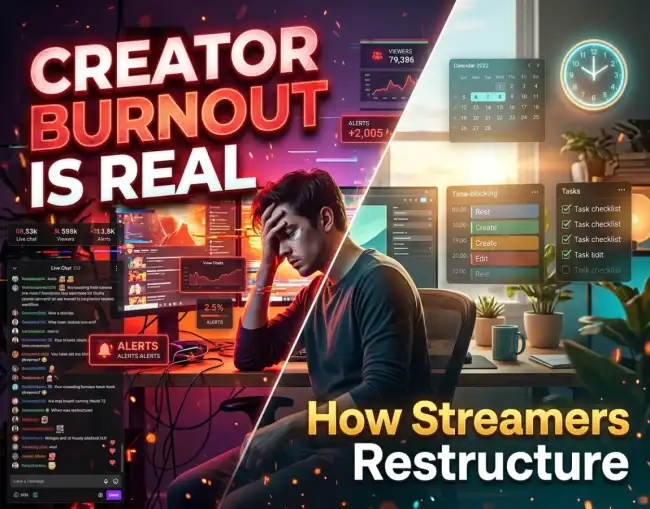
For millions of viewers worldwide, the life of a professional livestreamer appears to be an effortless cycle of playing video games, chatting with a supportive community, and collecting monetization milestones from the comfort of a home studio. Yet behind the glowing rings, dual-PC setups, and cheerful emotes lies a silent, pervasive industry crisis. The modern digital economy demands an unrelenting cadence of content creation, where algorithmic algorithms punish rest and reward chronic overwork. As a result, creator burnout has metastasized from an occasional occupational hazard into an existential threat facing the streaming ecosystem, forcing industry pioneers to fundamentally rethink how they operate.
The contemporary media landscape has evolved past the days of spontaneous, unstructured broadcasting. Today’s top-tier streamers operate as full-scale media enterprises, managing sponsor relations, cross-platform video editing, community moderation, and live performance simultaneously. This hyper-commercialization has compressed personal boundaries, turning human beings into 24/7 content delivery systems. When the camera is always on, the mind is never off. The physiological and psychological toll of this constant exposure manifests as chronic fatigue, emotional detachment, anxiety, and severe creative block—symptoms that directly jeopardize both personal well-being and long-term career viability.
Addressing this crisis requires more than just taking an occasional weekend off; it demands a radical, architectural overhaul of daily operations. Navigating the intersection of career longevity and psychological preservation involves prioritizing mental health for influencers through rigorous workflow optimization. By treating content creation as an industrial process that requires safety margins, automated redundancies, and strict capacity planning, digital creators can protect their cognitive resources while maintaining robust audience engagement. In this comprehensive guide, we will deconstruct the mechanics of streamer burnout, explore actionable restructuring blueprints, and examine how industry leaders are reclaiming their lives without sacrificing their empires.
Understanding the Anatomy of Creator Burnout
The Physiological and Psychological Toll of Constant Performance
To dismantle burnout, one must first understand its biological and psychological drivers. Streaming is an intensely performative medium that requires high-arousal social engagement for hours on end. Unlike traditional actors who get breaks between scenes, or office workers who can turn off their cameras during internal debates, live streamers are subjected to an unblinking, collective gaze. This sustained hyper-vigilance keeps the autonomic nervous system locked in a perpetual fight-or-flight response, flooding the body with cortisol and adrenaline.
Over time, this biochemical overload degrades cognitive function, disrupts sleep architecture, and impairs emotional regulation. Streamers often experience depersonalization—feeling like a spectator watching an avatar perform on screen rather than living an authentic life. Recognizing these early warning signs is critical before they cascade into clinical depression or forced, permanent retirement from the digital space. Safeguarding mental health requires establishing clinical boundaries between the public persona and the private self.
The Algorithmic Trap and the Fear of Irrelevance
Compounding the psychological pressure is the relentless tyranny of recommendation engines. Platforms like Twitch, YouTube, and TikTok operate on algorithms that heavily favor frequency, consistency, and session length. Creators internalize a deeply ingrained fear: taking a week off means algorithmic burial. This scarcity mindset drives creators to push past biological limits, trading health for view counts. The industry must recognize that algorithmic sustainability cannot be built on the exploitation of human biology.
Furthermore, financial precarity amplifies this anxiety. Because monetization models fluctuate wildly based on ad rates, subscription renewals, and volatile sponsorship pipelines, many streamers feel they cannot afford to slow down. Diversifying revenue streams and building financial safety nets are therefore not just business strategies; they are essential mental health interventions. Creators who secure stable, predictable income are vastly better equipped to say no to grueling schedules and yes to necessary rest.
The Blurring Lines Between Community and Invasion of Privacy
Community building is the lifeblood of modern streaming, fostering deep parasocial relationships that drive loyalty and financial support. However, these same parasocial bonds frequently morph into boundary violations. When viewers feel they "know" a creator intimately, expectations escalate. Fans demand access to the streamer's personal life, opinions, and constant availability across Discord, Twitter/X, and Instagram.
This lack of spatial and temporal separation prevents creators from ever truly decompressing. Every public outing, quiet dinner, or family moment carries the latent anxiety of being recorded or scrutinized. Restructuring workflows must therefore include rigorous community management protocols, clear behavioral boundaries, and the strategic deployment of moderation teams to shield creators from emotional exhaustion.
The Workflow Optimization Framework for Streamers
Batching Content Production to Eliminate Context Switching
One of the primary friction points causing mental fatigue is constant context switching—jumping from brainstorming thumbnail ideas to editing a YouTube video, then switching to live chat moderation, and finally preparing for a six-hour live broadcast. Human brains expend significant cognitive energy shifting between disparate tasks. Top creators combat this by implementing rigorous content batching methodologies.
Batching involves grouping similar tasks into dedicated time blocks. For instance, a creator might dedicate every Tuesday entirely to recording YouTube essays, Thursday mornings to sponsor meetings and administrative emails, and specific evenings to live broadcasting. By eliminating the mental friction of switching gears multiple times a day, creators drastically reduce cognitive load and increase creative output while working fewer total hours.
Implementing Modular Stream Formats and Asset Libraries
Improvisational streaming for eight hours straight is a recipe for rapid exhaustion. Successful workflow restructuring relies heavily on modular stream design. Creators divide their broadcasts into predictable, repeatable segments—such as an opening community check-in, a core gameplay or discussion block, and a structured wind-down Q&A—using pre-designed templates, transitions, and automated alert packages.
Additionally, building a comprehensive asset library—including pre-edited intros, reusable overlays, and automated chat bots—minimizes real-time decision fatigue. When technical execution runs on autopilot, the creator’s mental bandwidth can be preserved entirely for authentic audience interaction and creative performance, rather than wrestling with software bugs or layout adjustments.
Leveraging Automation and Strategic Delegation
No successful enterprise is built by a single individual operating in total isolation. Many burnout sufferers fall into the "solopreneur trap," believing they must control every pixel and line of code associated with their brand. Scaling a streaming career requires systematic delegation and the integration of advanced software automation.
From utilizing AI-driven clipping tools that automatically extract highlight moments from long-form VODs to hiring freelance thumbnail designers and dedicated Discord moderators, offloading operational friction is paramount. As creators scale their operations and negotiate complex commercial partnerships, ensuring legal and structural protections is equally vital; many leverage comprehensive resources like The Ultimate 2025 Creator Contract Checklist: Protecting Your IP and Profits to secure their intellectual property without drowning in administrative legalese.
Redefining Work-Life Boundaries in the Digital Age
Establishing Uncompromising Offline Hours
True workflow optimization extends far beyond the studio door; it governs how a creator lives their entire life. Establishing unshakeable offline hours is non-negotiable for long-term survival. This means setting hard stops for streaming sessions, silencing work-related notifications on personal devices, and carving out sacred spaces where technology is strictly prohibited.
Family dinners, morning walks without smartphones, and offline hobbies act as essential psychological buffers. These activities remind the brain that identity exists independently of metrics, viewer counts, and subscriber milestones. When creators cultivate a rich inner life away from the screen, their resilience against online criticism and algorithmic turbulence multiplies exponentially.
Communicating Transparently with Communities About Capacity
Audiences often react negatively to sudden disappearances, which can trigger anxiety for the creator upon their return. The antidote to this friction is radical, proactive transparency. Top streamers have found immense success by openly discussing their energy levels, capacity limits, and scheduled breaks with their communities.
By framing time off not as an abandonment of the audience, but as a necessary maintenance period to ensure higher-quality future broadcasts, creators cultivate a mature, empathetic fanbase. Communities that feel respected through honest communication are far more likely to support their favorite creators through scheduled hiatuses and mental health sabbaticals.
Designing Physical Workspaces That Promote Ergonomic and Mental Well-being
The physical environment plays a profound role in psychological endurance. Many streamers spend upwards of ten hours a day confined to a single chair in a windowless room illuminated only by RGB lighting and monitor glare. This sensory-deprived, sedentary setup accelerates both physical degradation and mental fatigue.
Optimizing the physical workspace involves investing in sit-stand desks, ergonomic seating, proper ambient lighting that mimics natural circadian rhythms, and acoustic treatment that reduces low-grade auditory stress. Furthermore, incorporating designated "chill zones" away from the streaming rig encourages micro-breaks during long production days, keeping the body and mind limber.
Diversification, Monetization, and Financial Resilience
Shifting Away from Hourly Dependence via VOD and Asynchronous Content
The most exhausting aspect of live streaming is its synchronous nature: if you aren't live, you aren't earning. This creates an unhealthy compulsion to stream even when sick, tired, or creatively bankrupt. Restructuring a career requires building asynchronous content engines—such as pre-recorded YouTube videos, serialized podcasts, and digital courses—that generate revenue around the clock.
Asynchronous content decouples income from physical presence. A well-optimized evergreen video can acquire views and ad revenue for years, funding the creator's lifestyle while they rest. This financial cushion allows live streams to transform from desperate daily grinds into joyful, occasional community touchpoints.
Exploring Collaborative Ecosystems and Shared Ventures
Isolation breeds burnout. Collaborating with peers not only injects fresh creative energy into broadcasts but also distributes the audience acquisition burden. Co-streaming, podcast roundtables, and joint brand ventures allow creators to pool their resources and reach new demographics with half the individual effort.
Moreover, collaborative frameworks extend into commercial ventures, such as multi-creator merchandising lines or coordinated live events. When creators band together, they build robust professional support networks that can advocate for better industry standards and platform policies.
Navigating Brand Partnerships Without Compromising Creative Freedom
Sponsorships are essential for revenue diversification, but poorly managed brand deals can introduce immense stress. Creators often find themselves buried in endless revision rounds, rigid compliance metrics, and misaligned product promotions that alienate their audiences. Protecting workflow integrity requires establishing clear brand vetting protocols.
Top streamers establish comprehensive media kits and rate cards that dictate clear boundaries, turnaround times, and creative control clauses. By working exclusively with brands that respect their artistic vision and scheduling limits, creators turn sponsorships into sustainable revenue streams rather than sources of acute performance anxiety.
Real-World Case Studies & Scenarios
Case Study A: The Collapse and Rebuild of Streamer "ApexPixel"
Marcus, known online as ApexPixel, was a variety streamer who built a thriving channel by broadcasting 35 hours a week across seven days, supplemented by daily TikTok clips and rigorous Discord management. Within two years, Marcus hit a catastrophic wall: severe clinical burnout, debilitating carpal tunnel syndrome, and complete creative apathy. He attempted to push through with energy drinks and sheer willpower, resulting in an on-stream panic attack that forced an indefinite hiatus.
During his four-month forced retirement, Marcus completely restructured his enterprise. He cut his live streaming schedule down to three days a week for four hours per session. He hired a part-time editor to manage his VOD repurposing pipeline and established strict off-hours boundaries. Upon his return, while his live concurrent viewer count initially dipped slightly, his net revenue actually increased by 40% due to reduced operational overhead, optimized sponsorship rates, and sustainable monetization from his automated YouTube channel. Most importantly, Marcus regained his passion for the craft.
Case Study B: Scaling Sustainable Growth Through Strategic Collaboration
Elena managed a mid-tier lifestyle and gaming channel, constantly struggling to balance live streaming with brand campaign fulfillment. Recognizing the early symptoms of burnout—chronic insomnia and irritability—she avoided collapse by pivoting her business model. Instead of shouldering the entire content burden alone, she partnered with three fellow creators to launch a collaborative streaming collective.
By rotating hosting duties, sharing production staff, and pooling marketing efforts, Elena reduced her individual broadcast hours by 50% while expanding her total audience reach. Her story mirrors broader industry shifts where digital leaders leverage collective models—much like those seen in TikTok Shop Secrets: How Collaborative Livestreams Are Rewriting E-Commerce—to maximize impact while preserving individual mental health and creative longevity.
Critical Mistakes to Avoid When Restructuring Your Workflow
- Making Abrupt, Unannounced Schedule Changes: Dropping your streaming hours from 40 hours a week to zero overnight without communicating with your community causes panic and viewer attrition. Always phase schedule reductions gradually and explain the rationale transparently.
- Neglecting Financial Modeling Before Delegating: Hiring editors, moderators, and virtual assistants without auditing your cash flow can plunge your business into debt. Ensure your revenue diversification is stable before outsourcing operational tasks.
- Confusing Rest with Isolation: True psychological recovery requires active social connection, physical movement, and engaging offline hobbies—not simply sitting in a dark room scrolling social media feeds while pretending not to work.
- Ignoring Early Physiological Warning Signs: Pushing through chronic fatigue, repetitive strain injuries, or persistent anxiety with stimulants guarantees a catastrophic burnout crash. Treat bodily discomfort as an urgent system alert, not an inconvenience.
- Failing to Set Hard Boundaries with Sponsors: Accepting poorly defined, high-stress brand deals out of financial fear disrupts your entire workflow. Stand firm on creative control and realistic delivery timelines to protect your peace.
Comprehensive Workflow & Burnout Prevention Strategies
| Strategy Dimension | Traditional / Burnout Approach | Optimized / Sustainable Approach |
|---|---|---|
| Broadcasting Schedule | 6–7 days a week, 6+ hours per day with zero planning. | 3 structured days a week with modular, timed segments. |
| Content Production | Synchronous live streaming as the sole income source. | Omnichannel ecosystem mixing live, VOD, and evergreen assets. |
| Operational Support | Solopreneur mindset handling every technical and editorial task. | Strategic delegation and automation of clipping, moderation, and admin. |
| Community Management | 24/7 availability across Discord, DMs, and live chat. | Empowered moderation teams, clear behavioral guidelines, and offline hours. |
| Financial Management | Living hand-to-mouth on volatile ad revenue and ad-hoc tips. | Diversified revenue streams, brand vetting, and financial safety reserves. |
Frequently Asked Questions (FAQ)
How do I know if I am experiencing true creator burnout or just temporary creative fatigue?
Temporary creative fatigue usually resolves after a restful weekend or a short vacation, leaving you eager to return to your projects. True creator burnout, however, is a chronic state of physical and emotional exhaustion characterized by persistent dread, depersonalization, cynicism toward your audience, and a total inability to find joy in creation. If rest does not restore your enthusiasm and your body is exhibiting stress symptoms like insomnia or chronic headaches, you are likely experiencing clinical burnout requiring systemic restructuring.
Will cutting my streaming hours permanently kill my channel's algorithmic growth?
While algorithms favor consistency, consistency does not require infinite labor. Sudden drops can cause a temporary dip in viewership, but audiences and recommendation engines rapidly adapt to predictable, high-quality schedules. Creators who transition from frequent, low-energy broadcasts to fewer, higher-production-value streams consistently report healthier community retention, higher engagement rates, and sustainable long-term growth.
What is the best way to inform my community that I am taking a mental health break?
Honesty and clarity are your best tools. Post a concise, heartfelt update across your community tab, Discord, and social media channels explaining that you are taking a scheduled maintenance break to recharge your creative batteries. Frame the break positively—emphasizing that returning with renewed energy will result in much better streams for them—and provide an exact date for your return so fans feel secure.
How can I afford to delegate tasks if my streaming revenue is currently unstable?
Delegation does not have to start with expensive full-time hires. Begin by utilizing free or low-cost software automation tools for clipping and scheduling. As you identify specific administrative bottlenecks, consider trading skills with peer creators or hiring trustworthy community members on a part-time, project basis. Financial stability is built progressively through revenue diversification, not overnight expansion.
How do I establish boundaries with viewers who demand constant personal access?
Setting boundaries requires polite firmness and absolute consistency. Clearly communicate your availability hours in your channel panels and Discord rules. Use automated bots to filter out intrusive boundary-pushing inquiries, and never feel obligated to share intimate details of your personal life. Communities quickly learn to respect boundaries when they are enforced calmly and consistently without exception.
Strategic Roadmap & Final Takeaway
The streaming industry is maturing rapidly, transitioning from the wild-west era of unbridled, round-the-clock broadcasting into a sophisticated, professionalized media landscape. As platforms evolve and audience expectations shift, the traditional model of sacrificing personal health for algorithmic favor is no longer viable. Creator burnout is not a personal failure of willpower; it is a systemic design flaw that requires an intentional, architectural correction.
Looking ahead over the next two to five years, the most successful digital entrepreneurs will be those who master sustainable workflow optimization. By embracing content batching, diversifying asynchronous revenue streams, enforcing rigid offline boundaries, and leveraging strategic automation and collaboration, creators can build resilient empires that endure. Your career is a marathon, not a sprint. Protect your most valuable asset—yourself—and the creativity, community, and commercial success will naturally follow.
Be the first creator to share your take on this story.