
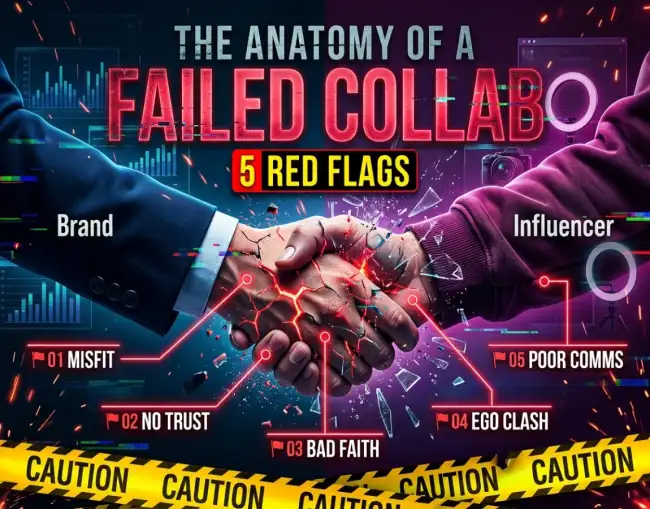
In the high-stakes arena of modern digital marketing, brand-creator partnerships represent both the fastest route to hyper-targeted cultural relevance and the most volatile flashpoint for enterprise reputational destruction. Over the past decade, influencer marketing has matured from an experimental line item into a global multi-billion-dollar discipline. Yet, despite enterprise-tier analytics, seven-figure talent retainers, and sophisticated creative agencies, catastrophic campaign failures continue to dominate industry headlines with alarming regularity. The difference between an asymmetric marketing win and a humiliating public relations disaster rarely hinges on creative whimsy; it hinges on whether brands identify systemic, detectable collaboration red flags before greenlighting deployment.
The cultural dynamics governing modern social platforms have fundamentally changed. Audiences are no longer passive consumers vulnerable to transparent brand placements disguised as organic endorsements. Today’s digital consumers possess unprecedented commercial literacy, immediate access to historical creator archives, and a collaborative appetite for deconstructing disingenuous brand alliances. When a campaign feels opportunistic, hypocritical, or tone-deaf, online communities do not simply scroll past—they mobilize. The speed of digital contagion transforms what was once an underperforming creative execution into a full-scale corporate crisis, eroding enterprise valuation, tanking organic engagement, and permanently scorching creator equity within hours.
This exhaustive post-mortem conducts a forensic investigation into the structural mechanics behind high-profile failed campaigns. By moving beyond superficial post-mortems and unpacking the psychological, legal, and operational vulnerabilities that doom brand partnerships, marketing executives, agency leads, and professional creators can uncover the definitive roadmap for diagnosing catastrophic risks long before the first asset goes live. True brand safety requires rigorous due diligence, uncompromising contract mechanics, and real-time crisis engineering.
Foundational Principles & Mechanics of Collaboration Catastrophes
Every partnership collapse is governed by an underlying structural failure rather than mere artistic misalignment. To understand why campaigns self-destruct, one must first dissect the fundamental mechanisms that govern audience trust, digital distribution, and institutional risk in modern media ecosystems.
The Parasocial Divergence Effect
The bedrock of influencer marketing is the parasocial relationship: the intense psychological bond of intimacy and perceived reciprocity established between creators and their followers. When a brand contracts a creator, it is not merely renting ad inventory; it is borrowing that accumulated parasocial equity. However, when an integration sharply violates the community’s shared moral baseline or thematic expectations, the phenomenon shifts into Parasocial Divergence. Followers perceive the integration as a betrayal of the digital covenant. Rather than projecting positive brand affinity, the audience directs latent resentment directly toward both the creator and the sponsoring brand, catalyzing swift, severe backlash.
Contextual Friction and Algorithmic Amplification
Modern discovery engines on TikTok, YouTube, and Instagram do not optimize for brand safety; they optimize exclusively for engagement velocity. Outrage generates exponential retention metrics compared to mild satisfaction. When an integration generates negative comments, quote tweets, and response videos, platform algorithms interpret this hostility as viral intrigue and accelerate the asset’s distribution to mainstream feeds. Without pre-established guardrails, this algorithm-driven loop rapidly drags niche creator controversies into broad consumer consciousness, ensuring that a simple influencer mistake escalates into a corporate reputational inferno.
Red Flag 1: The Audience Sentiment and Demographic Disconnect
The most pervasive error in modern talent acquisition is the blind worship of surface-level vanity metrics. Millions of followers and high baseline engagement rates frequently obscure catastrophic demographic mismatches, bot-skewed distributions, or deeply hostile audience sentiment profiles.
Vanity Metric Deception and Ghost Audiences
Enterprise media buyers frequently fall prey to aggregate follower numbers, failing to conduct granular audience auditing. A creator may boast two million subscribers, but an analytical dissection may reveal that 45% of those profiles reside outside the brand’s shipping regions, 30% are inactive or bot-generated accounts, and the remaining 25% skew significantly younger than the brand’s purchasing demographic. Furthermore, buying power cannot be inferred solely from view counts. When a luxury watchmaker commissions a lifestyle creator whose primary engagement originates from teenagers reacting to prank videos, conversion rates inevitably approach zero, signaling systemic mismanagement of the enterprise media budget.
Modern campaign architecture demands advanced forensic vetting. Brands must audit the creator's last ninety days of dynamic content, stripping out viral outliers to assess stable median performance. Engagement rates must be cross-referenced against historical bookmark rates, comment quality, and share velocities. If the comment section is dominated by generic emojis, automated engagement pods, or recurring accusations of paid shilling, the creator’s organic influence is functionally dead—regardless of what aggregate vanity metrics show.
Sentiment Incongruence and Hostile Engagement
A high engagement rate does not inherently represent a receptive audience. In many failed campaigns, creators who maintain above-average engagement metrics do so because their digital presence thrives on controversy, outrage-baiting, or antagonistic discourse. Deploying a family-oriented, risk-averse consumer packaged goods (CPG) brand into an ecosystem populated by hyper-critical, adversarial commenters virtually guarantees that the brand asset will be co-opted as collateral damage in an ongoing creator-audience war.
Pre-campaign sentiment analysis must move beyond basic positive-versus-negative natural language processing. Brands must quantify the creator’s reputational volatility score: how frequently their comment sections ignite into ideological skirmishes, whether their legacy sponsors experienced blowback, and how aggressively the creator engages with critical feedback. Partnering with talent whose audience displays a chronic disposition toward cynicism is the fastest route to an expensive commercial write-down.
Red Flag 2: Ideological & Value Incongruence (Performative Synergy)
Consumers have developed acute radar for brand hypocrisy. The modern marketing landscape is littered with campaigns that attempted to co-opt cultural movements, sustainability initiatives, or socio-political values by partnering with talent whose lifestyle, commercial history, or personal ethics directly contradicted the brand's stated campaign thesis.
The Fast-Fashion Eco-Warrior Paradox
Consider the disastrous dynamic when an enterprise fast-fashion brand, notoriously associated with supply chain waste and hyper-consumerism, retains a prominent eco-conscious activist to headline a "sustainable collection" launch. The fallout is instantaneous and bidirectional. The creator’s community correctly labels the move as greenwashing and commercial co-optation, eviscerating the influencer's hard-won authenticity. Concurrently, the brand faces immediate investigation from environmental journalists and watchdog agencies who dissect the tokenistic nature of the capsule line.
This dynamic was critically highlighted during several misguided sustainable fashion showcases where fast-fashion giants sent mega-influencers to showcase so-called "ethical factories." The resulting digital blowback demonstrated that audiences will unearth public records, trade filings, and historical creator declarations to challenge corporate narratives. For campaigns operating at the intersection of corporate activism and public trust, such as those analyzed in our deep dive into Beyond the Post: How Digital Humanitarians Are Mobilizing Millions for Global Relief, authenticity is not a creative angle—it is a functional prerequisite. When structural integrity is absent, the campaign collapses into reputational liabilities.
Cultural Appropriation vs. Authentic Representation
Equally lethal is the strategic deployment of creators into cultural or demographic spheres where they have no authentic connection, lived experience, or community standing. Brands that force corporate-mandated multicultural initiatives through talent who possess no organic lineage within that community routinely trigger charges of opportunistic exploitation. True integration demands that the creator possess unassailable credibility within that specific cultural niche before any commercial transaction is initiated.
Red Flag 3: The Extremes of Creative Governance (Dictatorship vs. Anarchy)
The operational tension between brand oversight and creator autonomy is the central battlefield of influencer marketing. Campaign disasters almost invariably manifest at the polarized extremes of this dynamic: either suffocating micro-management that produces corporate propaganda, or total absence of oversight that leads to public brand safety breaches.
The Sterile Corporate Script: Killing Conversion
When legal and corporate affairs teams sanitize creator briefs to the point where the influencer is forced to recite corporate press releases verbatim, the campaign fails instantly. Creators have cultivated an intuitive, highly refined cadence with their audience. When a casual, dynamic YouTuber suddenly sits motionless before an unnaturally lit set, reading uncharacteristic clinical ad copy with hyper-specific compliance language, audience retention plunges.
The resulting content is uncanny and off-putting. The creator’s organic audience skips the segment immediately, the algorithm penalizes the video for sudden drops in average watch time, and the brand’s return on ad spend (ROAS) collapses. Over-regulated, clinical campaigns are just as catastrophic from an ROI standpoint as public relations scandals are from a brand equity standpoint.
Unchecked Creative Liberty and Brand Safety Breaches
The opposite extreme is equally dangerous: handing six-figure checks to unpredictable creators with no guardrails, no mandatory pre-approval workflows, and no clear negative guidelines. Digital marketing history is crowded with beverage, gaming, and consumer tech brands that allowed controversial creators to "do what they do best," only to watch the talent casually integrate the product alongside hate speech, dangerous physical stunts, or insensitive humor.
Brand safety is not an organic byproduct of good intentions; it is an engineered operational reality. Campaigns require a standardized tier of non-negotiable boundaries, distinct from the creative hook. Creators must understand the non-negotiables: prohibited topics, visual brand standards, and clear regulatory mandates (such as FTC disclosure requirements). They must retain total creative liberty over narrative cadence, aesthetic framing, and conversational hooks. Stripping away narrative freedom produces dead ad spend; stripping away brand guardrails produces existential corporate risk.
Red Flag 4: Flawed Contractual Governance & Inadequate Risk Buffers
When a campaign detonates, the contract determines whether the brand absorbs a total loss or successfully enforces recovery. A shocking percentage of multi-million-dollar influencer agreements still rely on outdated legal templates designed for legacy print models, leaving brands dangerously vulnerable to modern influencer mistakes and regulatory sanctions.
The Illusion of Safety in Outdated Boilerplates
Legacy agreements frequently omit critical clauses governing conduct, real-time crisis scenarios, exclusivity parameters, and content scrubbing protocols. If an ambassador is arrested for criminal conduct or exposed in an investigative report for orchestrating crypto pump-and-dump schemes, does the brand have the unilateral right to terminate the relationship immediately, recoup fees, and compel the immediate deletion of co-branded assets? In contracts missing comprehensive, contemporary language, the answer is often no.
To avoid finding your organization trapped in litigation while an active partner faces public outrage, legal teams must implement the robust frameworks outlined in The Ultimate 2025 Creator Contract Checklist: Protecting Your IP and Profits. Integrating modern morality clauses, definitive clawback mechanisms, and precise usage rights protection is standard enterprise due diligence.
"A contract should never be treated as a procedural formality in influencer marketing. It is your only operational defense against systemic reputation contagion when an external talent partner loses control of their public narrative."
FTC Non-Compliance and Regulatory Exposure
Inadvertent or willful non-compliance with the Federal Trade Commission's disclosure guidelines remains a rampant source of campaign self-destruction. The FTC has repeatedly demonstrated that relying on obscure tags like #sp or burying #ad beneath lines of truncated captions is legally unacceptable. Regulatory bodies hold both the brand and the individual creator strictly liable for deceptive advertising practices.
When an agency allows talent to push stealth ads, the short-term conversion boost is heavily outweighed by the subsequent threat of millions in regulatory fines, brand equity degradation, and mandatory corporate auditing. Contracts must legally mandate precise, standardized, platform-approved disclosure methods (such as native platform paid-partnership banners alongside unambiguous spoken disclosures) prior to asset release.
Red Flag 5: The Fragile Single-Channel Echo Chamber & Live Selling Disasters
Modern campaigns fail when enterprise teams concentrate capital into hyper-concentrated live events or high-risk single-channel environments without testing the dynamic infrastructure under real-world operating conditions.
The High-Stakes Live Commerce Pitfall
The rapid emergence of real-time social commerce has introduced extraordinary volatility to brand execution. When brands enter live shopping without rigorous logistical stress-testing, real-time chat moderation, and broadcast media training for creators, minor errors instantly escalate into viral disasters.
Consider the logistical breakdowns in unvetted live selling environments: supply chain integrations fail, inventory numbers glitch, or unvetted hosts make unsubstantiated medical claims or unscripted slurs on an uneditable, real-time broadcast. As analyzed in our field report on TikTok Shop Secrets: How Collaborative Livestreams Are Rewriting E-Commerce, live collaborative environments demand ironclad operational execution. Without sub-second inventory sync, zero-latency customer support, and sophisticated digital moderation filters running continuously during the stream, live shopping campaigns can backfire, driving chargebacks, platform penalties, and long-tail brand mockery.
Channel Diversification and Crisis Buffers
Failing to plan for platform-specific algorithmic changes is an equally costly strategic oversight. Building an entire multi-month initiative around a single creator on a single channel leaves the entire campaign budget vulnerable to shadowbanning, algorithmic throttling, or sudden channel demonetization. Modern campaigns require omni-channel distribution architectures that insulate the core media spend against single-point delivery failures.
Comprehensive Strategy Comparison: High-Risk vs. Enterprise-Grade Vetting
To systematically insulate brand capital from catastrophic influencer mistakes, enterprise teams must overhaul legacy vetting frameworks. The following matrix illustrates the operational differences between fragile, legacy influencer buying methods and resilient, institutional-grade campaign execution.
| Strategic Dimension | Fragile Legacy Methodology | Institutional Enterprise Blueprint |
|---|---|---|
| Talent Discovery | Raw follower counts, superficial PR agency suggestions, unverified media kits. | Algorithmic deep-crawling, multi-year sentiment tracking, audience demographic authentication. |
| Audience Due Diligence | Aggregate monthly views, surface-level engagement percentages (likes/followers). | Bot-farm elimination, audience purchasing power verification, dynamic comment-to-share ratio analysis. |
| Contractual Protection | Generic MSA boilerplates, vague standard termination clauses, zero clawback structures. | Dynamic reverse-morality clauses, verified FTC compliance triggers, automated escrow fee payouts. |
| Creative Direction | Absolute dictatorial scripts or uncontrolled creative freedom. | Rigid "sandbox" parameters: clear negative safety boundaries paired with narrative autonomy. |
| Crisis Infrastructure | Reactive damage control, panicky post-deletion, delayed executive PR statements. | Pre-drafted scenario playbooks, automated content-freeze protocols, 24/7 dark-site readiness. |
| Performance Verification | Self-reported creator screenshots, aggregate coupon code usage. | Server-side API tracking, closed-loop conversion attribution, cohort-level brand sentiment lift studies. |
5 Costly Influencer Mistakes and Exact Countermeasures
Understanding abstract red flags is insufficient; digital leaders must enforce exact operational countermeasures across their campaign design pipeline. Here are the five most damaging operational mistakes practitioners routinely make, along with actionable remedies.
1. Omitting Historical Digital Forensics
The Mistake: Brands routinely sign trending creators based purely on their recent six-month trajectory, neglecting their historical footprint. When the creator gains mainstream exposure, internet users excavate offensive blog posts, racist humor, or discriminatory videos from seven years prior, dragging the brand into historical controversies.
The Countermeasure: Retain professional third-party digital forensic auditing services. Before any enterprise contract is drafted, ingest the creator's full public archive—including deleted tweets accessible via the Wayback Machine, archived livestreams, and historical collaborative appearances—through automated text and audio transcription engines. Any unaddressed historical liability must be uncovered, contextualized, and resolved before contract execution.
2. The Lack of Real-Time Crisis Escrow Clauses
The Mistake: Paying creators 100% of their upfront integration fee prior to delivery or immediately upon posting. If a catastrophic incident unfolds forty-eight hours post-launch, the brand has zero financial leverage to recoup costs.
The Countermeasure: Restructure talent compensation into milestone-gated escrow schedules. Disburse a 30% production retainer, 30% upon verified, compliant publication, and the remaining 40% contingent upon passing a thirty-day post-publication brand safety audit. If a severe morality clause violation occurs during the thirty-day post-launch window, the remaining funds are retained and clawback provisions for previous disbursements trigger immediately.
3. Allowing Hidden Whitelisting Without Safeguards
The Mistake: Gaining access to creator accounts to run paid ads (whitelisting/Spark Ads) without explicit caps on spend or duration. If public backlash strikes the creator organically, automated algorithmic ad spend can pump millions of impressions into a hostile, brand-damaging comment environment.
The Countermeasure: Implement strict circuit-breaker configurations within your Meta Business Manager and TikTok Ads Manager environments. Establish programmatic rules that automatically pause all paid creator licensing ads if the asset's negative comment frequency surges past an acceptable threshold (e.g., more than 15% negative sentiment across a rolling two-hour window).
4. Equating Fame With Authentic Product Adoption
The Mistake: Hiring high-tier celebrity influencers to promote complex products they clearly do not use, understand, or believe in. The resulting creative delivery highlights their technical illiteracy and alienates actual power users.
The Countermeasure: Require mandatory product immersion and onboarding periods before executing formal creative agreements. Send product samples, software access, and engineering resources thirty days in advance. If the talent cannot organically articulate the product's core value proposition without referencing an ad script, discontinue the partnership before production starts.
5. Unmanaged Negative Contagion in Comment Sections
The Mistake: Treating comment feeds on sponsored posts as an unmonitored bulletin board. When trolls, bots, or aggrieved consumers launch coordinated attacks, brands often panic and silence comments completely, which only amplifies accusations of censorship.
The Countermeasure: Deploy sophisticated community moderation protocols. Establish pre-cleared reply trees for customer service friction points. Use real-time semantic moderation tools to hide defamatory slurs and targeted spam, while intentionally preserving valid, civil criticism. Responding to thoughtful critiques with transparent, human, corporate ownership often defuses early brand crises before they snowball.
Frequently Asked Questions (FAQ)
What constitutes a legally enforceable morality clause in modern creator agreements?
A legally enforceable morality clause must be precise, objective, and clearly defined. Ambiguous phrases like "actions that bring disrespect to the company" are frequently challenged in arbitration. Effective clauses explicitly detail specific disqualifying actions: criminal charges, confirmed civil fraud, public use of hate speech, proven intellectual property theft, or significant violations of agreed-upon community values.
Additionally, modern clauses should feature reciprocal provisions that address both digital behavior and offline actions. They must establish the standard of evidence required to trigger the clause (such as verifiable audio, video, or verified platform reporting) and clearly outline the financial remedies: immediate contract termination, forfeiture of pending payments, and clear timelines for scrubbing co-branded media assets from distribution networks.
How should a brand respond within the first four hours of a collaboration crisis?
The first four hours are the golden window of crisis mitigation. Step one is executing an immediate content freeze: pause all paid amplification, affiliate promotions, and scheduled cross-platform posts linked to the creator. Do not immediately issue a generic, panicky public statement, as premature corporate communications frequently worsen the situation by revealing internal confusion.
Step two: convene your cross-functional crisis council (legal, public relations, social media, and executive leadership) to evaluate the situation against your pre-drafted risk playbook. Determine whether the controversy is an authentic corporate threat or a transient, bad-faith internet flare-up. Step three: if the crisis threatens core business operations, issue a clear, concise statement taking structural ownership, outlining concrete steps being taken, and detailing how the partnership is being managed moving forward.
Can a failed influencer campaign be redeemed, or is complete cancellation always required?
Total cancellation is not the only viable outcome. If the failure stems from a non-malicious creative misstep, technical friction, or honest ignorance rather than intentional deceit, hate speech, or criminal negligence, campaigns can often be saved through strategic transparency. Audiences frequently respect creators and brands that openly admit errors, correct their messaging, and take actionable steps to fix problems.
However, if the failure exposes fundamental corporate hypocrisy, structural deception, or severe moral misconduct, trying to force-salvage the campaign simply extends the crisis lifecycle. In these high-severity scenarios, a swift, clean severance of the partnership, accompanied by complete financial dissociation and an audit of your talent vetting pipeline, remains the only viable path to protecting brand equity.
What software stack is required to identify collaboration red flags before contracting talent?
An enterprise-grade influencer intelligence stack must combine multiple analytics platforms. Relying on any single data provider leaves blind spots. You need enterprise intelligence tools to analyze audience authenticity, track demographic distributions, and flag automated engagement patterns across global talent pools.
You also need social listening engines that run ongoing natural language processing and semantic sentiment scoring across historical commentary feeds. Finally, this infrastructure should be paired with deep-web forensic scrapers to review historical web archives, ensuring your due diligence uncovers red flags across all public platforms, not just active channels.
How can creators protect their personal brand when an enterprise sponsor faces a PR disaster?
Creators face brand safety risks from sponsors just as brands do from talent. Creators must conduct due diligence on their corporate partners before executing campaigns. Investigate the brand's regulatory history, supply chain practices, executive controversies, and legacy marketing activations to ensure alignment with your personal platform.
Contractually, creators must insist on reverse-morality clauses. If the sponsoring brand experiences a major public crisis, commits corporate malfeasance, or takes public stances that compromise the creator’s community standing, the creator must have the contractual right to terminate the partnership immediately, keep all paid retainers, and publicly distance their brand from the company.
Strategic Roadmap & The Future of Collaboration Safety (2025–2028)
The next era of influencer marketing will be defined by algorithmic transparency, real-time risk intelligence, and automated compliance. As artificial intelligence fundamentally reshapes the media landscape, the legacy models of talent matchmaking and brand safety are evolving rapidly.
Between 2025 and 2028, leading global brands will abandon manual spreadsheet tracking and disconnected influencer workflows in favor of end-to-end, real-time brand governance platforms. Predictive risk modeling algorithms will continuously assess talent networks, dynamically updating partner risk scores based on real-time shifts in comment sentiment, third-party network mentions, and cross-platform activity. Smart contracts powered by programmatic escrow architectures will automatically manage compliance, executing disbursements only when third-party verification engines confirm asset integrity, FTC disclosure requirements, and baseline engagement benchmarks.
Ultimately, preventing high-profile campaign failures is not about eliminating creative risks. The most impactful marketing will always carry a degree of cultural tension. Rather, true collaboration maturity is about identifying and eliminating structural vulnerabilities: the lazy vetting, deceptive vanity metrics, missing contractual protections, and ideological mismatches that turn manageable challenges into public relations catastrophes. By approaching every collaboration with investigative discipline, uncompromising governance, and operational resilience, digital leaders can consistently drive high-impact campaigns that protect brand safety, safeguard creator equity, and generate sustainable long-term enterprise value.
Be the first creator to share your take on this story.