
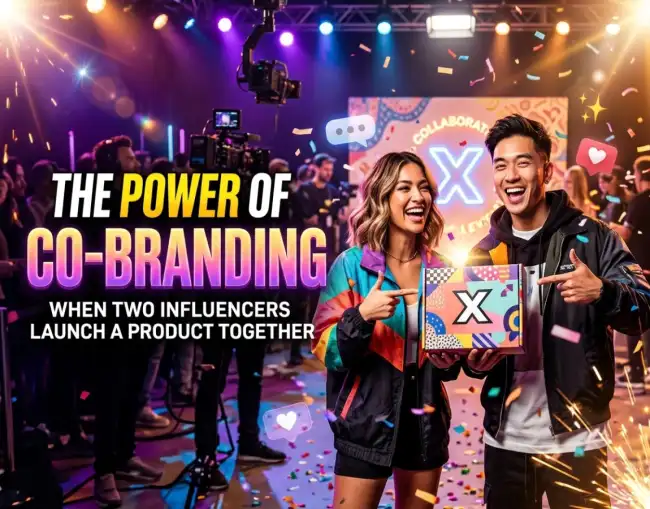
For the past decade, the standard monetization arc for high-profile digital creators followed an almost dogmatic trajectory: secure brand sponsorships, monetize platform ad revenue, and eventually launch a proprietary direct-to-consumer (DTC) line—typically standard merchandise, private-labeled cosmetics, or white-labeled fitness gear. However, the creator economy has matured into an intensely competitive marketplace where audience attention is fragmented and consumer skepticism toward single-creator cash grabs sits at an all-time high. The solo influencer product launch is increasingly plagued by escalating customer acquisition costs (CAC), logistics nightmares, and audience exhaustion. In response to these headwinds, the frontier of creator commerce has pivoted toward a dramatically more resilient, high-yield structure: peer-to-peer co-branding.
When two autonomous digital influencers pool their cultural capital, intellectual property (IP), and operational resources to co-found, co-design, and co-market a physical or digital product, they unlock structural advantages that traditional single-influencer brands cannot replicate. This is not simply cross-promoting an affiliate link or staging an ephemeral social media appearance. Rather, it represents the formation of a dual-engine joint venture—a sophisticated business architecture where two distinct digital communities converge around a single, highly differentiated value proposition. By unifying disparate niche ecosystems, co-branded influencer ventures slash customer acquisition costs to near-zero, insulate against algorithmic volatility, and forge a level of social proof that neither creator could command in isolation.
Understanding the true power of creator-to-creator co-branding demands a rigorous examination of strategic partner evaluation, audience topology, joint legal governance, supply chain orchestration, and omnichannel go-to-market execution. As traditional consumer packaged goods (CPG) giants look on with mounting anxiety, agile creators are discovering that their greatest asset is not just their audience size, but their capacity to execute high-impact horizontal integration with fellow industry disruptors. This article unpacks the underlying mechanics, empirical models, and execution frameworks that dictate whether an influencer joint venture becomes a viral multi-million-dollar empire or an operational disaster.
Foundational Principles & Mechanics of Influencer Joint Ventures
At its core, a creator joint venture is a commercial alliance wherein two or more sovereign creators commit proprietary equity, creative direction, distribution power, and brand identity to launch a shared commercial enterprise. Unlike conventional brand ambassadorships—where a creator functions merely as an outsourced distribution channel for an established corporation—a co-branded peer launch is characterized by mutual skin in the game. Both parties bear financial, reputational, and operational risk, and both share directly in enterprise value creation, top-line revenues, and terminal equity upside.
The operational mechanics of these partnerships hinge on four fundamental market dynamics:
- Asymmetric Audience Intersection: The ideal co-branded partnership relies on an audience Venn diagram characterized by high demographic alignment but low direct content redundancy. If Creator A and Creator B share an 85% audience overlap, the collaborative product launch yields diminishing returns, merely cannibalizing the same consumer base. Conversely, if two creators share complementary lifestyle values with only a 15% to 25% direct overlap, the launch generates an aggressive mutual acquisition flywheel, cross-pollinating both communities instantaneously.
- Complementary Skill Distribution: High-performing influencer partnerships balance production competencies. One creator typically possesses deep technical domain expertise (e.g., cosmetic formulation, software development, physical manufacturing, culinary technique), while the other excels in cinematic storytelling, community mobilization, or viral distribution.
- Consolidated Social Proof: When a consumer sees an endorsement from one influencer, they perceive an ad; when they see two independent influencers they trust actively co-creating and investing in a physical artifact, the endorsement transcends advertising and becomes an organic cultural movement.
- Capital and Operational Efficiency: Pooling initial working capital, shared retainers for external counsel, freight costs, and inventory financing immediately halves the financial exposure born by each party while effectively doubling the initial addressable market at launch.
To successfully execute this model, creators must shift their mindset from "content monetization" to "enterprise infrastructure." A co-branded launch is not an extended media campaign; it is the establishment of a modern commercial vehicle that happens to leverage social distribution as its unfair competitive advantage.
Phase 1: Strategic Partner Selection & Audience Matrix Mapping
Audience Overlap Auditing and Psychographic Alignment
The genesis of a successful joint venture begins long before product formulation, legal paperwork, or product design. It demands an exhaustive audit of audience topology. Relying on superficial vanity metrics—such as combined follower count or average view counts—is an infallible path to failure. Sophisticated practitioners deploy advanced audience intelligence tools (such as SparkToro, Modash, and bespoke First-Party Data exports) to calculate the precise audience affinity, geographical concentration, and income distribution across both channels.
The goal is to pinpoint the exact psychographic intersection that unites both followings. For instance, pairing a technical fitness creator specializing in powerlifting with an investigative wellness creator who deconstructs ingredient quality creates an immediate thematic bridge: high-performance, clean-label sports nutrition. Understanding this dynamic is especially critical when examining how authoritative creators translate influence into enterprise value, a phenomenon analyzed extensively in The Rise of Edu-Creators: How Academic Experts Are Taking Over Social Media. When academic rigor or domain expertise meets charismatic, entertainment-driven distribution, the resulting commercial entity commands unparalleled trust and industry pricing power.
Reputational Due Diligence and Brand Safety Matrix
In a single-creator enterprise, your brand equity is tied entirely to your personal conduct. In a co-branded venture, your enterprise equity is irrevocably tied to your partner’s past, present, and future behavior. Because a joint venture fundamentally fuses the public reputations of both influencers, rigorous reputational due diligence is mandatory. This process entails an unsparing historical audit of your potential partner's archived content, historical brand deals, digital footprint, personal litigations, and regulatory compliance track records (such as past FTC disclosure compliance).
Furthermore, both creators must design a "Reputational Code of Conduct" that governs commercial and public behavior for the duration of the joint venture. If one partner becomes embroiled in a catastrophic brand crisis, does the surviving partner have an unencumbered buyout option? Does the partnership agreement mandate a morality clause that automatically forfeits voting rights or liquidates shares at fair market value? Answering these questions upfront separates professional commercial operations from amateurish social media pacts.
Phase 2: Product Ideation & Operational Architecture
Market Gap Analysis and Iterative Co-Design
A fatal mistake in influencer co-branding is selecting an off-the-shelf white-label product and slapping a joint logo on the package. Modern consumers recognize private-label repackaging instantaneously, and the backlash is swift and unforgiving. The co-branded product must solve an authentic, deeply felt consumer pain point that neither creator’s current sponsors are adequately addressing. The development phase should function as an open-loop collaboration, actively incorporating user feedback from both communities to achieve unmistakable product-market fit.
This community-led development philosophy mirrors the most resilient commercial playbooks in digital commerce. By studying how pioneering consumer brands leverage organic advocacy—such as the methodologies detailed in Inside Glossier’s Playbook: How Community-Led Growth Built a Beauty Empire—influencer partners can transform passive followers into active co-designers. Conducting private discord focus groups, blind taste-testing videos, or iterative community surveys converts the product development process itself into captivating, high-converting top-of-funnel content.
"When two creators co-develop a physical SKU, the manufacturing journey is not proprietary back-office work; it is the primary narrative asset. Documenting the supply chain failures, formula adjustments, and mutual design compromises transforms a simple commercial product into an emotional investment for both audiences."
Supply Chain, Sourcing, and Working Capital Allocation
Logistical and operational execution is where high-profile creator projects face their greatest stress tests. Designing a digital mock-up is trivial; managing tier-one international supply chains, securing minimum order quantities (MOQs), navigating customs tariffs, and securing bonded warehouse fulfillment is exceptionally complex. In an influencer joint venture, creators must decide whether to build their own end-to-end supply chain or partner with a specialized, creator-focused venture studio (such as Night Ventures, Pietra, or Creator CPG).
Working capital requirements must be clearly modeled 6 to 12 months out. Joint ventures require upfront capital allocations for raw materials, laboratory testing, regulatory clearances, structural tooling, and packaging manufacturing. The partners must mathematically model lead times, establishing minimum cash reserve thresholds to fund inventory reorders before initial drop cash-flows are realized, thereby avoiding crippling stockouts that extinguish hard-earned promotional momentum.
Phase 3: Legal Structuring, Governance, and Cap Table Design
Corporate Entity Selection: SPV vs. Joint Venture LLC
Operating a co-branded venture through informal split payments, simple Stripe integrations, or basic vendor agreements is legal negligence. A co-branded launch requires the formal incorporation of a brand-new legal entity—typically a manager-managed Special Purpose Vehicle (SPV) structured as a Limited Liability Company (LLC) or a Delaware C-Corporation if venture backing or institutional acquisition is targeted. This corporate entity acts as an independent shield, insulating the personal assets and primary creator business entities of both influencers.
The foundational corporate documents must articulate equity distributions, vesting schedules, initial capital contribution obligations, and voting control with granular specificity. For an exhaustive architectural breakdown of governance checkpoints and administrative setup protocols, creators should review The Ultimate Onboarding Checklist for Brand-Influencer Campaigns to ensure that baseline compliance, clear deliverable calendars, and stakeholder liabilities are codified prior to commercial execution.
Intellectual Property Assignment and Wind-Down Provisions
The single most contentious operational battleground in influencer joint ventures revolves around intellectual property (IP). Who owns the product formulation? Who owns the customer database, the SMS marketing lists, the trademarked brand assets, and the proprietary e-commerce domain? The Operating Agreement must explicitly define whether IP is assigned permanently to the newly formed corporate entity or licensed to it via exclusive, revocable license agreements from the individual creators.
Equally critical is the inclusion of sophisticated exit mechanisms and dispute resolution protocols. The contract must contain a robust "Shotgun Clause" (or Texas Shootout clause), whereby if the creators reach an irreconcilable strategic deadlock, one partner can make a binding cash offer to buy out the other partner's equity, giving the receiving partner the option to either accept the buyout or purchase the offering partner's shares at the identical valuation. Codifying these contingencies when the relationship is amicable is the only reliable way to preserve enterprise value when disputes arise.
Phase 4: Co-Created Go-to-Market (GTM) Strategy & Orchestration
Narrative Staging: The "Enemies-to-Partners" & Complementary Tropes
A standard product announcement generates a transient spike in sales; a carefully orchestrated, multi-week narrative arc generates an emotional cultural phenomenon. The most successful influencer co-branded launches leverage recognizable narrative tropes across social media to prime their respective audiences for the reveal. Whether framing the partnership as two previous competitors putting aside differences to solve a systemic industry problem, or an unexpected meeting of minds across entirely different disciplines, the pre-launch narrative must build organic curiosity.
This staging unfolds across three distinct emotional acts:
- The Incubation & Breadcrumbing Phase (T-minus 60 Days): Deliberate, subtle cross-appearances in background b-roll, micro-interactions in comment sections, and unbranded prototypes shown organically in daily vlogs or Instagram Stories without commercial calls-to-action.
- The Problem Statement Documentaries (T-minus 21 Days): Collaborative long-form content (YouTube videos, collaborative podcasts) where both creators exhaustively discuss the shared frustration, technical challenge, or market gap that forced them to take matters into their own hands.
- The Commercial Convergence (Launch Week): Co-hosted live launch events, synchronized omni-channel platform drops, collaborative Instagram Reels, YouTube Shorts, and joint TikTok live shopping activations deployed concurrently across both distribution footprints.
Attribution Modeling, Tracking, and Data Infrastructure
In a dual-influencer launch, absolute data transparency is non-negotiable. If both creators possess identical equity, but Creator A's audience generates 80% of top-line revenues while Creator B's audience drives only 20%, deep operational resentment will fester unless the attribution infrastructure is clear, objective, and tied to equitable incentive models.
Every digital touchpoint must be fortified with multi-touch attribution architectures. The engineering team must implement dynamic UTM parameters, distinct personalized discount codes, deep-link social tracking, and post-purchase attribution surveys ("How did you first hear about this collaboration?"). Advanced setups leverage server-side tracking (Conversions API) to ensure signal fidelity amid strict privacy frameworks (such as Apple's App Tracking Transparency). Understanding which partner's audience converts higher on first-touch versus last-touch allows the enterprise to strategically align ongoing content responsibilities—directing one creator toward broad-funnel reach and the other toward conversion-heavy consideration loops.
Phase 5: Post-Launch Community Retention & Second-Phase Expansion
Unified Community Management and Cross-Pollination Engines
The true financial triumph of a co-branded venture is determined not on Day 1, but on Day 180. Once the initial hype drop concludes, the joint enterprise must instantly transition from transactional hype into durable community retention. The new brand must build its own autonomous audience footprint (dedicated email lists, SMS subscribers, proprietary social channels, and Discord communities) that exists independently of the personal platforms of the individual founding creators.
To institutionalize this retention, implement a cross-pollination engine. Host ongoing joint masterclasses, exclusive co-streamed Q&As, and unboxing highlights featuring customers from both creator demographics. The overarching objective is to convert individual fans into brand acolytes who purchase because the product delivers exceptional standalone value, irrespective of whether their favorite creator mentions it in a given month.
Second-Phase Iterations: Limited-Edition Drops vs. Evergreen SKU Portfolios
Following a successful minimum viable launch, the founders face a core strategic fork in the road: maintain a high-margin, scarcity-driven "drop model" or transition the business into an evergreen, wholesale/retail CPG powerhouse. The drop model preserves brand exclusivity, slashes inventory holding costs, and continuously reignites viral urgency, making it exceptionally well-suited for fashion, streetwear, and collectibles.
Conversely, consumables, wellness supplements, cosmetics, and functional beverages require an evergreen SKU architecture supported by predictable monthly recurring revenue (MRR) through subscription tiers. In this scenario, the creators must actively navigate the shift from direct-to-consumer e-commerce to national retail placement (e.g., Target, Sephora, Whole Foods), balancing the massive working capital requirements of retail distribution against their combined social power to clear shelves on demand.
Real-World Scenarios: Successful Execution vs. Catastrophic Breakdown
Scenario 1: The Complementary Cross-Niche Triumph
Consider the theoretical joint venture between a Michelin-trained culinary creator (1.5M subscribers) and a functional fitness/biohacking influencer (2M subscribers) who launched a clean-label, high-protein bone broth concentrate. Prior to launch, neither creator competed directly; their audiences had a mere 14% direct overlap. The chef provided authoritative formulation, sensory credibility, and flavor profile engineering; the fitness creator provided empirical macronutrient validation, athletic recovery case studies, and high-intensity conversion messaging.
By synchronizing their campaigns around a single narrative—"Gourmet nutrition without biological compromise"—the venture achieved complete sell-out of its 50,000-unit initial production run within 38 minutes. Customer acquisition costs were effectively negative when factoring in initial preorder cash flows. Twelve months later, the business maintains a 42% 90-day repeat order rate and commands retail distribution across 1,200 specialty grocery doors, having successfully transitioned into an autonomous, fundable CPG brand.
Scenario 2: The Symmetrical Redundancy Disaster
Contrast this with an actualized market failure: two lifestyle and fashion vloggers with nearly identical audiences (82% overlap across identical demographic bands) who co-founded a fast-fashion loungewear label. The founders failed to incorporate a distinct corporate entity, operating instead via an informal verbal agreement and a 50/50 profit-share arrangement managed through one creator's existing business manager.
The launch suffered immediate cannibalization; consumers who watched both creators were confused by repetitive, near-identical promotional content across both feeds. Workload distribution quickly broke down: one creator spent hundreds of hours managing fabric mills and fulfillment houses, while the other creator merely posted occasional TikToks. When sales plateaued after the initial drop, intense disputes erupted over operating expenses, promotional effort, and inventory liability. Lacking a buy-sell agreement or formal deadlock resolution clause, the brand dissolved into bitter litigation, sitting on $180,000 of unsellable dead stock while inflicting lasting reputational damage on both creators' solo careers.
Critical Mistakes in Influencer Co-Branding & Countermeasures
-
The 50/50 Equity Trap Without Operational Parity:
Splitting equity right down the middle because "we are friends" is the most lethal mistake in digital joint ventures. Equity must reflect total contribution, encompassing working capital contributions, intellectual property assignment, operational overhead, and guaranteed promotional deliverables. Countermeasure: Implement a dynamic, Milestone-Based Vesting Schedule. If a creator fails to meet guaranteed content production thresholds, their operational equity scales down proportionally, protecting the operational founder from carry-over deadweight.
-
Neglecting the Formal Operating Agreement:
Launching a product based on email threads, direct messages, and loose verbal promises invites commercial tragedy. Countermeasure: Hire independent legal representation for each creator to draft a comprehensive Operating Agreement covering capital calls, cash distribution cascades, non-compete clauses, and IP licensing before a single dollar is spent on inventory or design.
-
Overestimating Conversion Rates and Over-Ordering Inventory:
Creators routinely conflate passive video views with active purchasing intent, leading to catastrophic inventory over-orders. Countermeasure: Employ a Demand Validation Architecture. Utilize limited pre-orders, waitlists, or small-batch drops (Minimum Viable Batches) to empirically calculate real-world cash conversion rates before committing to massive factory purchase orders.
-
Audience Cannibalization and Redundant Messaging:
Subjecting shared followers to the exact same commercial messaging simultaneously triggers rapid ad fatigue and audience irritation. Countermeasure: Map separate, non-overlapping messaging tracks. Creator A leads on the operational storytelling and craftsmanship; Creator B leads on functional lifestyle integration and unvarnished peer utility, giving the shared audience unique reasons to engage with both channels.
-
Absence of an Autonomous Brand Identity:
Treating the brand merely as "The Collab" prevents the business from ever acquiring independent enterprise valuation. Countermeasure: Build an independent brand entity with distinctive typography, unique visual design language, and an autonomous social presence that can stand on its own feet and survive the eventual step-back of its original creator founders.
Comprehensive Commercial Model Comparison
| Metric / Dimension | Solo Creator Product | Traditional Brand Collab | Creator-to-Creator Co-Branded JV |
|---|---|---|---|
| Audience Expansion Potential | Low (Monetizes existing audience; near-zero incremental expansion). | Moderate (Exposure to the legacy brand's customer base). | Very High (Aggressive cross-pollination across two distinct cultural ecosystems). |
| Long-Term Enterprise Value | High (100% owned, but entirely dependent on single-creator relevancy). | Zero (Creator receives short-term cash fee or ephemeral royalty percentage). | Exceptional (Autonomous commercial entity with enterprise valuation and M&A viability). |
| Customer Acquisition Cost (CAC) | Low initially; spikes rapidly once existing core audience saturates. | Subsidized by the external brand's marketing budget. | Near Zero (Dual-engine organic launch mechanics and mutual social amplification). |
| Operational Complexity | High (Creator must manage all supply chain and back-office alone). | Minimal (Creator merely handles approved deliverables and promotional assets). | Very High (Requires complex corporate governance, legal structuring, and joint management). |
| Capital Risk Exposure | 100% borne by the individual creator. | Zero financial downside risk for the creator. | Shared (Split 50/50 or pro-rata based on cap-table structure and initial capital contributions). |
Frequently Asked Questions (FAQ)
How should two creators structure profit distributions versus equity ownership?
Equity ownership and profit distributions do not always have to mirror one another linearly. In professional joint ventures, equity dictates ultimate enterprise value, terminal sale payouts, and statutory voting rights, whereas profit distributions (dividends) govern how operating free cash flow is distributed at set intervals. Many creator partnerships establish a preferred return structure: if Creator A financed the entire $150,000 initial production run while Creator B provided sweat equity and distribution, 100% of net profits typically flow to Creator A until their initial capital contribution is fully recouped. Only after working capital is paid back does the venture shift to normal pro-rata profit splits.
Additionally, creators must mutually agree on operational reinvestment thresholds. A growing physical product enterprise cannot afford to distribute 100% of its operating profits at the end of every quarter. The Operating Agreement must explicitly define a mandatory Retained Earnings percentage—often 30% to 50% of monthly net income—reserved to fund secondary inventory runs, freight buffers, and customer acquisition campaigns before any owner draws are approved by the board.
What happens if one creator stops posting or experiences an audience decline?
This is precisely why detailed, legally enforceable Operating Agreements are essential. A standard commercial contract must contain guaranteed promotional schedules—stipulating the exact number of long-form videos, short-form assets, community posts, and live shopping hours each creator must execute per quarter. If a creator systematically fails to deliver their contractual commitments, the agreement should initiate an automatic equity dilution clause or a reduction in operational dividend distributions.
If one creator suffers an audience drop-off due to shifting platform algorithms or natural life changes, the health of the venture relies heavily on whether the founders succeeded in building an autonomous brand. If the product possesses independent market utility, proprietary customer lists, and strong organic search authority, the business will continue to thrive even if one creator’s personal reach normalizes. The goal from Day 1 must be to build a business that is reinforced by the creators, not perpetually dependent on their daily social media output.
Can two creators co-brand a digital product, or does this model only apply to physical CPG?
While physical consumer packaged goods (CPG) represent the most visually compelling applications of this model, co-branding is equally potent for high-ticket digital products, specialized SaaS platforms, masterminds, and private subscription communities. The underlying economics of digital co-branding are extraordinarily attractive because digital products boast 85% to 95% gross margins and eliminate the complex supply chain risks, warehousing overhead, and cross-border customs logistics that plague physical retail.
For example, a machine learning researcher and a digital marketing creator can co-found an advanced AI automation educational platform or specialized workflow software. The technical creator builds the functional intellectual property, prompts, and tooling, while the marketing creator architectures the sales funnel, video sales letters, and enterprise outreach. The foundational rules remain unchanged: formal legal corporate entities, ironclad IP assignments, and attribution transparency are just as critical for digital products as they are for physical manufacturing.
How do you establish clear operational roles without micromanaging each other?
The only operational structure that prevents friction is complete, uncompromised functional bifurcation. The founders must explicitly designate "Zones of Absolute Authority." Typically, one creator assumes the title and operational responsibilities of Chief Executive Officer (CEO) or Chief Product Officer (CPO), retaining ultimate decision-making authority over product development, supply chain selection, packaging, and logistical operations. The other creator assumes the role of Chief Marketing Officer (CMO), commanding exclusive domain over creative campaigns, storytelling, promotional rollouts, and social strategy.
Under this functional architecture, neither creator is permitted to micromanage the other's operational territory. The CMO does not get to unilaterally alter the cosmetic chemist's formula, and the CPO does not get to dictate the framing or pacing of the CMO's short-form promotional edits. Regular, highly structured weekly executive standups replace constant, informal messaging, maintaining operational velocity, personal boundaries, and long-term professional respect.
What is the most effective way to protect the venture from personal scandals?
Protecting an enterprise against individual reputational liability requires the integration of rigorous "Morality Clauses" and "Key Person Severance Triggers" within the company's operating bylaws. These clauses articulate specific real-world events—such as criminal indictments, documented systemic fraud, egregious hate speech, or severe regulatory violations—that constitute material breach of the partnership.
Upon triggering a verified morality clause breach, the surviving partner must possess the unilateral, legally binding option to execute an involuntary, discounted buyout of the offending creator’s equity. Alternatively, the agreement can mandate the immediate removal of the offending creator's public likeness, name, and voting rights, reclassifying their shares as passive, non-voting equity. This allows the surviving creator to publicly decouple the underlying brand from the disgraced influencer, reassuring retail partners and consumers that the business does not tolerate or reward the catastrophic behavior.
Strategic Roadmap & Final Takeaway
The creator economy is entering an era of professional consolidation. The era of the low-effort, solo dropshipping merch store has reached its logical conclusion. Over the next two to five years, the market will witness the rise of creator-led micro-conglomerates: sophisticated business operations formed through the strategic convergence of elite, complementary digital operators who prioritize defensible equity over temporary sponsorship checks.
We will increasingly see private equity firms, tier-one venture funds, and legacy CPG giants actively funding, acquiring, and rolling up high-performing influencer joint ventures. Because these ventures combine zero-CAC distribution, authentic consumer dialogue, and distinct product engineering, they represent the single most formidable threat to traditional retail brands that rely on legacy television and display advertising.
To successfully capture this opportunity, creators must immediately abandon casual, transactional attitudes toward collaboration. Find a partner whose competencies fundamentally complete your own, audit your audience overlaps with mathematical rigor, incorporate a fortified legal entity, build an independent product experience that solves a genuine consumer need, and execute an authentic, synchronized narrative launch. In the high-stakes arena of modern digital commerce, horizontal integration is not just an opportunistic play—it is the ultimate strategic moat.
Be the first creator to share your take on this story.