
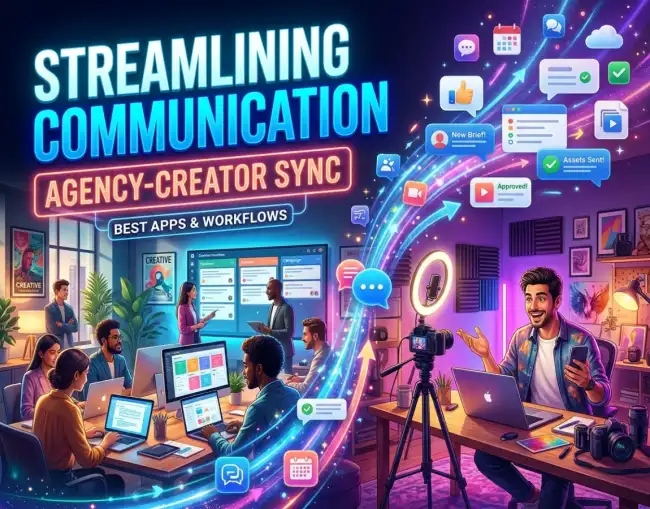
The modern creator economy operates at a velocity that traditional public relations and talent management firms were simply never designed to handle. What was once a cottage industry of occasional brand deals negotiated over email threads has rapidly matured into a multi-billion-dollar global economic engine. In this high-stakes ecosystem, talent agencies, multi-channel networks, and brand-side creator management teams juggle hundreds of simultaneous campaigns across TikTok, Instagram, YouTube, and Twitch. Yet, despite the sophisticated monetization strategies and high-budget productions, the single most persistent bottleneck threatening campaign ROI remains administrative friction: the chaotic, disjointed, and exhausting nature of day-to-day agency-creator communication.
When communication breaks down between a talent manager and a creator, the cascading effects are disastrous. Missed content approval deadlines, conflicting feedback loops, lost asset files, and misaligned messaging guidelines can turn a promising multi-platform partnership into a logistical nightmare. Historically, agencies attempted to solve this operational chaos by simply throwing more human hours at the problem—hiring army-sized teams of account coordinators to chase deliverables across endless WhatsApp threads, messy Slack channels, and overflowing email inboxes. This approach is no longer scalable. To survive and thrive in today's fiercely competitive landscape, agencies must implement structural discipline by adopting purpose-built communication apps and airtight agency workflows designed specifically for creators.
This comprehensive blueprint explores the intersection of software infrastructure and human process engineering. By examining the mechanics of centralized communication apps, mapping out meticulous agency workflows, and leveraging specialized influencer management tools, we will unpack how top-tier agencies eliminate operational drag. Whether you are scaling a boutique talent agency or optimizing an enterprise-level influencer marketing department, mastering the art of the agency-creator sync is the definitive competitive advantage required to protect margins, foster healthy creator relationships, and consistently deliver exceptional campaign outcomes.
Foundational Principles of Agency-Creator Synchronization
Deconstructing Operational Friction in Talent Management
Operational friction in influencer marketing is rarely caused by a lack of talent or capital; it is almost invariably the result of unstructured communication channels. In a typical campaign lifecycle, information flows across multiple vectors: brand representatives communicate with agency account directors, who then translate those notes for talent managers, who subsequently relay the feedback to creators—often through entirely different messaging apps. This "telephone game" model of management introduces massive latency and catastrophic distortion. When feedback regarding a sponsored video hook or a brand compliance disclaimer is passed through three layers of abstraction, vital nuance is inevitably lost.
To eliminate operational friction, agencies must transition from reactive communication to proactive, centralized information architecture. This requires establishing a single source of truth for every campaign, where assets, briefs, communication logs, and approval milestones live in a unified environment. By establishing strict communication protocols—such as banning ad-hoc feedback via personal text messages and routing all creative reviews through dedicated collaboration platforms—agencies can drastically reduce the cognitive load placed on creators. Creators are artists and content strategists first; forcing them to act as administrative project managers invariably leads to burnout, creative fatigue, and eventual churn.
The Anatomy of an Optimized Creator-Facing Workflow
An optimized agency workflow is built upon absolute clarity, radical transparency, and predictable cadences. Creators thrive in environments where expectations are definitively established long before the ink dries on a contract. This process begins during the onboarding phase, where establishing structured expectations sets the tone for the entire relationship. For a deep dive into laying this groundwork, reviewing The Ultimate Onboarding Checklist for Brand-Influencer Campaigns provides essential operational frameworks that prevent miscommunication from day one.
Once onboarding is complete, the workflow must transition into distinct, repeatable phases: briefing, ideation, draft submission, revision, final delivery, and post-campaign reporting. Each phase must have designated communication apps associated with it, ensuring that stakeholders never have to guess where a file lives or who holds the current approval bottleneck. Furthermore, top-tier agencies design their workflows to accommodate the unique working hours and psychological rhythms of digital creators, many of whom operate outside traditional nine-to-five corporate structures. By baking asynchronous communication norms into the workflow, agencies respect creator autonomy while maintaining rigorous operational control.
The Psychology of Creator-Agency Relationships
Successful synchronization is as much an exercise in emotional intelligence as it is in software deployment. Creators frequently experience high levels of anxiety regarding financial stability, algorithmic volatility, and brand reputation management. When an agency communicates with a creator purely through the lens of demands, deadlines, and compliance warnings, the relationship rapidly deteriorates into an adversarial dynamic. Effective agency workflows intentionally integrate moments of positive reinforcement, collaborative brainstorming, and strategic business development discussions into regular sync meetings.
Moreover, agencies must recognize that creators are individual brands with distinct voices and audiences. When communication apps are configured to treat creators like nameless, interchangeable ad units, the authenticity that makes influencer marketing so effective is systematically crushed. Modern agency management tools must therefore support individualized communication styles while enforcing enterprise-grade accountability. By balancing empathetic, human-centric relationship management with rigorous software-driven tracking, agencies can build long-term loyalty that attracts the highest-caliber talent in the industry.
Selecting and Deploying the Right Communication Apps
Evaluating Real-Time Messaging vs. Asynchronous Hubs
The foundation of any technical stack for agency-creator sync rests on choosing the appropriate communication apps. Agencies frequently make the mistake of relying on consumer-grade chat applications like WhatsApp or iMessage for complex campaign management. While these apps are convenient for casual check-ins, they completely lack the organizational depth required for multi-stakeholder campaign execution. Critical feedback gets buried beneath casual conversation, files expire, and search functionality is notoriously inadequate for retrieving specific contractual or creative revisions months after the fact.
Instead, modern agencies must deploy a hybrid model utilizing real-time collaboration spaces alongside asynchronous project management hubs. Platforms like Slack or Microsoft Teams serve as the real-time connective tissue for urgent, day-to-day dialogue, provided they are structured with strict channel naming conventions and thread discipline. Concurrently, asynchronous hubs like Notion, Airtable, or specialized influencer CRMs act as permanent knowledge repositories. This dual-layered approach ensures that urgent questions are answered swiftly without sacrificing the institutional memory required for long-term campaign tracking and auditing.
Leveraging Dedicated Influencer Management Tools
Generic project management software often falls short when managing creators because it fails to account for the unique lifecycle of media production and rights management. This is where dedicated influencer management tools—such as Grin, CreatorIQ, Upfluence, and Captiv8—become indispensable. These platforms bridge the gap between CRM functionality and communication tracking, allowing talent managers to monitor email correspondence, content deliverables, payment statuses, and performance analytics within a single unified dashboard.
When selecting an influencer management tool, agencies must evaluate its creator-facing interface. Many enterprise platforms are designed exclusively for brand-side managers, presenting an overwhelming, overly corporate dashboard that alienates creators. The best communication apps and management tools offer simplified, mobile-friendly creator portals or streamlined guest views. These interfaces allow creators to upload raw video files, view feedback timestamps, and sign off on deliverables with minimal friction, drastically reducing the time spent chasing assets across disparate cloud storage folders.
Integrating Cloud Storage and Asset Management Ecosystems
Communication breakdown frequently occurs over file sharing. Sending 4K video files via standard email attachments is impossible, and relying on unorganized personal Google Drive or Dropbox links inevitably leads to permission errors, broken links, and version confusion ("Final_Video_v2_FINAL_edited.mp4"). Implementing a centralized Digital Asset Management (DAM) system or structuring cloud storage ecosystems with immutable naming conventions is non-negotiable for smooth agency workflows.
Advanced agencies integrate cloud storage directly into their communication apps. For instance, configuring automated workflows where a creator uploads a draft to a specific Frame.io project automatically triggers a notification in Slack and logs the status update in the agency CRM. This eliminates manual data entry, reduces human error, and ensures that every stakeholder—from the junior account coordinator to the brand CMO—is looking at the exact same version of the creative asset with precise time-coded feedback capabilities.
Designing Step-by-Step Agency Workflows for Campaign Execution
The Briefing and Ideation Phase Workflow
The campaign lifecycle begins with the briefing phase, where communication clarity dictates ultimate creative success. Agencies must avoid dropping dense, 20-page corporate PDF briefs on creators and expecting immediate execution. Instead, the briefing workflow should be interactive and collaborative. The agency account manager should schedule a 15-minute kick-off sync via video conferencing to walk through core messaging pillars, mandatory compliance disclosures, and do’s and don’ts, recording the session for future reference.
Following the kick-off, the ideation workflow must utilize a shared collaborative workspace where creators can pitch concepts in real time. Rather than sending disjointed email threads with bulleted content ideas, creators should submit outlines directly into a standardized content pipeline card within the agency’s project management tool. This allows the agency and brand to review, comment on, and approve hooks, angles, and scripts in a structured, transparent environment before a single frame of video is shot or recorded.
Streamlining Draft Review and Revision Cycles
The draft review and revision cycle is historically the most contentious and time-consuming phase of agency-creator collaboration. Without a formalized workflow, feedback becomes subjective, contradictory, and endless. To solve this, agencies must enforce a strict "two-revision maximum" policy codified in initial contracts, coupled with time-coded review software such as Frame.io or Wipster. These tools allow brand stakeholders and agency directors to drop precise visual and auditory comments directly onto the exact second of the video file, eradicating ambiguous feedback like "make the middle part more engaging."
Furthermore, the review workflow must establish hard deadlines for feedback consolidation. If three different brand stakeholders have review privileges, the agency account manager must collect, vet, and synthesize those notes into a single, cohesive revision brief before sending it back to the creator. Allowing multiple brand representatives to message a creator with conflicting notes simultaneously is a primary driver of talent frustration and project failure. By operating as an impenetrable strategic filter, the agency protects the creator's time and preserves creative integrity.
Publishing, Verification, and Post-Campaign Reporting
Once content is approved, the publishing workflow requires absolute precision regarding scheduling and metadata compliance. Creators must submit live post links through a dedicated intake form within 24 hours of going live. Advanced agencies utilize automated tracking pixels and API integrations via their influencer management tools to monitor engagement metrics in real time, bypassing the need to constantly badger creators for manual screenshot uploads of their analytics dashboards.
The workflow concludes with comprehensive post-campaign reporting. Instead of manually stitching together disparate data points from Instagram Insights, TikTok Analytics, and YouTube Studio, agencies should leverage automated reporting dashboards that pull performance data directly into client-ready presentation templates. A seamless conclusion to one campaign naturally feeds into the onboarding workflow for the next, solidifying the agency-creator partnership through demonstrated competence, reliability, and mutual financial success.
Scaling Communication for Multi-Platform and Roster Management
Managing High-Volume Talent Rosters Without Losing the Personal Touch
As talent agencies scale their creator rosters from a handful of exclusive partners to dozens or hundreds of digital personalities, maintaining personalized communication becomes an immense operational challenge. A talent manager handling thirty creators cannot possibly maintain deep daily check-ins with every single individual without burning out. To solve this scaling paradox, agencies must segment their talent rosters based on revenue tiers, management levels, and communication preferences while standardizing baseline operational touchpoints.
For top-tier, high-revenue creators, dedicated talent managers should maintain bespoke communication routines, including weekly strategic syncs and priority messaging channels. For mid-tier and emerging creators, agencies can deploy semi-automated communication workflows—such as scheduled automated check-ins, group educational webinars, and self-service resource portals. Interestingly, many agencies managing diverse digital talent portfolios also oversee specialized creators, such as academic experts and thought leaders transitioning into mainstream entertainment. Exploring The Rise of Edu-Creators: How Academic Experts Are Taking Over Social Media offers critical insights into how communication workflows must adapt when managing highly specialized, intellectually rigorous content creators who require a vastly different onboarding and editorial touch.
Cross-Functional Team Alignment: Bridging Legal, Finance, and Creative
Internal communication breakdowns within the agency are just as destructive as friction between the agency and the creator. A common failure mode occurs when the creative team books a campaign and promises a tight turnaround, completely unaware that the legal department has not yet finalized contract amendments, or that the finance team has flagged the brand for delayed payment terms. Achieving true agency-creator sync requires flawless internal alignment across all departmental silos.
To eliminate internal friction, agencies must map out cross-functional workflows using enterprise collaboration apps that connect CRM records directly to accounting and legal software. For example, when a creator signs a deal in the talent CRM, an automated trigger should instantly notify the legal team to draft compliance addendums and alert finance to prepare milestone invoicing schedules. By synchronizing internal operations before engaging the creator, agencies project an image of absolute professionalism and reliability.
Handling Crisis Communication and Real-Time Pivots
In the fast-moving world of social media, unexpected crises can strike at any moment. A brand partner may experience a sudden PR scandal, an algorithm update might suppress a specific content format overnight, or a creator may face sudden public backlash requiring an immediate messaging pivot. When crisis strikes, standard email chains and delayed approval workflows are completely useless. Agencies must establish an emergency crisis communication protocol built into their core tech stack.
This protocol involves setting up dedicated emergency notification channels on mobile communication apps with push notifications enabled for all essential stakeholders. Pre-approved crisis response templates, clear chains of command, and designated legal sign-off procedures must be documented in advance. When an agency can orchestrate a rapid, coordinated response to a market disruption within minutes rather than days, they demonstrate immense value that deeply fortifies the agency-creator bond.
Real-World Case Studies & Scenarios
Case Study 1: The Boutique Talent Agency Transformation
The Scenario: A boutique talent management agency representing 15 top-tier lifestyle and beauty creators was drowning in operational disarray. Communication was fragmented across personal iMessages, Instagram DMs, and endless email threads. Consequently, the agency missed three major campaign deadlines in a single quarter, resulting in dropped brand contracts, withheld commissions, and severe creator dissatisfaction.
The Intervention: The agency overhauled its entire operational infrastructure. They replaced fragmented chat apps with a centralized workspace combining Slack for real-time internal communication, Notion as an asynchronous creator knowledge hub, and Frame.io for time-coded video reviews. They instituted mandatory weekly operational syncs and established strict feedback consolidation protocols.
The Results: Within six months of implementing these structured communication workflows, missed deadlines dropped to absolute zero. Creator retention increased by 40%, and the agency successfully scaled its roster to 35 creators without increasing administrative headcount. The time spent managing manual asset collection decreased by 65%, allowing talent managers to focus entirely on high-value brand negotiations and strategic business development.
Case Study 2: Enterprise Brand-Side Influencer Program Failure & Recovery
The Scenario: A Fortune 500 consumer brand launched a massive global influencer campaign activating over 200 creators simultaneously across TikTok and Instagram. Operating without an influencer management tool or standardized agency workflows, the internal marketing team attempted to manage all communications via a massive shared spreadsheet and individual email chains.
The Failure: The campaign was an operational catastrophe. Creators received conflicting brand guidelines from different campaign coordinators, asset versions were hopelessly mixed up, and payment processing was delayed by months due to unorganized invoicing. Over 30% of creators dropped out of the campaign mid-stream, resulting in devastating public complaints on social media and a severely damaged brand reputation.
The Recovery: The brand halted the campaign, brought in an expert influencer marketing consultancy, and rapidly deployed an enterprise influencer management platform (CreatorIQ). They restructured all creator communications through a standardized portal, automated compliance tracking, and established clear, predictable payment workflows. By rebuilding trust through radical operational transparency, they successfully salvaged the second phase of the campaign, ultimately achieving positive campaign ROI.
Critical Mistakes and How to Avoid Them
1. Over-Communicating via Unstructured Channels
The Mistake: Relying on endless streams of casual messages across WhatsApp, Slack, and text messaging without establishing operational boundaries or categorization. This creates constant notification fatigue for creators, leading to missed messages, high anxiety, and severe burnout.
The Countermeasure: Establish a strict communication charter. Define which topics belong in real-time chat apps versus asynchronous project management boards. Implement "do not disturb" windows respecting creator time zones and creative flow states.
2. Failing to Filter Brand Feedback
The Mistake: Forwarding raw, contradictory, and subjective feedback directly from multiple brand stakeholders to the creator without prior agency synthesis. This forces creators to navigate corporate politics and arbitrary creative whims.
The Countermeasure: Enforce the agency's role as an impenetrable strategic filter. The account manager must collect, vet, resolve contradictions, and synthesize all brand notes into a single, cohesive, objective revision brief before presenting it to the talent.
3. Using Outdated File-Sharing Methods
The Mistake: Exchanging massive video assets via unorganized cloud storage links, standard email attachments, or consumer file-sharing services that lack time-coded comment capabilities and version control.
The Countermeasure: Mandate professional media review platforms like Frame.io or Wipster integrated directly into your agency workflow. Ensure all files adhere to a strict, immutable naming convention and live within a centralized DAM system.
4. Neglecting Onboarding and expectation Setting
The Mistake: Rushing the onboarding process to get campaigns moving quickly without establishing clear communication protocols, deliverable timelines, and mutual expectations from day one.
The Countermeasure: Implement a rigorous onboarding checklist and kick-off synchronization meeting for every single campaign. Ensure contracts explicitly outline communication SLAs, revision limits, and approval workflows before creative work begins.
5. Ignoring Internal Cross-Functional Alignment
The Mistake: Operating agency departments (creative, legal, finance, account management) in isolated silos, leading to embarrassing situations where creators are promised timelines that violate legal agreements or payment terms.
The Countermeasure: Integrate CRM records with project management, legal, and accounting software using automated triggers and unified dashboards to ensure internal teams share a single source of truth.
Comprehensive Comparison of Agency Communication Strategies
| Strategy / Approach | Primary Tech Stack | Operational Scalability | Creator Retention Impact |
|---|---|---|---|
| Ad-Hoc / Unstructured (Emails, WhatsApp, Text) |
Consumer chat apps, standard email, personal cloud folders | Extremely Low (breaks down past 5 creators) | Negative (high burnout, frustration, and churn) |
| Hybrid Collaborative Hub (Slack + Notion + Cloud DAM) |
Slack, Notion/Airtable, Frame.io, Google Workspace | Moderate-High (scales efficiently up to 50+ creators) | Positive (balanced structure with creative freedom) |
| Enterprise CRM & Portal (Grin, CreatorIQ, Captiv8) |
Dedicated influencer platforms, automated APIs, integrated portals | Maximum (enterprise-grade scaling for hundreds of creators) | High (transparent tracking, fast payments, clear workflows) |
Frequently Asked Questions (FAQ)
What are the absolute best communication apps for managing influencer talent agencies?
The ideal communication stack depends on your agency’s size and budget, but industry best practices point toward a hybrid approach. For real-time internal team sync and urgent creator messaging, Slack or Microsoft Teams configured with strict channel architectures is essential. For asynchronous project management, knowledge bases, and brief tracking, platforms like Notion or Airtable provide unmatched flexibility. Finally, for creative asset reviews, time-coded video platforms like Frame.io are mandatory. For enterprise agencies managing large rosters, dedicated influencer management platforms like CreatorIQ, Grin, or Upfluence consolidate CRM, communication, and analytics into a single unified ecosystem.
How can talent managers prevent creator burnout caused by constant messaging and notifications?
Creator burnout is frequently triggered by "notification fatigue"—the relentless influx of pings across multiple apps at all hours of the day and night. To combat this, agencies must establish strict communication charters and boundary protocols. Define clear operating hours, utilize asynchronous project management boards instead of instant messaging for non-urgent updates, and respect creator time zones. Furthermore, talent managers should consolidate multiple small inquiries into a single, structured weekly sync meeting rather than peppering creators with micro-requests throughout the week.
How should agencies handle contradictory feedback from multiple brand stakeholders during draft reviews?
Allowing multiple brand representatives to send conflicting notes directly to a creator is a primary operational failure that destroys trust and stalls campaigns. The agency account manager must act as a strict strategic filter. When brand notes are submitted, the agency must review, synthesize, resolve any internal contradictions, and translate the feedback into a single, cohesive revision brief. Only this unified, vetted document should ever be presented to the creator, protecting them from corporate politics and ensuring absolute clarity.
What is the difference between generic project management software and dedicated influencer management tools?
Generic project management software (such as Asana, Trello, or Monday.com) is designed for traditional corporate task tracking and general workflow management. While powerful, these tools lack features tailored to the influencer economy, such as social media handle tracking, audience demographics analytics, content rights management, automated compliance disclosure monitoring, and creator-facing portals. Dedicated influencer management tools (like Captiv8, Grin, and Upfluence) are custom-built to handle the unique lifecycle of digital media production, talent CRM, and multi-platform performance tracking.
How do you successfully onboard a new creator into an agency's communication workflow?
Successful onboarding begins on day one by establishing clear operational expectations, introducing the agency’s tech stack, and providing a comprehensive orientation guide. Every new creator should receive an interactive walkthrough of how communication apps are utilized, where to submit drafts, how review feedback will be delivered, and who their dedicated point of contact is. Setting these expectations early prevents confusion, establishes mutual respect, and sets the stage for a long-term, highly profitable partnership.
Strategic Roadmap and Final Takeaway
As the creator economy continues its explosive trajectory over the next two to five years, the operational complexity of managing talent will only intensify. Platform algorithms will evolve, new social channels will emerge, and brand partnerships will demand increasingly sophisticated multi-format content strategies. In this hyper-competitive environment, agencies that rely on outdated, unstructured communication methods will find themselves crippled by operational drag, high creator churn, and eroding profit margins. Conversely, agencies that treat communication architecture and workflow engineering as core strategic assets will dominate the market.
The definitive takeaway for agency leaders and creator managers is clear: operational excellence is not an administrative afterthought; it is the primary engine of scale. By thoughtfully selecting integrated communication apps, enforcing disciplined agency workflows, and leveraging specialized influencer management tools, agencies can eliminate friction, protect creator well-being, and unlock unprecedented campaign performance. The future belongs to those who build systems that allow creativity to flourish without administrative chaos.
Be the first creator to share your take on this story.