
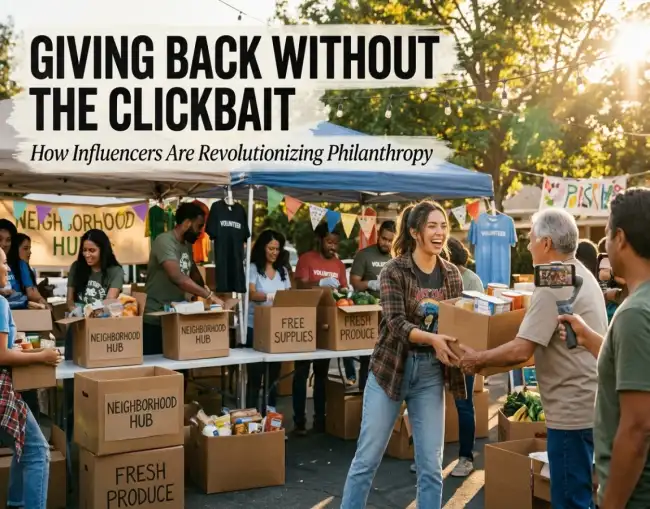
For over a decade, the digital creator economy was synonymous with conspicuous consumption. Unboxing hauls, luxury brand trips, and high-gloss lifestyle vlogs dictated the metrics of online success. However, a profound cultural shift has quietly taken root across TikTok, YouTube, Twitch, and Instagram. Modern audiences have grown profoundly fatigued by performative luxury, prompting a massive pivot toward social consciousness. Today, internet personalities command platforms with millions of followers who no longer measure worth strictly by what creators own, but rather by what they give back. This is not the tokenistic, annual charity gala sponsorship of traditional Hollywood; it is an agile, deeply integrated, and digitally native movement of radical generosity that is entirely reshaping modern philanthropy.
At the forefront of this evolution is a rejection of transactional clickbait. Historically, early internet attempts at charity often fell into the trap of poverty tourism or exploitative stunts designed purely for shock-value metrics. Creators would hand a $100 bill to an unhoused individual while a camera crew zoomed in on the tearful reaction, trading human dignity for algorithmic engagement. But as audiences matured, so did their bullshit detectors. Viewers began demanding structural transparency, verifiable impact receipts, and long-term community empowerment over cheap emotional manipulation. Consequently, the industry has birthed a new standard of giving back campaigns that rely on audited foundations, direct peer-to-peer micro-donations, and community-led mutual aid initiatives.
Navigating this new era requires a delicate balance of earnest empathy and rigorous operational compliance. When creators attempt to merge monetization with altruism, the margin for error narrows to almost zero. A single mismanaged dollar or an unclear partnership disclosure can trigger an immediate backlash, echoing the severe digital fallout detailed in our analysis on Crisis Management 101: How Influencers Survive Sudden Online Cancel Culture. This article explores the mechanics, strategies, and ethical frameworks that define modern ethical philanthropy, providing a comprehensive blueprint for creators, brands, and non-profits looking to drive authentic social impact without falling into the traps of sensationalism.
Understanding the Architecture of Modern Digital Altruism
The Evolution from Performative Stunts to Structural Giving
The early days of digital philanthropy were characterized by high-visibility, low-sustainability gestures. Creators treated charitable acts as content hooks rather than commitments to social betterment. The psychological mechanism was straightforward: evoke a strong emotional spike, capture the reaction, and monetize the resulting ad revenue or brand sponsorships. However, this model fundamentally commodified the recipients of aid. Over the past five years, consumer literacy regarding digital media has skyrocketed. Audiences now expect creators to move beyond temporary Band-Aid solutions and engage in systematic, structural giving that addresses the root causes of systemic issues.
This structural evolution means that modern giving back campaigns often resemble sophisticated non-profit operations rather than impromptu weekend stunts. Creators are partnering directly with established 501(c)(3) organizations, setting up dedicated donor-advised funds, and utilizing blockchain-verified platforms to ensure absolute transparency. By shifting the focus from the creator’s emotional journey to the community’s tangible outcomes, digital leaders are establishing a sustainable baseline for what it means to leverage an audience for social good.
The Psychology of Audience-Driven Micro-Philanthropy
One of the most powerful catalysts in modern influencer charity is the democratization of giving. Traditional philanthropy was long viewed as the exclusive domain of wealthy elites and corporate foundations. Digital creators have shattered this barrier by proving the immense, collective power of micro-donations. When a streamer with two million concurrent viewers asks each fan to contribute a single dollar, a life-changing sum can be raised in a matter of minutes. This dynamic creates a powerful sense of shared purpose and community identity.
Furthermore, this participatory model fulfills a deep psychological need among digital natives for agency in a complex world. Gen Z and millennial audiences frequently experience profound eco-anxiety and socio-economic despair. By channeling their collective attention and spare capital into a synchronized campaign, they transition from passive consumers of bad news into active agents of change. The creator acts not as a savior, but as a trusted orchestrator who channels the collective will of a digital tribe toward a vetted, high-impact destination.
Defining Ethical Boundaries in Digital Fundraising
As the intersection of content creation and philanthropy expands, establishing clear ethical boundaries has become an absolute necessity. The line between altruism and exploitation is notoriously thin when cameras are rolling. Ethical creators must navigate consent, privacy, and power dynamics with extreme care. For instance, filming vulnerable populations—such as children, refugees, or individuals experiencing homelessness—requires informed consent that goes far beyond a standard media release. It requires a fundamental respect for human dignity that supersedes algorithmic metrics.
Moreover, the monetization of charitable content demands absolute financial transparency. If a creator runs a livestream where ad revenue, super chats, and affiliate commissions are ostensibly dedicated to a cause, every cent of that ledger must be publicly accounted for. Blurring the lines between personal profit and charitable funds is the fastest way to permanently destroy credibility. Ethical philanthropy in the digital age requires treating community trust as a sacred, non-renewable resource.
Strategic Blueprint for Launching Impactful Creator Campaigns
Phase 1: Deep-Dive Cause Selection and Alignment
The foundation of any successful giving back campaign is authentic alignment between the creator’s personal brand, their audience demographics, and the mission of the chosen non-profit. A gaming creator focusing on mental health initiatives or an environmental vlogger partnering with ocean conservation groups creates a natural bridge that audiences can easily understand and trust. Forced partnerships—where a fashion influencer suddenly launches a campaign for industrial agricultural reform without prior context—invariably trigger skepticism and alienation.
To execute this effectively, creators must conduct a thorough audit of their audience’s core values and geographic distribution. If a significant percentage of a creator's fanbase resides in urban centers facing housing crises, hyper-local shelter campaigns will naturally outperform abstract global initiatives. Collaborating with non-profits requires vetting their overhead costs, operational history, and impact metrics. Creators should demand impact reports, speak directly with program directors, and ensure the organization possesses the administrative capacity to handle sudden surges in digital donations.
Phase 2: Designing Transparent Monetization and Donation Loops
Once the cause is selected, the mechanical architecture of the campaign must be engineered for absolute transparency. Modern audiences are deeply suspicious of vague phrases like "a portion of proceeds will be donated." Creators must utilize dedicated, direct-giving platforms such as Tiltify, Classy, or Donorbox that allow funds to flow directly from the donor to the non-profit entity without passing through the creator’s personal bank accounts.
When running merchandise-based campaigns where a percentage of sales goes to charity, the exact mathematical breakdown must be explicitly stated on the checkout page (e.g., "$15 from every $45 hoodie directly funds clean water initiatives through Charity: Water"). Additionally, creators should establish real-time fundraising trackers embedded directly into their livestreams or video descriptions. This real-time visibility gamifies the experience positively, turning collective generosity into a shared milestone celebration rather than a opaque black box of financial transactions.
Phase 3: Crafting the Content Narrative Without Exploitation
Content creation is the engine that drives visibility, but the storytelling must be handled with exquisite journalistic integrity. The narrative should never frame the creator as a heroic savior rescuing passive victims. Instead, the narrative framework must center the agency, resilience, and stories of the community members or the non-profit workers on the ground. The creator’s role is that of a megaphone, amplifying voices that are typically unheard by mainstream algorithms.
When documenting field visits or project completions, creators should focus on systemic solutions rather than emotional trauma porn. Show the before-and-after of a community garden, the structural impact of a newly funded classroom, or the operational scaling of a food bank. By educating the audience on the *why* and the *how* behind the issue, creators transform passive viewers into lifelong advocates who understand the structural complexities of social change.
Phase 4: Post-Campaign Accountability and Impact Reporting
The campaign does not end when the live stream goes offline or the fundraising window closes. In many ways, the most critical phase of ethical philanthropy begins after the money has been collected. Creators have a professional and moral obligation to close the feedback loop by providing detailed impact reports to their community. If a million dollars was raised, the audience deserves to see where every dollar went within three to six months of the campaign's conclusion.
This accountability can take the form of dedicated update videos, written blog posts, or audited financial summaries published on the creator’s website. When non-profits experience delays or project pivots due to external circumstances, creators must communicate these realities transparently to their fanbase. Maintaining open channels of communication proves that the campaign was driven by a genuine desire for impact rather than a transient public relations boost.
Scaling Impact Through Cross-Industry Collaborations
Uniting Creators, Brands, and Non-Profits into Ecosystems
Scaling digital philanthropy beyond the capacity of a single creator requires building collaborative ecosystems. When content creators join forces with corporate sponsors and established NGOs, the resulting synergy can mobilize millions of dollars and massive global attention. However, these multi-party collaborations require sophisticated negotiation and alignment of values to prevent corporate greenwashing or creator co-optation.
Brands looking to participate in ethical philanthropy must step back from heavy-handed product placement and instead empower creators to lead the narrative. Similarly, non-profits must learn to cede some control over messaging to creators who intuitively understand what formats resonate with digital-native audiences. As the digital ecosystem matures, we are seeing fascinating intersections between entertainment and social good, much like the visionary evolution documented in our feature on Expert Panel: The Future of Virtual Influencers and AI Creators in Brand Collabs, where emerging digital entities are also being leveraged for cause-driven initiatives.
Leveraging Live-Streaming Marathons and Gamified Giving
Live-streaming platforms like Twitch and YouTube Live have revolutionized the mechanics of modern fundraising through gamification. Features such as milestone unlocks, charity incentive streams (where creators undergo humorous or physically challenging tasks upon reaching donation thresholds), and community-wide raids create an immersive, highly engaging environment for giving back.
These marathons require meticulous logistical planning. Creators must partner with technical platforms that integrate seamlessly with payment gateways to prevent site crashes during high-traffic surges. Furthermore, moderators must be thoroughly briefed to manage chat toxicity, coordinate with non-profit representatives in real-time, and highlight major community contributions. When executed correctly, a 24-hour charity stream transforms from a broadcast into a historic communal event.
Building Sustainable, Multi-Year Commitments
One-off campaigns, while effective for emergency disaster relief, are insufficient for addressing long-term systemic issues like education inequality, chronic homelessness, or environmental degradation. The gold standard of modern influencer charity is the multi-year commitment. Creators are increasingly signing on as long-term ambassadors, pledging a percentage of their ongoing merchandise revenue, channel memberships, or personal income to specific causes over a multi-year horizon.
This sustained partnership model allows non-profits to engage in long-term strategic planning rather than living from one emergency campaign to the next. It also signals to the creator's audience that their commitment is authentic and deeply ingrained in their personal ethos, rather than a fleeting trend adopted for temporary algorithmic favor.
Real-World Case Studies & Scenarios
To fully understand the divergence between successful execution and catastrophic failure in digital philanthropy, we must examine concrete real-world scenarios that illustrate the stakes involved.
Scenario A: The Anatomy of a Successful Clean Water Initiative
A mid-tier lifestyle creator with 800,000 subscribers on YouTube decided to partner with an established international water charity to fund the construction of three community wells in East Africa. Instead of flying out immediately with a camera crew, the creator collaborated with local project managers on the ground to produce a documentary-style educational series explaining the specific water scarcity challenges faced by the region.
The Strategy: They utilized a direct-integration donation link, hosted a 12-hour livestream featuring guest scientists and community leaders, and pledged to match the first $20,000 of viewer donations out of pocket. They also committed to publishing quarterly video updates showing the construction progress.
The Result: The campaign raised over $185,000 in less than 48 hours—nearly triple their initial goal. The follow-up update videos received millions of views, proving that deep, educational, and respectful storytelling drives both high engagement and profound, long-term social impact.
Scenario B: The Perils of Performative Stunt Philanthropy
Conversely, a prominent prank and lifestyle channel with millions of followers decided to film a viral video distributing expensive electronics to residents of a low-income neighborhood. The video was edited for maximum emotional impact, featuring dramatic, soaring orchestral music and lingering close-ups of recipients crying on camera.
The Failure: Within 24 hours of publication, investigative internet sleuths discovered that the electronics distributed were non-functional dummy units used purely for the video shoot, and that several vulnerable participants had never given consent to have their faces broadcast to millions. Furthermore, no actual charitable funds or long-term support infrastructure were provided to the community.
The Aftermath: The creator faced immediate public condemnation, lost multiple major corporate sponsorships, and experienced a mass subscriber exodus. The incident served as a textbook cautionary tale illustrating why superficial, exploitative stunts are no longer viable in an era that demands absolute authenticity and respect.
Critical Mistakes and How to Avoid Them
Navigating the complex landscape of digital philanthropy requires avoiding several costly pitfalls that can permanently damage a creator's reputation and alienate their audience.
- Mistake 1: Failing to Vet the Non-Profit Organization. Partnering with unverified or poorly managed charities can result in misappropriated funds and severe public backlash. Countermeasure: Always require audited financial statements, verify 501(c)(3) or equivalent legal status, and consult independent charity watchdog evaluations before launching any campaign.
- Mistake 2: Commingling Personal and Charitable Funds. Accepting donations directly into a creator’s personal or business bank account creates legal liabilities and erodes trust. Countermeasure: Utilize dedicated, certified third-party digital fundraising platforms where funds go directly from the donor to the non-profit entity.
- Mistake 3: Exploiting Vulnerable Populations for Clicks. Recording individuals in distress without informed consent or reducing human dignity to an emotional engagement hook. Countermeasure: Center systemic solutions, obtain rigorous written consent, and prioritize the agency and voices of the community members over sensationalized visuals.
- Mistake 4: Neglecting Post-Campaign Transparency. Raising funds and failing to provide follow-up reports on how the money was spent. Countermeasure: Establish a mandatory post-campaign timeline for publishing audited financial summaries and project progress updates to the community.
- Mistake 5: Launching Unaligned, Random Campaigns. Jumping on trending social issues without genuine connection or audience alignment, resulting in perceived inauthenticity. Countermeasure: Carefully map campaign causes to your core values, audience demographics, and long-term content strategy to ensure seamless authenticity.
Comparative Analysis of Digital Philanthropy Approaches
| Approach Metric | Performative Stunt Philanthropy | Traditional Charity Sponsorship | Modern Ethical Philanthropy |
|---|---|---|---|
| Primary Driver | Algorithmic shock value & short-term views | Corporate tax write-offs & PR box-checking | Authentic community impact & shared values |
| Financial Transparency | Opaque; funds often flow through creator accounts | Standard corporate reporting; low audience visibility | Radical transparency; direct-to-charity API integration |
| Community Engagement | Passive consumption of emotional manipulation | Minimal; disconnected from daily content | Active participation via micro-donations & marathons |
| Long-Term Sustainability | Non-existent; single-use content pieces | Annual monetary grants | Multi-year partnerships & structural empowerment |
| Risk Level | Extremely high risk of cancel culture and exposure | Moderate risk of PR disconnect | Low risk when vetted with rigorous compliance |
Frequently Asked Questions
What makes a giving back campaign truly ethical?
An ethical campaign is defined by radical financial transparency, informed consent of all participants, rigorous vetting of the beneficiary non-profit, and a narrative structure that prioritizes community agency over creator glorification. It ensures that funds flow securely without commingling and that clear impact reports are delivered to the audience after the campaign concludes.
How can micro-influencers make a meaningful impact with smaller audiences?
Micro-influencers often boast exceptionally high engagement rates and tight-knit, trusting communities. Even with a smaller follower count, targeted niche campaigns—such as raising funds for a local animal shelter, a community food bank, or a specific educational program—can mobilize hundreds or thousands of highly dedicated supporters to create profound hyper-local change.
Should creators ever handle donation money directly?
As a best practice, creators should never route charitable donations through their own personal or business bank accounts. Doing so introduces severe legal, tax, and ethical liabilities. Creators should always utilize established third-party fundraising platforms that transfer funds directly to certified non-profit organizations.
How do creators protect themselves against non-profit scandals?
Protection comes from rigorous due diligence prior to launching any partnership. Creators should consult independent charity evaluation organizations (such as Charity Navigator or GuideStar), request recent audited financial reports, and maintain clear contractual agreements that outline accountability standards and exit clauses in the event of organizational misconduct.
What is the future outlook for influencer-led charity over the next 5 years?
The next five years will see a massive professionalization of digital philanthropy. We will witness the integration of blockchain-verified donation tracking, deeper institutional partnerships between major streaming platforms and global NGOs, and a consumer base that completely rejects unverified stunts in favor of long-term, structural, and transparent social impact initiatives.
Strategic Roadmap and Final Takeaway
The evolution of digital philanthropy marks a watershed moment in the creator economy. We are moving decisively past the era of exploitative clickbait and performative stunts, entering a sophisticated landscape where influence is leveraged for structural, sustainable social good. The modern audience has made their expectations crystal clear: they demand transparency, accountability, and genuine respect for human dignity.
For creators, brands, and non-profits willing to embrace this rigorous ethical framework, the opportunities to drive meaningful change are unprecedented. By combining data-driven campaign architecture with authentic, community-centered storytelling, digital leaders can transform their platforms into powerful engines of global progress. As you plan your next initiative, remember that true influence is not measured by the views you capture today, but by the lasting, positive impact you leave behind tomorrow.
Be the first creator to share your take on this story.