
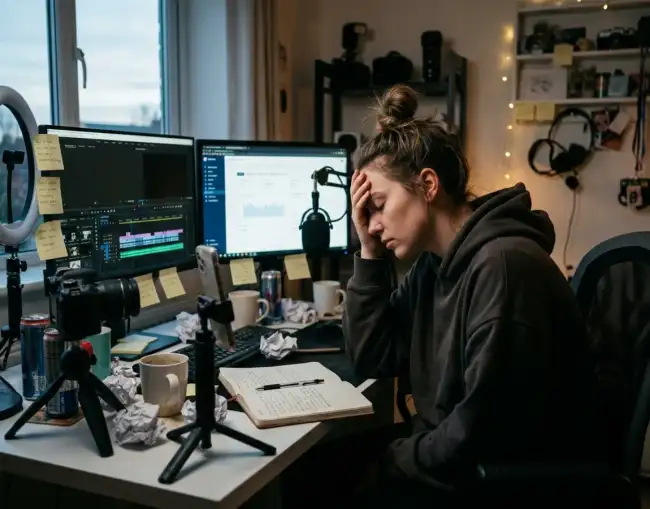
The ring light flickers at 3:15 AM in a dimly lit bedroom, casting an artificial, unforgiving glow over a creator who hasn't seen the sun in three days. Across the digital landscape, millions of viewers swipe through pristine feeds, laughing at seamless transitions, marveling at luxurious brand trips, and digesting bite-sized entertainment in under fifteen seconds. What the audience rarely sees is the invisible machinery grinding behind the scenes: the endless content matrices, the algorithmic anxiety of a plateauing engagement rate, the relentless pressure to monetize every waking second, and the crushing weight of maintaining an idealized digital persona. This is the stark, unvarnished reality of the modern creator economy, where the line between personal identity and corporate enterprise has been entirely erased.
Over the past decade, the democratization of media has transformed everyday individuals into global micro-media empires. However, this hyper-accelerated growth has birthed a profound psychological crisis. When your livelihood is tethered directly to the mercurial moods of algorithmic gatekeepers, taking a day off feels less like self-care and more like professional suicide. Creator diaries have emerged not merely as a content trend, but as a vital psychological lifeline—a therapeutic space where top-tier digital architects pull back the velvet curtain to expose the human cost of social stardom. Examining influencer burnout requires more than surface-level sympathy; it demands an investigative look into structural industry failures, operational inefficiencies, and the psychological frameworks necessary to survive and thrive in high-pressure digital environments.
Understanding this ecosystem means acknowledging that burnout is not an individual moral failing or a lack of resilience; it is a systemic occupational hazard. Creators operate as sole proprietors, creative directors, on-camera talent, editors, community managers, and financial controllers all at once. Without human resources departments, mandatory paid time off, or collective bargaining agreements, the modern influencer is left entirely vulnerable to the relentless demands of the attention economy. As we unpack the mechanics of creator diaries, explore strategic operational blueprints, and analyze real-world case studies, our objective is to provide a comprehensive, actionable roadmap for reclaiming mental well-being without sacrificing professional longevity.
Deconstructing the Anatomy of Creator Burnout
The Algorithmic Treadmill and the Psychology of Intermittent Reinforcement
At the very heart of influencer burnout lies the sinister architecture of modern content platforms. Algorithms are meticulously engineered to maximize user session lengths using principles of variable ratio reinforcement—the exact psychological mechanism that makes slot machines addictive. For creators, this manifests as an unpredictable feedback loop where one video generates millions of views while the next three stall out, sending a subconscious signal that their worth is constantly in flux. This volatility triggers a chronic state of hyper-arousal in the nervous system, keeping creators trapped in a perpetual cycle of overproduction to chase the elusive high of the next viral hit.
To combat this psychological trap, creators must understand that algorithmic fluctuations are external variables completely outside their direct control. Establishing psychological detachment from real-time metrics is the first line of defense. Successful digital operators schedule specific, limited windows during the day to check analytics, treating data as objective business intelligence rather than a direct reflection of personal self-worth. By reframing metrics as market feedback rather than validation, creators can begin to step off the algorithmic treadmill without letting go of their strategic business objectives.
The Erosion of Boundaries Between Public Persona and Private Self
In traditional entertainment, actors and musicians clock out of character and retreat behind private gates. In the social media ecosystem, however, the product *is* the person. When followers feel intimately connected to an influencer's daily life, they develop a parasocial relationship that often demands radical transparency, constant accessibility, and emotional vulnerability. Over time, creators begin to view themselves entirely through the lens of their audience's expectations, leading to severe depersonalization, identity fragmentation, and a terrifying internal void when the camera finally switches off.
Preserving mental health for creators requires the aggressive implementation of psychological and operational firewalls. This involves defining explicit boundaries regarding what aspects of life remain strictly offline—such as intimate relationships, family dynamics, and vulnerable personal struggles. Creators must actively cultivate a rich, offline identity anchored in hobbies, physical communities, and relationships that have zero intersection with their digital footprint. When the private self is nourished independently of the public persona, the inevitable criticisms and trolls of the internet carry significantly less existential weight.
Operational Blueprints for Sustainable Content Creation
Batch Production Frameworks to Eliminate Daily Content Panic
One of the primary catalysts for creator burnout is the frantic, day-to-day scramble of ideation, filming, editing, and publishing—a reactive workflow that keeps the nervous system in a perpetual state of "fight or flight." Transitioning from a reactive schedule to a proactive batch production framework is essential for reclaiming operational sanity. By grouping similar tasks into dedicated time blocks, creators can dramatically reduce cognitive switching costs and enter deep states of creative flow without the suffocating pressure of an immediate publishing deadline.
Implementing this framework begins with a dedicated monthly content planning session where overarching themes, brand partnerships, and narrative arcs are mapped out in advance. Following this, creators should designate specific, uninterrupted filming days where multiple videos or posts are recorded in a single session, utilizing wardrobe changes and lighting setups efficiently. This methodology ensures a robust content buffer of two to four weeks, providing the operational breathing room necessary to step away from the screen for a weekend or even a week without impacting audience engagement or revenue generation.
Diversifying Revenue and Delegating Operational Overhead
Relying solely on ad revenue sharing programs from individual platforms is a precarious financial strategy that exacerbates stress and anxiety. When income fluctuates wildly based on shifting payout rates or sudden policy changes, financial panic sets in, driving creators to overwork themselves to compensate. Building a sustainable digital career requires diversifying revenue streams across multiple pillars, including digital products, affiliate marketing, Patreon memberships, and brand sponsorships. Furthermore, strategic diversification often aligns seamlessly with broader marketing initiatives, such as Unlocking Collaboration Campaigns That Go Viral Across 3 Platforms Simultaneously, which amplify reach while distributing workload and risk.
Beyond financial diversification, delegation is the ultimate antidote to operational burnout. Many creators suffer from the "superhero complex," believing that nobody else can edit, script, or manage community engagement quite like they can. However, attempting to maintain 100% control over every micro-task inevitably leads to a hard ceiling on growth and mental exhaustion. Hiring freelance video editors, virtual assistants, or community managers transforms a stressed solo creator into a lean media company executive, freeing up precious mental bandwidth to focus exclusively on high-level strategy, creative vision, and authentic audience connection.
Strategic Networking and Community Resilience
Finding Solace in Peer-to-Peer Support Networks
Social stardom is notoriously isolating. Paradoxically, while a creator may have millions of followers watching their every move, they often experience profound loneliness because very few people in their immediate offline circle understand the unique psychological pressures of the industry. Friends and family mean well, but they rarely grasp why a negative comment from an anonymous troll can ruin an entire week or why an unexpected shadowban causes severe financial anxiety. This isolation intensifies burnout, leaving creators to suffer in silence behind closed doors.
Building a resilient career requires intentionally cultivating peer-to-peer relationships with fellow creators who are navigating similar challenges. These confidential mastermind groups or informal accountability circles provide a safe harbor where creators can vent frustrations, share technical insights, and normalize the mental health struggles that come with the territory. As explored when examining how top industry leaders connect, mastering this space often involves adopting insights from Influencer Voices: Top Creators Share Their Best Secrets for Unstoppable Networking to build authentic, reciprocal relationships rather than purely transactional ones.
Establishing Transparent Communication Channels with Audiences
For years, the unwritten rule of social media was perfection: never let the audience see you sweat, never reveal a bad mental health day, and always project an aura of effortless success. However, this facade of perpetual flawlessness creates an impossible standard that alienates communities and tortures creators. Recently, a cultural shift has emerged within creator diaries, where radical transparency and vulnerability are celebrated. Audiences increasingly crave authenticity, and sharing moments of vulnerability fosters a deeper, more resilient bond of trust.
When creators proactively communicate their need for a break, explain their boundaries, or share behind-the-scenes struggles with burnout, they often discover that their communities respond with overwhelming empathy and support rather than abandonment. Setting these expectations requires clear, compassionate communication: letting followers know that posting schedules may shift, explaining that self-care is a priority, and actively dismantling the toxic expectation of 24/7 availability. In doing so, creators not only protect their own mental health but also model healthy psychological boundaries for their often impressionable audiences.
Real-World Case Studies & Scenarios
Case Study A: The Collapse and Rebirth of a Lifestyle Vlogger
Consider the trajectory of "Elena," a lifestyle and wellness creator who amassed over 1.5 million subscribers on YouTube by documenting her seemingly idyllic daily routines, clean eating habits, and mindful living practices. Driven by the fear of missing out and the pressure of the algorithm, Elena fell into the trap of posting daily vlogs without taking a single day off for fourteen consecutive months. Her physical health deteriorated; she suffered from chronic insomnia, digestive issues, and severe clinical anxiety. When her engagement inevitably dipped due to formulaic and exhausted content, she panicked, doubling down on output and pushing herself into a complete physical and mental collapse that required a three-month hiatus from all digital platforms.
Upon her return, Elena completely restructured her business model. She transitioned from daily vlogging to a high-production weekly format, hired a part-time editor to handle 60% of her post-production workload, and utilized brand partnerships strategically to secure financial stability without needing endless daily uploads. Most importantly, her comeback video was a brutally honest creator diary detailing her burnout and recovery. The result? Her audience engagement soared by 45%, her community trust deepened exponentially, and her mental health stabilized. Elena's journey proves that vulnerability and strategic restructuring are far more powerful than relentless, unsustainable grinding.
Case Study B: Scaling Without Sacrifice in the Fitness Niche
In contrast to the reactive collapse model, examine the strategic approach of fitness creators who study scalable community-driven models. Much like major commercial brands that prioritize long-term sustainability over short-term hype—similar to the principles outlined in Brand & Influencer Spotlight: How Gymshark Mastered Community-Driven Marketing—these savvy creators build robust ecosystems where community engagement is decentralized and supported by collaborative networks rather than resting entirely on one individual's shoulders.
By building out membership communities, training mobile apps, and empowering certified coaches within their networks to handle day-to-day customer support and workout programming, these creators successfully decoupled their personal time from their revenue generation. When one creator needed to step away for emergency family matters, the automated systems, pre-recorded content buffers, and empowered community moderators kept the business thriving seamlessly. This case study demonstrates that shifting from a personal-brand bottleneck to a resilient, systems-driven business is the ultimate insurance policy against burnout.
Critical Mistakes and How to Avoid Them
Navigating the high-pressure world of social stardom is fraught with hidden traps. Even well-intentioned creators frequently fall victim to systemic pitfalls that accelerate burnout and jeopardize their long-term careers. Recognizing these critical missteps is the first step toward implementing robust preventative measures.
- Mistake 1: Treating Every Platform as a Full-Time Priority. Spreading yourself thin across TikTok, Instagram, YouTube, and X simultaneously without adequate resources guarantees exhaustion. Countermeasure: Master one primary platform where your target audience congregates before repurposing content passively to secondary channels.
- Mistake 2: Ignoring Early Physical and Psychological Warning Signs. Pushing through chronic fatigue, irritability, and dread under the guise of "hustle culture." Countermeasure: Establish non-negotiable bodily metrics—such as sleep duration and stress levels—and treat a dip in these metrics as an immediate emergency stop.
- Mistake 3: Monetizing Every Hobby and Passion. Turning every personal interest into a monetizable content vertical strips away the joy of unstructured play. Countermeasure: Maintain at least one completely private hobby that is explicitly off-limits to cameras, monetization, and public sharing.
- Mistake 4: Failing to Separate Business Finances from Personal Identity. Taking negative comments, low view counts, and brand rejections as direct assaults on personal character. Countermeasure: Form an LLC, review analytics strictly during business hours, and maintain distinct psychological detachment from your professional output.
- Mistake 5: Neglecting Legal and Financial Safety Nets. Operating without emergency cash reserves, comprehensive contracts, or professional healthcare support. Countermeasure: Build a minimum six-month financial runway and invest early in legal representation and health insurance tailored for self-employed media professionals.
Comprehensive Comparison Table: Reactive vs. Sustainable Creator Operating Models
| Operational Metric | Reactive Hustle Model (Burnout Track) | Sustainable Enterprise Model (Longevity Track) |
|---|---|---|
| Content Planning | Day-to-day scrambling; filming on demand based on immediate algorithmic trends. | Monthly thematic mapping with a 3-to-4-week advance content buffer. |
| Workflow & Production | Solo execution of all ideation, filming, editing, and community management. | Delegated tasks utilizing freelance editors, virtual assistants, and automated systems. |
| Revenue Diversification | Sole reliance on platform ad revenue sharing and sporadic brand deals. | Multi-pillar income including digital products, memberships, affiliates, and sponsorships. |
| Boundary Management | 24/7 availability; constant monitoring of analytics and parasocial engagement. | Strict offline hours, designated screen-free days, and protected personal relationships. |
| Community Engagement | Anxious responses to every comment; internalizing negative feedback and trolls. | Structured community guidelines, moderated comment sections, and healthy emotional detachment. |
Frequently Asked Questions (FAQ)
What are the earliest psychological warning signs of influencer burnout?
The earliest warning signs of influencer burnout are often subtle, masquerading as routine work fatigue. They typically manifest as a profound sense of dread when opening editing software, chronic irritability regarding comments or feedback, and a persistent numbness toward milestones that previously brought excitement, such as hitting a subscriber milestone or securing a brand partnership. Creators may also experience disrupted sleep patterns, decision fatigue, and an overwhelming urge to isolate themselves from both digital communities and offline friends.
Recognizing these symptoms early requires brutal self-honesty and regular check-ins with your mental health. If you notice that creating content has shifted from a passionate outlet of self-expression to a suffocating prison of obligation, it is time to immediately pull back, evaluate your workload, and implement structured rest protocols before a full psychological collapse occurs.
How can creators effectively communicate a break to their audience without losing momentum?
Audiences are far more understanding than most creators believe, provided the communication is honest, respectful, and transparent. When announcing a break, avoid vague disappearances that trigger anxiety among followers. Instead, record a dedicated video or post a clear update explaining that you are taking a scheduled pause to recharge your creative batteries and prioritize your mental health.
To maintain momentum while away, pre-schedule evergreen content using your batch production buffer, or collaborate with fellow creators to host guest takeovers. Assure your community of when you plan to return, and set firm digital boundaries during your hiatus by turning off notifications and stepping completely away from analytics dashboards.
Is it possible to recover from burnout while actively maintaining a daily posting schedule?
Attempting to recover from severe burnout while maintaining a high-frequency, daily posting schedule is akin to trying to heal a broken leg while running a marathon. The continuous output of energy prevents the nervous system from resetting, deepening the psychological exhaustion and prolonging the recovery timeline.
If you are experiencing clinical burnout, temporary scaling down—or pausing altogether—is non-negotiable. If a total pause is financially impossible, you must drastically reduce your output frequency, archive older demanding formats, and rely entirely on pre-batched content while outsourcing every non-essential operational task immediately.
How do top creators handle negative comments and internet trolls without sacrificing their mental health?
Top-tier digital operators understand that internet vitriol is almost always a projection of the troll's internal state rather than an objective critique of the creator's worth. To protect their mental health, successful creators utilize aggressive content moderation tools, automated keyword filters, and dedicated moderation teams to keep toxic comments out of their direct line of sight.
Furthermore, seasoned creators practice cognitive reframing: they view negative engagement through an analytical lens—recognizing that controversy often boosts algorithmic reach—while maintaining a strict policy of never engaging with bad-faith actors. Cultivating a robust offline life ensures that internet criticism remains a distant, irrelevant hum rather than a defining emotional reality.
What role do multi-platform strategies play in mitigating or exacerbating creator burnout?
Multi-platform strategies can be a double-edged sword. When executed poorly—such as manually trying to create native, custom content for five different platforms from scratch every single day—it massively accelerates burnout. However, when executed strategically using smart repurposing frameworks, multi-platform expansion actually *mitigates* financial vulnerability.
By filming one master long-form asset and intelligently clipping it down into short-form teasers and community posts, creators maximize their distribution reach while minimizing the actual hours spent in front of the camera. The key is building a streamlined distribution pipeline rather than increasing your daily creative output.
Strategic Roadmap & Final Takeaway
As the creator economy matures over the next two to five years, the industry is experiencing a profound cultural reckoning. The era of the glorified, burnt-out hustler posting twenty-four-seven until physical collapse is rapidly giving way to a more sustainable, professionalized paradigm. Brands, platforms, and audiences are beginning to recognize that long-term creative brilliance cannot thrive in an environment of perpetual exhaustion. Creator diaries will continue to serve as the vital emotional compass of this movement, dismantling the toxic myths of effortless social stardom and replacing them with honest dialogues about resilience, mental health, and operational wellness.
Your immediate next steps as a creator or industry professional are clear: audit your current operational workflows today. Identify where you are trapped on the algorithmic treadmill, implement rigorous batch production schedules, diversify your revenue streams, and establish unshakeable psychological boundaries between your public persona and your private self. Remember that your long-term creative longevity is your most valuable business asset. Protect your mind, honor your limits, and build a sustainable media enterprise designed to thrive for decades, not just viral moments.
Be the first creator to share your take on this story.