
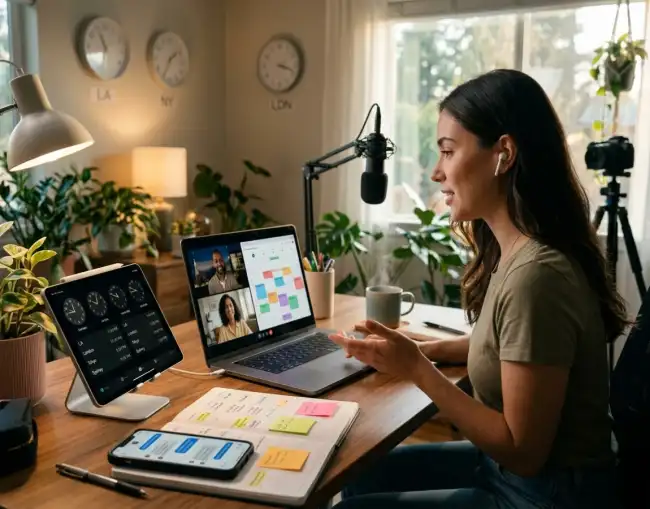
Imagine this: It is 11:00 PM in London, your co-creator in Los Angeles is just waking up to grab an iced matcha, and your brand partner in Tokyo is logging off for the weekend. Yet, your joint YouTube video drops in twelve hours, your shared TikTok series requires immediate cross-referencing of closed captions, and an unaddressed timezone calculation error means your live stream countdown is out of sync by exactly nine hours. For modern creators, this hyper-connected, round-the-clock reality is no longer an occasional anomaly; it is the daily operational baseline of international influencer projects. As global audiences crave cross-pollinated content and brands increasingly demand borderless activations, the modern digital creator must evolve from a solo artist into an executive producer of global logistics.
For years, the creator economy operated on localized bubbles. Success was defined by scaling within a single domestic market, collaborating with peers who lived down the street, or coordinating shoots within the same time zone. However, the maturation of digital platforms, the hyper-growth of global niche communities, and The Rise of Niche Networks: Why Specialized Influencer Groups Are Winning have shattered these geographic constraints. Today’s most lucrative and viral campaigns thrive on cross-continental synergy. Creators are pairing up across oceans to merge subscriber bases, blending European aesthetic storytelling with American high-energy pacing, and capturing the attention of multicultural demographics. But this borderless gold rush introduces a silent killer: chronic logistical friction. When calendar misalignment meets creative fatigue, the dream of global expansion quickly devolves into missed deadlines, strained professional relationships, and mental exhaustion.
The core thesis of this comprehensive guide is simple yet revolutionary: mastering global collaboration is not about working longer hours or sacrificing your sleep schedule to chase foreign clocks; it is about engineering a resilient infrastructure of asynchronous communication, smart automation, and disciplined boundary management. Throughout this deep dive, we will dissect the mechanical principles of global scheduling, establish step-by-step blueprints for deploying cutting-edge productivity tools, examine real-world case studies of massive cross-border triumphs and failures, and equip you with the precise tactical frameworks needed to execute international projects without losing your sanity. Whether you are orchestrating a multi-platform release or Unlocking Collaboration Campaigns That Go Viral Across 3 Platforms Simultaneously, the strategies ahead will redefine how you operate on the global stage.
Foundational Principles & Mechanics of Global Collaboration
To successfully orchestrate international influencer projects, one must first master the underlying mechanics that govern cross-border workflows. At its core, global scheduling is the intersection of temporal mathematics, digital infrastructure, and human psychology. Unlike traditional domestic projects where meetings can be spontaneously booked over a quick phone call, cross-continental partnerships require an intentional decoupling of real-time urgency from creative execution. Understanding these foundational pillars ensures that your collaborative engine runs smoothly, even when your partners are sleeping on the opposite side of the globe.
Temporal literacy is the first critical principle. Most creators make the amateur mistake of converting time zones manually in their heads, leading to costly errors involving Daylight Saving Time (DST) shifts, which do not happen concurrently across the United States, Europe, and the Southern Hemisphere. True scheduling creator collabs demands absolute reliance on standardized coordinated universal time (UTC) anchors and specialized remote collaboration apps that auto-adjust for seasonal anomalies. By treating time as a shared global resource rather than a localized convenience, you eliminate the friction of scheduling meetings during antisocial hours.
Furthermore, transitioning from synchronous dependency to asynchronous-first workflows is the ultimate equalizer in international projects. When you rely solely on live Zoom calls or instant messaging to drive a project forward, velocity grinds to a halt. Asynchronous workflows empower each creator to ideate, edit, and review content within their optimal biological peak hours, passing the digital baton seamlessly across time zones. Coupled with the right productivity tools, this methodology transforms time zone differences from a logistical barrier into a strategic 24-hour production cycle.
1. Architecting Your Global Tech Stack and Communication Hubs
Selecting the Right Remote Collaboration Apps for Your Workflow
The foundation of any successful cross-border creator partnership rests upon your software ecosystem. Relying on default consumer messaging apps like standard text threads or fragmented direct messages is a recipe for missed assets and miscommunication. Instead, you must curate an intentional suite of remote collaboration apps that centralize file sharing, version control, and real-time project visibility. Platforms like Notion, ClickUp, and Airtable serve as the single source of truth, allowing creators in New York, Sydney, and Berlin to view project pipelines in real-time without guessing who has the current cut of a video.
When selecting your core management hub, prioritize tools that offer robust mobile responsiveness and seamless third-party integrations. For instance, connecting your project management board to Google Drive, Frame.io, and Slack ensures that whenever a collaborator drops a new asset into a folder, an automated notification pings the appropriate channel with zero manual intervention. This level of automation is essential for international influencer projects, where waking up to a completed editing pass from an overseas partner accelerates your total production velocity by over fifty percent.
Equally important is establishing clear channel hygiene within your communication apps. Create distinct channels or spaces for specific workflows—such as #ideation, #rough-cuts, #audio-sync, and #legal-finance. Discourage collaborators from sending project-critical updates via ephemeral direct messages that easily get lost in the noise. By establishing these structural boundaries early, your remote collaboration apps become clean, searchable archives rather than chaotic digital clutter.
Mastering Time Zone Converters and Smart Calendar Ecosystems
Eliminating the cognitive load of mental math requires embedding specialized time zone intelligence directly into your daily routine. Tools like World Time Buddy, Every Time Zone, and advanced calendar extensions act as your logistical co-pilots when scheduling creator collabs. These platforms allow you to slide a visual timeline across multiple cities simultaneously, instantly highlighting the coveted 'overlap windows'—those golden hours where a 9:00 AM in London comfortably aligns with a 10:00 PM in Tokyo or a 1:00 PM in New York.
Beyond visual converters, you must optimize your public-facing booking links using tools like Calendly or SavvyCal configured with intelligent availability constraints. Set hard boundaries within these tools to ensure that international collaborators can only book meeting slots that fall within your designated working hours, preventing partners from inadvertently scheduling a sync at 3:00 AM in your local time zone. Furthermore, always configure your calendar invites to automatically detect and display the local time of the recipient, ensuring absolute clarity across all participants.
Finally, build buffer zones into every recurring calendar event. When working across disparate continents, internet connectivity drops, file transfer bottlenecks, and unexpected power outages happen. Adding a mandatory fifteen-minute buffer before and after collaborative syncs prevents back-to-back meeting fatigue and gives you breathing room to troubleshoot technical glitches without disrupting your entire daily schedule.
2. Establishing Asynchronous Workflows for 24-Hour Productivity
The Art of the Loom Video and Context-Rich Handoffs
When your collaborator is asleep while you are awake, real-time brainstorming sessions are impossible. To overcome this, master the art of the asynchronous video briefing using screen-recording tools like Loom or Vidyard. Instead of typing out a lengthy, ambiguous email explaining why a specific transition needs tweaking or how an intro hook should be restructured, record a three-minute visual walkthrough. Share your screen, highlight the timeline, point out specific frame errors, and narrate your creative vision with nuance and tone.
Context-rich handoffs drastically reduce revision cycles. When your overseas partner wakes up, they do not have to decipher confusing text notes; they can watch your exact thought process, ask questions in the comments, and immediately execute the requested revisions. This method transforms a potential 48-hour delay into a streamlined, single-night turnaround, keeping your international influencer projects moving forward at breakneck speed.
To maximize the effectiveness of asynchronous video briefs, always structure your recordings using a clear framework: state the objective of the asset, highlight what is working well, pinpoint exact timestamps that require changes, and outline the expected deliverables for the next handoff. This disciplined approach ensures your collaborators have total clarity without requiring a live meeting.
Structuring Shared Asset Libraries and Version Control Protocols
Nothing stalls a cross-border collab faster than a corrupted file or an accidental deletion of raw footage. Implementing strict cloud storage protocols and version control systems is non-negotiable. Utilize enterprise-grade cloud storage solutions like Google Drive, Dropbox, or specialized creator asset managers that maintain robust revision histories. Establish a rigid naming convention for every file—for example: ProjectName_VersionNumber_Date_AuthorInitials.mp4—to ensure that collaborators never accidentally edit an outdated draft.
Furthermore, designate specific folder hierarchies that separate raw uncompressed assets from proxy files and final exports. When working with massive 4K video files across international networks, direct cloud editing can lag due to bandwidth disparities. Utilize proxy workflows where lightweight, low-resolution files are shared for fast remote editing, while final color grading and audio mastering are conformed using the original master files stored locally or uploaded via high-speed transfer services like Frame.io or Aspera.
Regularly audit your shared folders to archive deprecated assets. A cluttered workspace causes cognitive fatigue and increases the likelihood of human error. By maintaining a pristine digital repository, you ensure that any creator on your team—regardless of their physical location—can locate, review, and deploy required assets in seconds.
3. Navigating Cultural Nuances, Language Barriers, and Tone
Bridging Cultural Norms and Communication Styles in Global Teams
Technical scheduling is only half the battle; managing the human element of international creator partnerships requires high cultural intelligence. Communication styles vary wildly across the globe. Direct, highly assertive feedback that feels completely normal in Western business cultures can be perceived as aggressive or disrespectful in other regions. Conversely, polite, highly nuanced phrasing common in East Asian or South American communications can sometimes be misinterpreted by Western creators as a lack of conviction or indecisiveness.
Establish a collaborative communication charter early in your partnership. Explicitly discuss how feedback will be delivered, what constitutes urgent versus non-urgent messaging, and how disagreements will be resolved. Cultivate an environment of psychological safety where international partners feel comfortable speaking up if a proposed publishing schedule conflicts with local holidays, cultural sensitivities, or regional platform regulations.
Moreover, be deeply cognizant of global holiday calendars. A major campaign launch scheduled during Golden Week in China, Ramadan in the Middle East, or the peak August holiday exodus in Europe will drastically underperform if local cultural nuances are ignored. Integrating global cultural calendars into your master project management board ensures your publishing dates align with audience receptivity rather than blind domestic assumptions.
Overcoming Language Barriers Through AI and Localization Frameworks
Collaborating with international creators often means navigating linguistic differences. While English serves as a common lingua franca in many digital circles, nuance, slang, and cultural humor frequently get lost in translation. Leverage modern AI-driven translation and transcription tools—such as DeepL, Descript, and automated multilingual captioning software—to bridge communication gaps during scriptwriting and conceptualization phases.
When drafting video scripts or caption copy intended for international audiences, prioritize clear, universally understood phrasing over localized idioms. If your collaboration targets multiple linguistic markets simultaneously, build dedicated localization sprints into your master schedule. Allow time for native-speaking creators or specialized translators to review scripts, ensuring that your collaborative content resonates authentically with each distinct regional audience.
Additionally, utilize AI voice cloning and high-quality dubbing tools where appropriate, but always defer to native creators for final sign-off on tone and delivery. Authenticity is the ultimate currency in the creator economy; preserving the unique voice and personality of each international collaborator across language barriers is what separates mediocre global campaigns from viral sensations.
4. Streamlining Collaborative Content Creation and Post-Production
Co-Editing and Reviewing Media Across Oceans
Reviewing video drafts across different continents used to mean exporting massive video files, uploading them to insecure transfer links, waiting hours for downloads, and exchanging endless, confusing email threads with timestamped notes. Today, cloud-based video review platforms like Frame.io have revolutionized how remote creators collaborate on post-production. These tools allow multiple creators across different time zones to pause a video on the exact frame, draw annotations directly onto the screen, and leave threaded comments that sync in real-time.
When utilizing these platforms for international projects, establish a clear review protocol. Assign a single 'lead editor' or 'project manager' per sprint cycle who is responsible for consolidating all feedback from international stakeholders before sending the final revision request. This prevents the creative team from receiving contradictory notes from partners in three different time zones, which often leads to creative paralysis and disjointed final cuts.
Furthermore, schedule dedicated asynchronous review windows. Instead of expecting immediate turnaround on a rough cut, give international collaborators a guaranteed 24-hour window to review and comment. This respects individual work-life balances and ensures that feedback is thoughtful, detailed, and actionable rather than rushed and reactive.
Coordinated Cross-Platform Publishing and Syndication
Launching a collaborative piece of content across multiple platforms and time zones requires military precision. If a creator in Los Angeles publishes their YouTube video at 9:00 AM PST, but their co-creator in London forgets to cross-post the corresponding TikTok until six hours later, the algorithmic momentum of the joint campaign is severely fractured. To prevent this, utilize enterprise social media management and scheduling tools like Agorapulse, Buffer, or Hootsuite configured specifically for creator syndication.
Develop a master publishing checklist that outlines exact launch times converted into every participant's local time zone. Include step-by-step instructions for pinning collaborative comments, tagging co-creators properly across platforms, updating bio links, and cross-promoting via Stories or community tabs. Automate where possible, but maintain a human check-in fifteen minutes prior to go-live to ensure all platform APIs are functioning smoothly.
Finally, remember that Creator Diaries: Surviving Burnout in the High-Pressure World of Social Stardom highlight the hidden mental toll of always-on digital execution. Guard your downtime fiercely; automation and robust scheduling tools exist precisely to liberate you from the tyranny of the clock so you can sustain long-term creative longevity.
5. Managing Contracts, Payments, and Legalities Across Borders
Navigating International Copyright, Revenue Splits, and Intellectual Property
Legal friction can instantly derail even the most harmonious international collaboration. When creators from different countries co-create intellectual property, questions of copyright ownership, ad-revenue splits, and platform monetization rights become exceptionally complex. Before a single frame of content is shot, you must execute a comprehensive digital collaboration agreement that clearly defines who owns the master assets, how ad revenue or brand sponsorship funds will be distributed, and what happens if one creator wants to exit the partnership.
International taxation and payment processing also present significant hurdles. Standardizing your payment rails using borderless financial services like Wise, Deel, or PayPal Business ensures that international funds can be transferred swiftly with minimal currency conversion fees. Consult with a legal professional specializing in digital creator rights to ensure your contracts comply with local regulations in both your jurisdiction and your collaborator's home country.
Furthermore, outline clear protocols for dealing with copyright strikes or platform policy violations across different regions. What is considered fair use or acceptable content on YouTube in the United States may trigger strict regulatory reviews or demonetization in the European Union or Asia-Pacific regions. Proactive legal alignment protects your revenue streams and preserves your professional reputation.
Establishing Dispute Resolution and Crisis Communication Protocols
When working across time zones, small misunderstandings can quickly escalate into major interpersonal conflicts if left unaddressed. Establishing a clear dispute resolution framework is essential for maintaining healthy long-term partnerships. Agree in advance on how creative disagreements will be settled—such as deferring to the creator whose audience is primary for that specific market, or utilizing an agreed-upon third-party mediator within your niche network.
Additionally, create a crisis communication protocol for high-stakes collaborative campaigns. If a brand partner pulls out at the last minute, a platform algorithm shifts dramatically, or a PR controversy arises involving one of the participants, you need an emergency communication channel—such as a dedicated Signal or WhatsApp group—where all international stakeholders can convene instantly regardless of the local hour.
By preparing for worst-case scenarios before they manifest, you insulate your business from emotional decision-making and ensure your international projects remain resilient under pressure.
Real-World Case Studies & Scenarios
Case Study 1: The Transatlantic YouTube Takeover (Success Story)
The Scenario: Sarah, a lifestyle vlogger based in Toronto, Canada, wanted to execute a simultaneous three-part collaborative series with Liam, a tech reviewer based in London, UK, and Kenji, a gaming creator based in Tokyo, Japan. The goal was to launch all three videos on the exact same calendar day to maximize cross-pollination of their combined 3.5 million subscribers.
The Execution: Instead of relying on chaotic email threads, the trio established a centralized Notion workspace managed via an asynchronous workflow. They used Loom video briefs for all creative handoffs and scheduled live syncs exclusively during a narrow two-hour window where Toronto's late afternoon overlapped with London's evening and Tokyo's early morning. They utilized Frame.io for collaborative video editing and synchronized their final YouTube publish times using an automated scheduling tool.
The Result: The campaign launched flawlessly, resulting in a 34% subscriber cross-transfer across all three channels within the first 72 hours and securing top trending spots in Canada, the UK, and Japan simultaneously. Zero burnout was reported, thanks to strict adherence to asynchronous boundaries.
Case Study 2: The Midnight Miscalculation (Failure & Lesson Learned)
The Scenario: Marcus, a fitness influencer in Los Angeles, partnered with a major nutrition brand and an influencer in Sydney, Australia, to host a high-profile global Instagram Live workout session. Marcus calculated the time difference in his head as a 16-hour gap instead of the correct 18-hour gap due to an upcoming Daylight Saving Time transition he overlooked.
The Execution: Marcus promoted the live stream based on his faulty mental calculation. On the day of the event, the Sydney creator logged on two hours late according to local Australian time, while Marcus was fast asleep. By the time Marcus was frantically awakened by frantic direct messages, the live stream audience had completely dispersed, and the brand sponsor threatened to withhold payment.
The Lesson Learned: Never rely on mental math for global scheduling. This costly failure forced Marcus to adopt standardized timezone software (World Time Buddy) and mandate automated calendar booking links with built-in DST detection for all future international projects.
Critical Mistakes & How to Avoid Them
- Mistake 1: Relying on Mental Math for Time Zone Conversions. Manually calculating hours across borders inevitably leads to Daylight Saving Time errors and missed meetings. Countermeasure: Always use automated scheduling tools and visual time-zone converters that account for seasonal shifts automatically.
- Mistake 2: Operating Exclusively via Synchronous Meetings. Forcing international collaborators into frequent live Zoom calls destroys productivity and drains creative energy. Countermeasure: Adopt an asynchronous-first workflow utilizing Loom video briefs, shared project management boards, and cloud review tools.
- Mistake 3: Neglecting Cultural Nuances and Regional Holidays. Launching campaigns during regional holidays or using tone-deaf communication styles damages brand reputation. Countermeasure: Build a global cultural calendar into your project planning and establish clear communication charters with overseas partners.
- Mistake 4: Using Fragmented Communication Channels. Spreading project updates across standard text threads, direct messages, and random emails causes critical assets to get lost. Countermeasure: Centralize all communication and file sharing within dedicated remote collaboration apps like Notion, Slack, and Frame.io.
- Mistake 5: Failing to Establish Clear Legal and Revenue Contracts. Skipping formal contracts regarding intellectual property and ad-revenue splits invites financial disputes and copyright strikes. Countermeasure: Execute comprehensive digital collaboration agreements via borderless legal and payment platforms before shooting begins.
Comprehensive Comparison Table: Global Scheduling & Collaboration Tools
| Tool Category | Recommended Platforms | Primary Use Case | Best For Time Zone Management |
|---|---|---|---|
| Project Management | Notion, ClickUp, Airtable | Centralized workflow tracking & asset organization | Real-time global visibility without meetings |
| Visual Time Converters | World Time Buddy, Every Time Zone | Finding overlapping working hours across continents | Eliminating mental math and DST errors |
| Asynchronous Briefing | Loom, Vidyard | Recording screen-share walkthroughs and feedback | Bridging communication gaps across sleeping hours |
| Post-Production Review | Frame.io, Descript | Cloud-based video editing and frame-accurate comments | Coordinating multi-country editorial sign-offs |
| Smart Calendar Booking | Calendly, SavvyCal | Automated meeting scheduling with availability guards | Preventing off-hours booking by overseas partners |
Frequently Asked Questions
How do I handle time zone differences when working with creators in vastly different regions?
The key is transitioning away from real-time meetings and embracing asynchronous-first workflows. Utilize visual time zone converters to identify your narrow overlap windows for essential live syncs, and rely on screen-recording tools like Loom and centralized project management hubs for day-to-day communication. This allows each creator to work during their peak biological hours while keeping the project moving forward 24/7.
What are the best remote collaboration apps for managing international influencer projects?
A robust global tech stack typically includes Notion or ClickUp for master project tracking, Frame.io for cloud-based video reviews and editing, World Time Buddy for timezone planning, and Slack or Discord for structured team communication. Ensuring all tools are mobile-responsive and integrated with cloud storage guarantees seamless execution across continents.
How can I prevent Daylight Saving Time (DST) errors when scheduling global collabs?
Never calculate time zones manually. Always utilize smart calendar scheduling tools like Calendly or SavvyCal that automatically detect and adjust for seasonal DST shifts across different hemispheres. Additionally, anchor your recurring planning meetings to standardized UTC times rather than local clock times.
What should be included in a cross-border creator collaboration contract?
Your agreement should explicitly outline intellectual property ownership, copyright distribution, exact ad-revenue or sponsorship splits, platform monetization rights, dispute resolution mechanisms, and compliance with regional platform policies. Utilize borderless payment platforms like Wise or Deel to streamline international transactions securely.
How do I manage creative feedback without driving my overseas collaborators crazy?
Establish a centralized review protocol using frame-accurate cloud video tools where all stakeholders can leave threaded comments in one place. Assign a single project manager to consolidate feedback before sending it to the creative team, and always respect asynchronous review windows rather than demanding instant turnaround across time zones.
Strategic Roadmap & Final Takeaway
As the creator economy continues its unstoppable march toward hyper-globalization, the ability to seamlessly schedule, execute, and scale international influencer projects will separate amateur hobbyists from elite digital entrepreneurs. The future of content creation belongs to those who master the art of asynchronous synergy, leverage cutting-edge remote collaboration apps, and respect the human boundaries of global teamwork. By implementing the step-by-step blueprints, technological frameworks, and protective countermeasures outlined in this guide, you can eliminate logistical friction and unlock limitless creative potential across every corner of the globe.
Your immediate next steps are clear: audit your current global tech stack, eliminate manual time-zone calculations from your daily routine, and transition your collaborative workflows to an asynchronous-first model. Embrace the power of borderless teamwork today, and build a sustainable, globally recognized digital empire without sacrificing your sanity or your sleep.
Be the first creator to share your take on this story.