
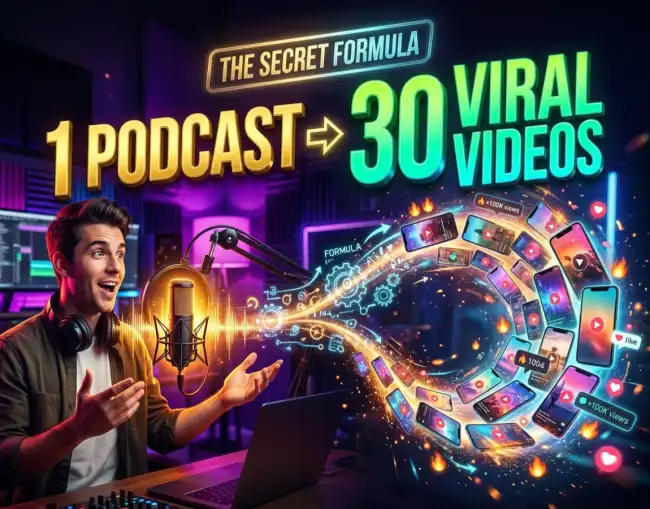
The modern attention economy is a relentless beast. Creators, thought leaders, and enterprise podcasters pour hundreds of hours into recording, editing, and producing long-form audio gold, only to watch their episodes collect digital dust after a brief, initial spike in downloads. Meanwhile, the algorithmic gods ruling TikTok, Instagram Reels, and YouTube Shorts demand a daily, almost insatiable sacrifice of vertical, high-octane short-form content. For years, this dichotomy forced creators into an exhausting binary choice: spend your life on a content treadmill, or fade into algorithmic obscurity. But a profound paradigm shift has quietly occurred in how digital empires are built, transforming a single long-form recording into an omnipresent ecosystem.
At the intersection of audience growth and operational efficiency lies the art and science of strategic content extraction. The secret formula for transforming one hour-long audio or video conversation into thirty high-converting, viral-ready micro-assets is no longer a privilege reserved for elite media agencies with massive budgets. It is a systematic discipline rooted in behavioral psychology, linguistic pattern recognition, and relentless multi-platform distribution. When executed correctly, this approach bypasses the traditional constraints of organic reach, allowing creators to scale their footprint exponentially without increasing their production hours. As algorithms evolve to prioritize engagement velocity and retention over simple follower counts, understanding how to maximize every single minute of recorded media has become the ultimate competitive advantage in the creator economy.
This comprehensive blueprint will deconstruct the exact mechanics, technical workflows, and psychological triggers required to master this transition. By diving deep into granular processes—ranging from automated transcript mining to manual hook engineering—you will learn how to build an unstoppable distribution engine. Whether you are scaling an emerging brand or looking to inject new life into your existing media library, mastering the art of repurposing content and turning a podcast to viral video assets will fundamentally transform your approach to audience acquisition. Furthermore, when paired with insights from From 0 to 100K Followers: The Exact Content Matrix That Drives Organic Growth, you will discover how these micro-videos serve as the exact fuel needed to power a full-scale digital ecosystem.
Deconstructing the Anatomy of a Viral Micro-Asset
The Psychology Behind the First Three Seconds
The success of any short-form video hinges almost entirely on its opening three seconds. In an environment where users scroll at lightning speed, your visual and auditory hook must interrupt their cognitive autopilot. When extracting clips from a long-form podcast, you cannot simply start the video at the beginning of a sentence. Podcasters naturally use conversational filler, contextual buildup, and gentle warm-ups that spell instant doom for short-form retention metrics.
Instead, master editors look for the emotional apex or the most controversial statement within a conversational arc and place it at the very beginning of the clip. This non-linear editing style creates an immediate open loop in the viewer's mind. They are thrust into the middle of a high-stakes disagreement, a shocking statistic, or a counterintuitive mindset shift. By forcing the brain to pause and seek resolution, you instantly spike your average view duration—the single most important algorithmic ranking factor across every major short-form platform.
Isolating High-Yield Narrative Arcs
Not every minute of a podcast is created equal. A standard sixty-minute episode typically contains three to five distinct thematic clusters, but only a fraction of those moments possess viral DNA. To identify these high-yield narrative arcs, you must listen with a dual-layered mindset: one ear tuned to the overarching educational value, and the other tuned to emotional resonance. Look for moments where the guest or host shares a vulnerable failure, challenges an industry dogma, or delivers an actionable framework in under sixty seconds.
These self-contained narrative units require minimal outside context to be understood and appreciated by a cold audience. If a viewer needs to listen to the preceding twenty minutes of conversation to understand the punchline, the clip will fail. The best micro-assets operate like miniature parables or standalone documentaries, introducing a premise, escalating the tension through dialogue, and resolving with a memorable takeaway.
Structuring Content for Infinite Loopability
One of the most sophisticated tactics used by elite content distribution teams is engineering videos for seamless loopability. When a short-form video finishes and restarts without the viewer consciously realizing it, the platform registers an effective view duration exceeding one hundred percent. This algorithmic signal practically guarantees that the video will be pushed out to a broader tier of the recommendation engine.
To achieve this, structure your clips so that the final sentence or concluding thought naturally flows back into the opening hook. This linguistic gymnastics requires cutting words precisely and utilizing clever audio crossfades. When a viewer watches the video loop a second time before swiping away, the algorithm interprets that prolonged dwell time as an indicator of supreme content quality, supercharging your content distribution efforts across the board.
The 5-Stage Content Extraction Framework
Stage 1: Comprehensive Transcription and Semantic Analysis
The journey from a raw audio file to thirty viral assets begins with pristine documentation. Relying on your memory or rough chapter markers will cause you to miss dozens of hidden gems buried deep within conversational tangents. The first step in our framework is running your long-form episode through advanced speech-to-text transcription software, ensuring speaker diarization is accurate so you can trace dialogue back and forth between host and guest.
Once you have a clean text document, employ semantic analysis tools or leverage AI-driven prompts to scan the text for sentiment spikes, emotional keywords, and thematic shifts. Modern creators utilize advanced data pipelines, much like those discussed in How AI Analytics Are Revolutionizing Influencer Discovery for Global Brands, to identify pattern recognition anomalies and high-engagement topics before manual editing even begins.
Stage 2: Categorization by Content Pillars
Raw transcripts are rarely ready for immediate production. Once potential clips are flagged, you must organize them into distinct content pillars that align with your overall brand or channel strategy. A single podcast episode might touch upon personal productivity, financial strategy, and mental health. By categorizing your extracted segments into these specific buckets, you ensure a balanced publishing calendar.
This categorization also allows you to batch your editing sessions effectively. Instead of jumping wildly between different tones and topics, editors can process all productivity-related clips in one sitting, maintaining a consistent aesthetic and pacing style across that specific content series. This methodical approach streamlines production workflows and prevents burnout among your creative team.
Stage 3: Granular Clipping and Aspect Ratio Conversion
With your moments selected and categorized, the technical conversion process begins. Import your long-form footage into your timeline editor of choice and crop the native 16:9 or horizontal audio-visual recording into a vertical 9:16 aspect ratio. This step demands dynamic framing—tracking the speaker's face as they lean, gesture, or shift positions to ensure they remain dead-center in the vertical frame.
During this stage, aggressive trimming is mandatory. Remove every dead breath, stutter, filler word, and awkward pause. Short-form video rewards hyper-density; every single frame must advance the narrative or provide visual stimulation. If a sentence can be shortened without losing its core impact, cut it mercilessly.
Stage 4: Kinetic Typography and Visual Anchors
A staggering percentage of social media users consume video content with the sound muted, especially in public spaces or office environments. Therefore, relying solely on spoken audio is a fatal strategic error. You must implement kinetic, animated typography that highlights key words in real time, synchronizing captions precisely with the speaker’s cadence.
Beyond standard subtitles, enhance retention by integrating visual anchors: B-roll footage, relevant meme inserts, zooming camera punches, and graphic overlays that emphasize numerical data or striking quotes. These visual pattern interrupts reset the viewer's attention span every two to three seconds, dramatically reducing scroll-away rates and driving up completion metrics.
Stage 5: Metadata Engineering and Native Optimization
The final stage of the extraction framework happens before publishing: engineering your metadata for platform-specific search engines. TikTok, Instagram, and YouTube Shorts have largely replaced traditional search engines for younger demographics. Your captions, hashtags, and on-screen text must contain targeted keyword phrases related to your niche.
Write compelling titles that spark curiosity rather than simply describing what happens in the clip. Pair these with a strategic mix of broad, high-volume hashtags and hyper-specific niche tags. Finally, schedule your thirty clips across staggered distribution windows, ensuring you never cannibalize your own reach by posting competing assets simultaneously.
Advanced AI Tools and Automated Transcription Workflows
Leveraging Speech-to-Text Engines for Speed
Manual clipping is a relic of the past for high-output media companies. Trying to comb through a two-hour podcast manually to find thirty viable clips is an inefficient use of creative capital. Today, specialized AI clipping tools ingest long-form video files, automatically analyze audio transcripts, score moments based on viral potential, and output vertical-ready draft clips in a matter of minutes.
These platforms utilize machine learning models trained on millions of viral videos, allowing them to detect crowd reactions, host laughter, raised voices, and sudden rhetorical shifts. While these automated tools provide an incredible baseline, they should be viewed as sophisticated assistants rather than complete replacements for human editorial judgment. The AI handles the heavy lifting of raw extraction, freeing up human creators to refine the narrative arc and inject authentic brand personality.
Human-in-the-Loop Quality Assurance
Relying one hundred percent on automated software often results in sterile, cookie-cutter content that fails to capture the subtle nuances of human conversation. The sweet spot of modern content production is a rigorous human-in-the-loop workflow. Once the AI extracts and pre-cuts potential segments, a skilled human editor reviews each clip for emotional resonance, contextual integrity, and aesthetic polish.
During this QA phase, editors fix awkward auto-caption line breaks, adjust facial tracking coordinates, and ensure that the chosen hook genuinely delivers on its promise. This hybrid approach combines the blistering speed of machine automation with the artistic intuition of human storytelling, resulting in an output volume and quality that is virtually impossible to achieve manually.
Building a Centralized Content Vault
As you consistently run episodes through your extraction workflow, you will accumulate hundreds of micro-assets. Managing this digital library requires a centralized, cloud-based content vault organized by keyword tags, emotional tone, and performance history. Leading digital publishers utilize digital asset management (DAM) systems integrated with cloud storage to ensure remote editors can access raw assets instantly.
This vault becomes an invaluable business asset over time. When a specific industry trend suddenly goes viral on social media, you can instantly query your vault for past podcast discussions on that exact topic, remix the footage with fresh captions or commentary, and capitalize on the trend within hours instead of days.
Multi-Platform Distribution Matrix
Tailoring Content for TikTok’s Native Culture
Each short-form platform possesses its own distinct subculture, algorithmic quirks, and community expectations. TikTok rewards raw authenticity, rapid trend adoption, and community participation. When distributing your podcast clips to TikTok, avoid over-polished corporate styling. Let the edges remain slightly rough; feature unedited behind-the-scenes banter or raw emotional reactions.
Furthermore, actively leverage TikTok’s native features, such as green screen replies, duet prompts, and trending audio tracks subtly layered beneath your dialogue. Encourage viewers to drop their opinions in the comments section, as comment velocity is one of TikTok's primary indicators for pushing content out to the wider "For You" page.
Maximizing Instagram Reels Through Aesthetic Polish
Instagram Reels operates in a slightly different cultural sphere, skewing toward higher aesthetic polish, lifestyle integration, and aspirational framing. While the raw narrative of your podcast clip remains king, the visual presentation on Reels must match the platform's clean, curated design standards.
Invest time in color grading your vertical crops, ensure your typography uses clean, modern sans-serif fonts, and craft caption copy that reads like a mini-essay or a thought-provoking LinkedIn post. Additionally, utilize Instagram’s collaborative posting features to cross-pollinate audiences with your podcast guests, instantly exposing your repurposed content to an entirely new follower base.
Dominating YouTube Shorts via Search Optimization
YouTube Shorts bridges the gap between ephemeral social media entertainment and long-term search discoverability. Unlike TikTok or Reels, where content has a relatively short shelf life, YouTube Shorts can generate views, subscribers, and podcast downloads for months or even years after publication because they are indexed by the world's second-largest search engine.
When publishing your extracted clips to YouTube Shorts, prioritize searchable titles, comprehensive descriptions, and clear calls to action pointing viewers back to the full-length podcast episode. Treat every short as an entry-level funnel asset designed to capture search traffic and convert casual scrollers into dedicated, long-form listeners.
Analytics, Iteration, and Growth Optimization
Decoding Retention Graphs and Drop-off Points
Publishing thirty clips from a single podcast gives you a massive statistical dataset to analyze. Instead of guessing why certain videos perform and others flatline, dive deep into the native analytics dashboards provided by each platform. Examine the retention graph for every single video you publish, noting the exact second where viewers experienced a sharp drop-off.
If viewers consistently abandon ship at the five-second mark, your hook was weak or misleading. If they drop off midway through, the narrative lost momentum or became overly complex. Use these forensic insights to course-correct your editing style for the next batch of thirty clips, steadily refining your conversion rates over time.
Double-Down Strategies on Winning Formats
The Pareto principle applies heavily to content distribution: roughly eighty percent of your total views will come from twenty percent of your repurposed clips. Once you identify which specific topics, guest archetypes, or visual styles resonate most with your audience, immediately double down on those formats.
For example, if clips featuring controversial industry debates outperform educational how-tos by a factor of five, restructure your podcast recording schedule to deliberately invite more polarizing guests or dedicate specific segments of your show to debating contentious industry topics. Let your short-form analytics dictate your long-form production strategy.
Real-World Case Studies & Scenarios
Case Study 1: The B2B SaaS Podcaster Scaling to Millions
Consider the case of a mid-sized B2B software podcast struggling to break past five thousand downloads per episode. Despite hosting world-class founders and venture capitalists, their distribution strategy was limited to posting static audiograms and link drops on professional networks. Frustrated by stagnant growth, the marketing team implemented the 30-clip extraction framework.
By slicing each one-hour episode into thirty vertical micro-assets, optimizing them with kinetic typography, and distributing them systematically across TikTok, Reels, and Shorts, the brand transformed its digital footprint. Within ninety days, cumulative short-form views surpassed four million. More importantly, click-through tracking revealed a 300% surge in full-length podcast listens and a direct increase in software demo sign-ups. The lesson is clear: long-form authority combined with short-form distribution creates an unbeatable acquisition funnel.
Case Study 2: The Pitfalls of Automated Laziness
Conversely, consider the cautionary tale of an independent lifestyle creator who attempted to fully automate their workflow without human oversight. Relying entirely on raw, unedited AI software to slice and publish thirty clips straight to social media resulted in a disaster. The AI clipped sentences mid-word, generated horrific auto-captions with spelling errors, and selected mundane, contextual transitions that lacked any hook value.
Within two weeks, the creator’s accounts were flagged by platform algorithms for repetitive, low-quality content, tanking their overall account reach. The takeaway is absolute: automation is a force multiplier for efficiency, not a replacement for human creativity and quality assurance. Without strategic human curation, scaling bad content only accelerates your failure.
Critical Mistakes and How to Avoid Them
- Neglecting Native Aspect Ratios: Uploading horizontal 16:9 podcast clips into vertical feeds with black bars at the top and bottom kills engagement. Always crop, reframe, and track speakers dynamically to fill the 9:16 vertical screen.
- Failing to Edit for Pacing: Leaving conversational filler words, stutters, and long pauses in short-form videos causes immediate scroll abandonment. Cut ruthlessly to maintain high narrative density.
- Ignoring Audio-Off Consumption: Assuming everyone listens with sound turned on is a critical error. Always bake kinetic, easy-to-read captions directly into your video files.
- Using Misleading or Clickbait Hooks: While strong hooks are necessary, baiting viewers with a dramatic statement that is never actually resolved in the clip destroys your audience trust and tanks retention metrics.
- Spamming Duplicate Content: Uploading the exact same video file with identical metadata across multiple platforms simultaneously can trigger spam filters. Tailor your captions, hashtags, and visual framing for each specific platform's native culture.
Comprehensive Comparison Table
| Strategy / Approach | Production Effort | Algorithmic Reach | Long-Term Value | Best Suited For |
|---|---|---|---|---|
| Manual Clipping & Editing | High (10+ hours/episode) | Maximum (Tailored & High Quality) | High | Established brands with dedicated video editors |
| AI-Assisted Hybrid Workflow | Medium (2-3 hours/episode) | High (Optimized & Polished) | High | Growing creators and lean marketing teams |
| Fully Automated AI Curation | Low (<30 minutes/episode) | Low (Prone to low retention & spam flags) | Low | Mass-volume spam accounts (Not recommended) |
| Static Audiograms & Link Drops | Low | Minimal | Negligible | Outdated podcasters unaware of modern distribution |
Frequently Asked Questions
How long should a repurposed podcast clip be for maximum viral potential?
The sweet spot for viral short-form content generally falls between 30 and 55 seconds. This duration allows enough time to introduce a compelling premise, develop the argument or story, and deliver a satisfying punchline or resolution without triggering audience drop-off. However, exceptionally punchy micro-clips under 15 seconds can perform exceptionally well if they feature an intense emotional reaction or a shocking revelation.
Do I need expensive video editing software to repurpose podcasts?
Not at all. While professional editors often rely on industry-standard software like Adobe Premiere Pro or DaVinci Resolve for advanced framing and color grading, there is a booming ecosystem of accessible browser-based editing tools. Many modern platforms feature built-in auto-captions, facial tracking, and template resizing that allow even beginner creators to produce high-quality vertical assets quickly.
How do I prevent my short-form videos from hurting my full-length podcast brand?
Repurposing content should never feel cheap or sensationalized to the point of misrepresenting your show. Always maintain the authentic context of the conversation. Treat short-form clips as high-value movie trailers for your full-length episodes. When viewers realize your short clips consistently deliver genuine intellectual or entertaining value, they will trust your brand and eagerly seek out the full-length interviews.
How many times a day should I post repurposed podcast clips?
Consistency is more important than sheer volume, but when you have thirty clips from a single episode, posting one to three times per day across your active channels is optimal. This frequency keeps your brand top-of-mind with algorithms and followers without overwhelming feeds or diluting your engagement metrics. Stagger your publishing times across different platforms to maximize audience reach.
What is the best way to drive traffic from a short video back to the full podcast?
The most effective conversion mechanisms include utilizing platform-specific features like pinned comments with direct episode links, updating your social media bio with a smart landing page link, and verbally mentioning the full episode title within the video or caption. Additionally, ending your short clip right before a major revelation—with an on-screen text prompt directing viewers to the full episode for the conclusion—is a highly effective psychological conversion tactic.
Strategic Roadmap and Final Takeaway
Mastering the art of repurposing content is no longer an experimental growth hack; it is the foundational pillar of modern media distribution. By taking one high-value, long-form podcast recording and executing our five-stage extraction framework, you unlock an engine capable of feeding your social channels with thirty viral-ready assets every single week. This disciplined methodology bridges the gap between deep, substantive thought leadership and the rapid-fire demands of vertical video algorithms.
As we look toward the next two to five years, the integration of AI analytics, automated transcription, and hyper-personalized distribution will only accelerate. Creators and brands who embrace this multi-platform ecosystem approach today will capture disproportionate market share and build unbreakable audience loyalty. Start auditing your existing media library, implement a hybrid human-in-the-loop editing workflow, and transform your long-form conversations into an unstoppable digital empire.
Be the first creator to share your take on this story.