
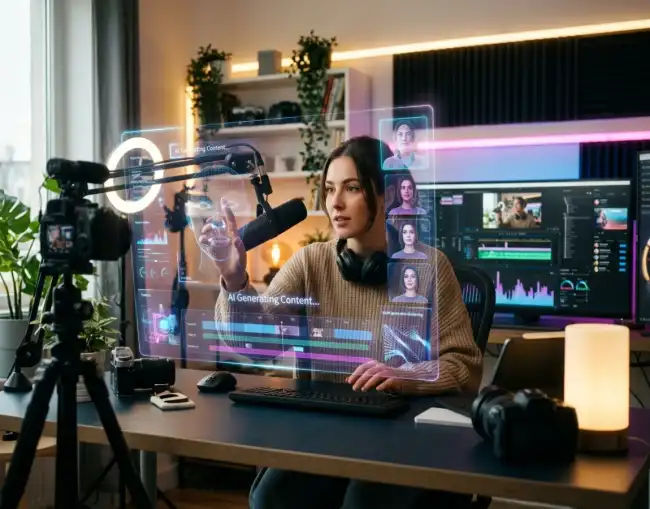
The glowing blue ring of a ring light used to signal the exhaustive commencement of a solitary ritual: hours of scripting, shooting dozens of retakes, scrubbing through timeline edits, and meticulously writing caption hooks designed to appease the capricious algorithms of Instagram, TikTok, and YouTube. Today, that solitary creator is no longer alone in the studio. Behind the camera, silent digital co-pilots powered by machine learning and neural networks are orchestrating the entire lifecycle of digital storytelling. We are living through a profound structural tectonic shift, one where the manual craftsmanship of social media content is colliding with the scalable, hyper-intelligent capabilities of artificial intelligence. This is not a subtle evolution of software toolsets; it is a total rewriting of the rules that govern how human influence, attention, and commerce intersect in the digital public square.
To understand the magnitude of this shift, one must examine the macro-economic pressures bearing down on modern digital publishers and creators. Audience expectations have hyper-escalated. Consumers now demand cinematic production values, hyper-localized personalization, and daily output across four distinct platforms, all while craving the authentic, unvarnished human connection that made influencer marketing a multi-billion-dollar industry in the first place. For years, this created an unsustainable bottleneck. Creators burned out, agencies scrambled to scale human talent networks, and brands faced diminishing returns on manual campaign workflows. Into this operational vacuum stepped AI in influencer marketing, fundamentally altering the economics of scale, creativity, and distribution.
Yet, this technological renaissance brings profound philosophical and strategic dilemmas. When an algorithm can synthesize photorealistic imagery, write high-converting direct-response hooks, and clone a creator's voice in thirty different languages, what happens to authenticity? How do brands maintain consumer trust when the line between human expression and synthetic generation blurs into obscurity? This investigative deep-dive explores how advanced content automation and generative AI are reshaping the creator economy. We will dissect the technical mechanics, layout step-by-step strategic blueprints for deployment, analyze real-world case studies, and provide an unvarnished look at the risks, rewards, and future trajectory of AI-driven influence.
Foundational Principles and Mechanics of AI in Content Creation
Before examining the strategic execution of AI within influencer ecosystems, it is vital to demystify the underlying technology. At its core, the current wave of innovation is driven by generative models—neural networks trained on petabytes of human text, imagery, video, and audio data. Unlike traditional software that executes rigid, pre-programmed instructions, generative AI models recognize patterns, predict probabilistic sequences, and synthesize entirely novel digital assets based on natural language prompts.
In the context of the creator economy, these capabilities manifest across three primary pillars: ideation and research, asset generation, and post-production optimization. Ideation engines ingest real-time social listening data, trending audio metrics, and semantic search queries to predict viral content angles before they peak. Generative AI tools then translate these concepts into storyboarded scripts, synthetic voiceovers, hyper-realistic B-roll footage, and localized multi-lingual translations. Finally, automated analytics pipelines evaluate the performance of these deployed assets, closing the feedback loop by feeding engagement data back into the generation models to continuously refine future outputs.
Understanding these mechanics requires recognizing that AI is fundamentally a leverage multiplier. It does not replace the strategic intuition of a seasoned creator; rather, it compresses days of labor into seconds of computational processing. Creators who master the symbiosis between human creative direction and machine-driven execution are rapidly outpacing traditional production houses, producing volumes of content previously reserved for enterprise media conglomerates.
Strategic Blueprint for Integrating Generative AI
1. Building an AI-Powered Ideation and Trend-Spotting Engine
The foundation of any successful influencer channel is topical relevance and immediate hook execution. Relying on gut feeling or manual scrolling through TikTok FYPs is no longer a viable strategy for creators managing multiple brands or high-volume publishing schedules. The first step in an advanced AI workflow is establishing a predictive listening framework.
Creators and agencies should integrate custom Large Language Model (LLM) instances with real-time social API connectors. By feeding historical channel analytics, competitor performance metrics, and trending hashtag data into the system, creators can prompt the AI to generate hyper-specific content matrices. For instance, instead of asking an AI to "give me video ideas," prompt it with: "Analyze the top 20 performing videos in the sustainable fashion niche over the last 30 days, identify the underlying psychological triggers in their hooks, and generate 10 unique video concepts tailored to Gen Z buyers."
Expert Insider Tip: Never publish raw, unedited AI-generated ideas. Use the AI to generate 50 disparate concepts, then apply human curation to select the top three that align with your unique brand voice and personal narrative arc.
2. Scriptwriting, Hook Optimization, and Narrative Architecture
The first three seconds of a modern social video dictate its algorithmic fate. If viewer retention drops off precipitously, the platform's distribution engine buries the content. AI excels at analyzing narrative pacing, emotional cadence, and psychological friction points within written scripts.
When drafting scripts using generative tools, utilize structured prompting frameworks. Instruct the AI to act as a direct-response copywriting expert specializing in short-form video retention. Provide it with specific structural constraints, such as the Hook-Retain-Reward framework. The AI should generate multiple variations of the opening hook, allowing the creator to A/B test different psychological angles—such as curiosity gaps, contrarian statements, or statistical shock value—before filming begins.
Expert Insider Tip: Train your AI scriptwriter on your top-performing past scripts. By providing samples of your authentic writing style and speech patterns, the model learns to mimic your cadence, significantly reducing the robotic phrasing common in generic AI outputs.
3. Synthetic Media, Voice Cloning, and Visual Expansion
Production constraints are often the primary bottleneck for scaling influencer channels. Shooting high-end B-roll, recording pristine voiceovers in noisy environments, or re-shooting segments due to minor dialogue errors consumes immense amounts of time and capital. Generative video and audio tools have fundamentally solved these friction points.
Modern creators utilize voice-cloning technology to record pickup lines or entire script revisions without returning to a sound booth, ensuring acoustic continuity across multi-part videos. Similarly, generative visual tools allow creators to expand aspect ratios, generate photorealistic contextual backgrounds, or synthesize custom graphics that illustrate complex talking points on the fly. This level of production polish, once requiring dedicated motion design teams, is now accessible to solo creators.
Expert Insider Tip: Always maintain strict quality control over synthetic visuals. Over-reliance on hyper-glossy stock AI imagery can trigger "uncanny valley" reactions from audiences, alienating viewers who value raw, unfiltered human connection.
4. Automated Content Repurposing and Omnichannel Distribution
Publishing a long-form YouTube video or hosting a live stream is only half the battle. The true engine of digital influence relies on omnichannel atomization—taking a single piece of long-form core content and slicing it into dozens of bite-sized assets tailored for TikTok, Instagram Reels, YouTube Shorts, and LinkedIn.
AI-driven clipping tools now ingest long-form video files, automatically analyze transcript semantics, identify high-engagement moments, crop footage to vertical 9:16 aspect ratios, apply dynamic kinetic captions, and generate contextual titles and descriptions for each platform. This transforms what was once a grueling eight-hour editing shift into an automated background workflow.
Expert Insider Tip: Customize the automated caption styles to match your channel's visual branding. Generic auto-generated captions signal low effort to savvy consumers; distinct typography and color-coded keyword highlights elevate perceived production value.
5. Hyper-Personalization and Dynamic Influencer Campaigns
For brands and agencies orchestrating large-scale influencer campaigns, the challenge has always been customization at scale. Managing hundreds of creators, each producing bespoke content for micro-segments of an audience, was previously an administrative nightmare.
AI platforms now enable brands to deploy dynamic creator campaigns where synthetic variants of an influencer's likeness or voice can address specific consumer segments directly. While fully synthetic virtual influencers are carving out niche markets, human-first hybrid campaigns—where human creators use AI to generate localized, personalized video messages for different tier-one customer segments—are yielding unprecedented conversion rates.
Expert Insider Tip: Transparency is non-negotiable in sponsored campaigns. When utilizing AI to generate localized variations of creator endorsements, ensure compliance with FTC guidelines and platform disclosures regarding synthetic media.
Real-World Case Studies and Scenarios
To ground these strategic methodologies in reality, let us examine two contrasting case studies within the creator economy: an ambitious lifestyle influencer who successfully scaled an empire using content automation, and a major beauty brand that suffered a catastrophic public relations misstep due to reckless AI deployment.
Case Study A: The Scaled Solo Creator (Success)
Sarah Jenkins, a mid-tier lifestyle and productivity creator with 400,000 combined followers, was facing severe creative burnout. Operating entirely solo, her output had dwindled to one YouTube video and two TikToks per week. In Q1, Sarah implemented an AI-first workflow utilizing automated research agents, AI script structuring, and automated short-form clipping tools.
By leveraging generative AI to handle her initial research and hook generation, Sarah reduced her prep time from six hours per video to forty-five minutes. She used automated clipping software to transform her weekly YouTube deep-dive into five polished TikToks and Reels. Within 90 days, her publishing frequency increased by 300%. More importantly, because her time was liberated from mechanical editing, she invested heavily in higher-value creative brainstorming and community engagement. The result? Her overall audience grew by 140% in six months, and brand sponsorship revenue doubled due to expanded cross-platform inventory.
Case Study B: The Synthetic Misstep (Failure)
Conversely, a prominent cosmetics brand launched an influencer campaign utilizing entirely AI-generated "virtual influencers" designed to look indistinguishable from real human creators, without explicitly disclosing their synthetic nature to the audience. The brand bypassed human creator partnerships entirely to cut production costs.
The backlash was swift and severe. Within 48 hours of launch, vigilant digital sleuths identified inconsistencies in the lighting and hand anatomy of the virtual models. Influencer communities rallied against the campaign, accusing the brand of attempting to bypass compensating human creators while deceiving consumers. The brand experienced a 22% drop in consumer sentiment scores on social media, faced a coordinated boycott hashtag, and was forced to pull the entire campaign within a week, issuing a public apology. The lesson is clear: AI should augment and amplify human creators, not attempt to deceitfully replace them in consumer-facing trust economies.
Critical Mistakes and How to Avoid Them
As the barrier to entry for content production lowers, the marketplace is becoming saturated with low-quality, synthetic noise. To maintain audience trust and algorithmic favor, practitioners must actively avoid these five critical pitfalls:
- Mistake 1: Relying on Generic, Unedited AI Output. Publishing raw text or video generated by basic prompts results in homogenized content that lacks personality. Countermeasure: Treat AI output as a rough first draft (a 70% solution). Inject your personal anecdotes, unique vernacular, and contrarian viewpoints during the final 30% editing phase.
- Mistake 2: Neglecting Platform-Specific Nuance. Dumping the exact same AI-generated video across TikTok, LinkedIn, and YouTube Shorts without adjusting formatting, pacing, or tone destroys performance. Countermeasure: Tailor prompts and output parameters to fit the distinct cultural norms and algorithmic expectations of each destination platform.
- Mistake 3: Violating Transparency and Ethical Boundaries. Deceiving audiences about the use of synthetic voiceovers, cloned imagery, or undisclosed AI-generated sponsorships destroys hard-earned trust. Countermeasure: Embrace radical transparency. Clearly label synthetic elements and adhere strictly to regulatory disclosure guidelines.
- Mistake 4: Sacrificing Substance for Velocity. Pushing out ten low-value posts a day via automated tools trains algorithms and audiences to ignore your channel. Countermeasure: Prioritize narrative depth and value delivery. Use AI speed to raise the overall quality ceiling of your content, not just inflate your volume floor.
- Mistake 5: Ignoring Data Feedback Loops. Treating AI generation as a one-way street without feeding performance analytics back into your prompt engineering stunts growth. Countermeasure: Regularly analyze retention graphs, CTR data, and conversion metrics to continuously refine and retrain your content generation parameters.
Comprehensive Comparison Table: Traditional vs. AI-Augmented Workflow
| Operational Phase | Traditional Creator Workflow | AI-Augmented Workflow | Strategic Advantage |
|---|---|---|---|
| Ideation & Research | Manual scrolling, gut feel, slow trend analysis. | Real-time NLP data aggregation, predictive trend modeling. | First-mover advantage on viral topics. |
| Scripting & Hooks | Blank page syndrome, iterative trial and error. | Multi-variant hook generation based on retention psychology. | Higher initial view retention rates. |
| Production & Editing | Hours of manual timeline cutting and audio balancing. | Automated clipping, voice cloning, smart background expansion. | 300%+ increase in publishing output speed. |
| Localization | Prohibitive cost of human translation and re-shooting. | AI lip-syncing and multi-lingual voice translation. | Instant access to global market segments. |
| Distribution | Manual export and scheduling across disparate apps. | API-driven omnichannel atomization and syndication. | Maximized digital footprint with minimal friction. |
Frequently Asked Questions
Will AI replace human influencers entirely?
No. While synthetic virtual influencers and AI-generated avatars will occupy specific commercial niches—such as 24/7 customer service avatars or standardized product explainers—human influence is rooted in lived experience, emotional resonance, and genuine trust. Consumers look to human creators for empathy, relatable flaws, and authentic community connection, none of which can be authentically synthesized by an algorithm. The future belongs to hybrid creators who leverage AI to scale their operational efficiency while doubling down on their unique human storytelling.
How do I maintain my authentic voice while using generative AI tools?
Maintaining authenticity requires treating AI as an assistant rather than a ghostwriter. To preserve your voice, feed the AI extensive samples of your past written work, transcripts of your speech patterns, and clear style guidelines outlining your tone, humor, and boundaries. More importantly, always review, rewrite, and inject personal anecdotes into the final output. If a piece of content does not feel like something you would passionately say in real life, discard it or rewrite it until it resonates with your personal brand ethos.
What are the primary SEO and algorithmic risks of using AI-generated content?
Major social platforms and search engines are continuously updating their algorithms to detect low-quality, spammy, or repetitive AI-generated content. If publishers rely on automated tools to flood feeds with generic, unoriginal content, algorithms will eventually throttle reach and penalize the domain or channel. Furthermore, platforms favor engagement metrics like watch time, shares, and meaningful comments. If AI content fails to captivate human audiences, poor behavioral signals will naturally suppress distribution.
How can small-scale micro-influencers compete with large agencies using enterprise AI tools?
Paradoxically, AI democratizes enterprise-level capabilities for solo creators. While large agencies have bigger budgets, a solo micro-influencer utilizing open-source or affordable AI toolsets can now match the publishing velocity, editing polish, and multi-platform distribution of a ten-person media team. The key differentiator for micro-influencers is agility; smaller creators can pivot messaging, experiment with new AI workflows, and deploy niche content much faster than rigid corporate structures.
What legal and copyright considerations should creators keep in mind with generative AI?
Copyright laws surrounding AI-generated assets are evolving rapidly. In many jurisdictions, purely AI-generated text or imagery cannot be copyrighted, leaving assets vulnerable to duplication by competitors. Additionally, creators must ensure the AI tools they use are trained on ethically sourced or licensed data to avoid intellectual property infringement lawsuits. Always review the terms of service of your AI software providers and prioritize tools that guarantee commercial indemnification for generated assets.
Strategic Roadmap and Final Takeaway
The integration of artificial intelligence into influencer marketing and content creation is not a temporary trend; it is the permanent establishment of a new digital baseline. Over the next two to five years, we will witness the maturation of real-time generative video, fully immersive interactive social experiences, and hyper-personalized brand campaigns that adapt dynamically to individual user profiles in milliseconds. Creators and brands clinging to legacy manual workflows will find themselves priced out of the attention economy, buried under an avalanche of high-velocity, machine-assisted competition.
However, technology remains a neutral instrument. The ultimate winners of this paradigm shift will not be those with the most complex algorithms, but those who best master the synthesis of computational scale and raw, uncompromised human creativity. Use AI to eliminate friction, scale distribution, and unlock new levels of production polish. But never forget that the core currency of the influencer economy is trust, empathy, and human connection—qualities no algorithm can manufacture.
"AI is the ultimate amplifier of human intent. It will make great creators extraordinary, and expose mediocre creators faster than ever before."
Your immediate next step is clear: audit your current content creation pipeline. Identify your biggest operational bottlenecks—whether in ideation, scripting, editing, or distribution. Introduce a single AI tool to solve that specific friction point this week, measure the efficiency gains, and progressively build out an integrated, automated workflow that frees you to focus on what matters most: your unique human story.
Be the first creator to share your take on this story.