
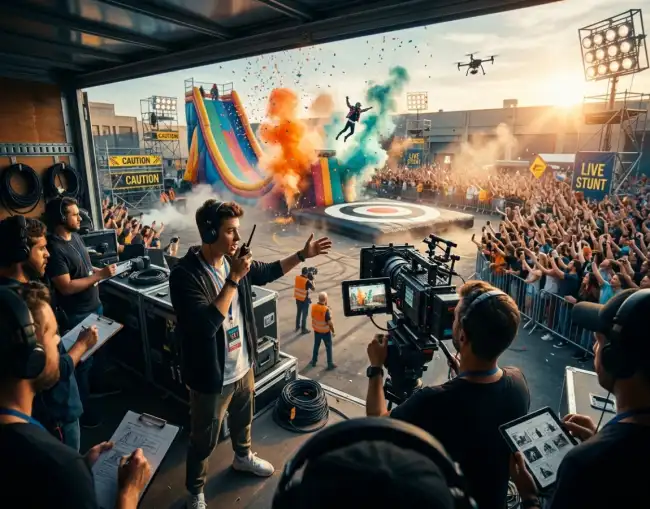
When millions of viewers tune into a high-octane YouTube video featuring a creator surviving 7 days inside a subterranean bunker, purchasing a private island for strangers, or converting a city block into an obstacle course, they experience seamless, adrenaline-fueled entertainment. What appears on screen as spontaneous, high-energy fun is actually the output of a hyper-calculated media production. Behind every 15-minute viral spectacle lies months of military-grade logistics, legal maneuvering, seven-figure financial exposure, structural engineering, and meticulous narrative design. The digital landscape has evolved past the era of serendipitous viral moments; today’s viral stunts are high-stakes architectural feats engineered for maximum human attention.
The fundamental economics of digital publishing have shifted. Algorithmic distribution rewards extreme retention, high click-through rates (CTR), and emotional resonance. As viewer sophistication increases and platform saturation accelerates, simple commentary or basic vlog setups no longer dominate culture. Industry leaders treat content creation not merely as artistic expression, but as an operational science. Executing a large-scale stunt requires balancing real-world physical danger, municipal compliance, real-time crisis management, and complex multi-camera production pipelines—all while preserving the organic, unscripted atmosphere that audiences demand.
This comprehensive guide goes behind the scenes of high-stakes viral stunts to expose the precise blueprints, logistical frameworks, editing methodologies, and commercial strategies elite production teams use to convert artificial chaos into global cultural moments and sustainable enterprise value.
Foundational Principles & Mechanics of the Modern Viral Stunt
To understand how high-impact stunts are executed, one must first dissect the psychological and technical mechanics that elevate a video from a routine upload to an algorithmic phenomenon. A viral stunt is not merely a bold act; it is a carefully calibrated delivery vehicle for specific emotional triggers designed to maximize digital reach and viewer retention.
At the foundation of every successful stunt lies the High-Concept Premise. A high-concept idea can be summarized in a single, visually evocative sentence that immediately communicates stakes, environment, and objective (e.g., "I Built a Real-Life Willy Wonka Chocolate Factory"). If a premise cannot be understood in less than two seconds through a thumbnail and a title, it fails the initial friction test. This clarity directly drives the primary curve of audience acquisition: initial Click-Through Rate (CTR).
Once the click is secured, the video’s operational architecture must manage Algorithmic Velocity and Retention Engineering. Platforms prioritize Average Percentage Viewed (APV) and total watch time. Large-scale stunts achieve high APV through continuous micro-escalations, spatial resets, and narrative loops. The production team must build physical sets and challenges that naturally scale in intensity, ensuring that the viewer feels compelled to stay until the final frame to witness the resolution.
Furthermore, execution relies on Controlled Peril and Calculated Absurdity. Audiences crave high stakes—whether financial, emotional, or physical—but creators must navigate these parameters within rigorous safety boundaries. The art of viral stunt design lies in creating the illusion of utter chaos and unscripted danger while maintaining complete operational control behind the lens. Achieving this equilibrium requires dedicated pre-production protocols, risk assessment matrices, and multi-layered redundancy across all production systems.
Conceptualization & Ideation Architecture
Visualizing the High-Concept Hook
The ideation phase does not begin with asking "what would be fun to film?" but rather "what image will stop millions of users mid-scroll?" Elite creative teams start by pre-visualizing the thumbnail and title before a single line of script is written or a single permit requested. If a concept cannot yield a compelling, uncluttered visual thumbnail that conveys extreme scale, contrast, or absurdity, it is immediately discarded.
During ideation, concepts are subjected to rigorous visual auditing. Writers and art directors draft dozens of potential thumbnail compositions, testing element placements, color palettes, and facial expressions. The physical stunt is then reverse-engineered from this singular ideal frame. If the visual hook involves dropping a sports car into a giant bowl of cereal, the operational team must calculate the physics, legal constraints, and cost structure required to make that exact visual frame a physical reality.
Feasibility Analysis and Scale Factor Stress-Testing
Once a high-concept hook survives initial visual vetting, it enters the operational stress-testing pipeline. Feasibility directors assess whether the concept can be physically built, safely executed, and filmed within budget constraints. This stage involves preliminary engineering consultations, site visits, and environmental assessments to evaluate weather patterns, power grid access, and local regulatory hurdles.
Simultaneously, the concept is evaluated for its "Scale Factor." A good stunt can be amplified by simply raising the stakes: turning ten thousands dollars into one million, or extending a 24-hour challenge to 100 hours. However, scaling a stunt exponentially increases logistical complexity. Teams must evaluate whether doubling the physical scale yields a proportional increase in retention and virality, or if it merely adds unnecessary operational overhead and safety hazards.
Pre-Production & Logistics Engineering
Legal Clearances, Permitting, and Risk Audits
The difference between an amateur prankster and a world-class production team lies in legal and risk infrastructure. Modern stunts operating in public or complex private environments require comprehensive municipal permits, environmental impact clearances, FAA authorizations for drone coverage, and strict non-disclosure agreements (NDAs) for participants and crew. A single unpermitted variable can result in immediate shutdown, massive fines, or catastrophic liability lawsuits.
Professional creator teams employ dedicated risk mitigation officers who draft comprehensive safety matrices for every production day. These risk audits map out every conceivable point of failure—from structural collapse and pyrotechnic misfires to medical emergencies and extreme weather events. Specialized production insurance policies, often costing tens of thousands of dollars per shoot day, are secured specifically to cover extreme activities, high-value asset destruction, and participant indemnity.
Multi-Cam Production Rigging & Tech Stack
Filming an unpredictable, unscripted stunt requires a vastly different production architecture than standard narrative filmmaking. Because key moments occur organically and cannot easily be re-shot, coverage must be absolute. Production rigs routinely feature 15 to 40 cameras recording simultaneously, including cinema primary cameras, mirrorless secondary angles, ultra-rugged action cameras mounted on physical assets, micro-bodycams on participants, and high-altitude cinema drones.
Managing this immense data footprint requires specialized on-set data wrangling protocols. Digital Imaging Technicians (DITs) deploy high-speed mobile SAN/NAS storage arrays to offload, verify, and back up terabytes of footage in real time. Timecode synchronization across all audio and video feeds is mandatory to prevent editing bottlenecks in post-production. Without synchronized timecodes, aligning dozens of continuous video feeds over a 48-hour continuous shoot becomes a logistical nightmare that can delay post-production by weeks.
Team Orchestration & Collaboration Dynamics
Directing Real-Time Chaos and Unscripted Talent
On set, the director's primary role is not to dictate lines, but to manage environment dynamics and energy levels. Talent and participants placed in high-stress, endurance-based, or competitive stunts naturally experience fatigue and emotional fluctuations. The director and showrunners must construct psychological triggers within the challenge environment that keep participants engaged, responsive, and expressive on camera.
Producers employ discreet audio communication systems (in-ear monitors and concealed IFB lines) to guide on-camera hosts. This allows showrunners to feed key narrative beats, real-time stat updates, and strategic prompts to the host without breaking the camera's visual immersion. The objective is to guide the chaos toward satisfying story arcs while preserving authentic human reactions and spontaneous humor.
Cross-Creator Synergies & Co-Star Integration
Scaling a viral stunt's organic reach often involves bringing together a ensemble cast of top-tier creators. Integrating multiple high-profile personalities requires careful talent management, alignment of incentive structures, and strategic schedule coordination. Each guest creator brings their own brand identity, audience expectations, and production preferences to the set, which must be seamlessly woven into the master narrative.
Executing successful ensemble stunts mirrors the collaborative frameworks deployed during executive industry summits. Elite creators leverage collective masterminds to share production resources, optimize cross-promotional distribution, and refine narrative pacing before going on set. To understand how top digital talent structure these high-level networks to optimize production scale and commercial output, explore our deep dive on The Art of the Creator Retreat: Why Masterminds Are the Secret Weapon of Top Influencers.
Live Execution & Real-Time Crisis Control
Capturing Unscripted Magic While Controlling Chaos
When the production clock starts, the master control trailer becomes a high-intensity command center. Live producers monitor multi-view video walls displaying every camera angle alongside real-time audio feeds. The goal is to identify emergent narrative threads as they happen—a sudden rivalry between contestants, an unexpected physical failure of an obstacle, or a moment of genuine emotional vulnerability—and direct camera operators to capture the action in tight, dynamic angles.
Safety marshals and emergency medical technicians remain stationed immediately outside the camera frame, equipped with direct radio channels to the director. If an unsafe condition develops, safety teams can pause the action without breaking character or compromising the setup. The production structure must be flexible enough to absorb unforeseen delays while maintaining momentum for participants and on-camera hosts.
Contingency Execution & Backup Narrative Threads
No complex stunt survives contact with reality entirely unchanged. Equipment fails, weather conditions deteriorate, and participants make unpredictable decisions that can break a planned format. Master stunt producers build operational redundancies directly into the production script, establishing "If-Then" operational trees for every stage of the shoot.
If the primary physical challenge breaks down midway through filming, the team must instantly pivot to an alternate rule set or a pre-rigged secondary setup without losing on-camera energy. This adaptability prevents catastrophic production halts that burn through daily operational budgets. A successful crew does not try to force reality to match their initial plan; they construct a flexible environment where any outcome yields compelling, high-stakes video content.
Post-Production Pacing & Retention Architecture
The First 30 Seconds: Pacing, Micro-Hooks, and Pattern Interrupts
Post-production is where raw chaos is refined into pure algorithmic engagement. The first 30 seconds of a viral stunt video determine its ultimate reach. Editors employ an aggressive editing philosophy known as "hyper-pacing." The cold open must re-confirm the title and thumbnail promise within the first three seconds, establish the ultimate stakes, and showcase high-intensity teaser clips of the video's climax without giving away the resolution.
To prevent early viewer drop-off (retention drop), editors integrate visual and auditory "pattern interrupts" every 2 to 4 seconds. These include rapid camera angle shifts, strategic sound effects, kinetic typography, dynamic zoom-ins, and visual split-screens. These micro-interruption techniques re-engage the viewer's brain, preventing passive scrolling habits and maintaining hyper-focused attention through the video's crucial setup phase.
Data-Driven Editing and Narrative Pruning
Top-tier editing rooms do not rely solely on creative intuition; they utilize analytics data from historical video performances to construct frame-by-frame pacing maps. Editors analyze historical audience retention graphs to identify the exact moments where past videos lost viewer attention—such as overly long verbal explanations, slow spatial transitions, or repetitive challenge rounds—and eliminate those structural patterns entirely.
Modern editing workflows leverage custom software platforms to track pacing cadence and scene length. To learn more about how creators utilize advanced data metrics to optimize video structure and audience retention, read our comprehensive feature on Data-Driven Storytelling: How Analytics Platforms Are Reshaping Content Strategy. Through precise data analysis, editors ruthlessly prune hundreds of hours of raw footage down to a dense, high-impact edit where every single second serves a clear narrative or emotional purpose.
Distribution, Amplification & Monetization Loops
The Multi-Windowing Content Waterfall
A multi-hundred-thousand-dollar stunt cannot rely on a single YouTube video upload to recapture capital and maximize return on investment (ROI). Elite media organizations deploy a synchronized content distribution waterfall across every major digital touchpoint. The main flagship video serves as the premium anchor asset, while specialized edit teams simultaneously cut short-form vertical assets tailored for TikTok, YouTube Shorts, and Instagram Reels.
These short-form assets are not mere promotional trailers; they are engineered as standalone micro-narratives that highlight specific sub-plots, behind-the-scenes mishaps, or high-intensity moments. Distributed across a coordinated release schedule, these short-form assets drive massive top-of-funnel traffic back to the primary long-form upload, capturing diverse audience demographics and creating a self-reinforcing views loop across ecosystems.
Capitalizing on Peak Impressions for Brand Equity
The surge of global traffic generated by a successful viral stunt creates a valuable window of brand equity. Savvy creators transform this short-term attention into long-term enterprise capital by integrating direct-to-consumer (D2C) product launches, limited-edition merchandise drops, or proprietary platform announcements directly into the video's peak emotional beats.
When millions of users simultaneously engage with a piece of content, monetizing through programmatic ad platforms (AdSense) alone captures only a fraction of the total commercial value generated. Creators who build scalable business models leverage these landmark content uploads as powerful launchpads for consumer brands, enterprise sponsorships, and recurring membership communities. For a detailed breakdown of how top digital brands turn massive audience events into sustainable commercial engines, explore our analysis on Milestone Madness: How Creators Turn 10 Million Subscribers Into Commercial Gold.
Real-World Case Studies & Scenarios
Scenario A: The Multi-Stage Island Challenge (Successful Execution)
A leading creator organization spent $600,000 to purchase and build a custom challenge arena on a remote tropical island, featuring 100 contestants competing for a major cash prize over five days. The team invested three months in pre-production, deploying a 50-person crew, dedicated medical teams, satellite link internet systems, and 32 continuous camera setups.
Execution Strategy: The production team used dynamic rule adjustments to manage contestant elimination pacing, ensuring high-energy competitors remained in the game through later rounds. Post-production spent six weeks sculpting 1,200 hours of footage into a tight, 38-minute narrative asset featuring intense audio soundscapes and clear structural chapters.
Outcome & Metrics: The video generated 45 million views within 72 hours, maintaining an average watch duration of 68% (unusually high for a video of that length). The launch was monetized through a custom brand sponsorship deal valued at $400,000, integrated D2C product placement, and programmatic ad revenue, yielding a total gross return of $1.4 million against a $600,000 production budget—resulting in a net ROI of over 133% alongside massive subscriber growth.
Scenario B: The Unsanctioned Urban Stunt (Catastrophic Failure)
An ambitious mid-tier creator attempted to film an unpermitted urban flash-challenge involving blocking traffic on a major city bridge to set up a mobile basketball court. The budget was relatively modest ($45,000), spent primarily on renting luxury vehicles and high-end camera rigs, but zero capital was allocated to municipal permits, safety coordinators, or legal counsel.
Execution Failures: Within eleven minutes of filming, local law enforcement shut down the operation. Key camera equipment was impounded, and the creator team was arrested for reckless endangerment and obstructing public transit. Because coverage was interrupted, the editing team lacked the necessary narrative footage to build a coherent story, resulting in a disjointed 6-minute video composed mostly of chaotic, low-quality phone clips.
Outcome & Metrics: The upload received 2 million views due to sensational news coverage, but YouTube demonetized the video immediately for policy violations regarding illegal and dangerous activities. Legal fees, vehicle impound charges, and equipment loss totaled over $110,000 in out-of-pocket costs. The brand suffered catastrophic reputation damage, lost existing corporate sponsors, and faced ongoing criminal liability—demonstrating the fatal consequences of ignoring professional pre-production protocols.
Critical Mistakes & How to Avoid Them
-
Sacrificing Narrative Architecture for Unstructured Chaos:
The Mistake: Believing that simply blowing up an expensive item or throwing cash into a crowd automatically creates a great video. Without clear character motivations, progressive stakes, and a structured narrative arc, viewers quickly experience visual fatigue and click away.
The Countermeasure: Map out your stunt using classic three-act story structure. Every major event must have a setup, an escalating complication, and a clear payoff. Treat raw spectacle merely as the setting; human emotion and competitive tension are the true drivers of audience retention.
-
Neglecting On-Set Audio & Single-System Failures:
The Mistake: Over-investing in cinematic 4K camera bodies while relying on weak on-board audio or single wireless receiver channels. Stunts take place in noisy, high-wind, or chaotic environments where audio dropouts destroy key emotional beats.
The Countermeasure: Deploy redundant, dual-system audio capture setups. Equip key talent with 32-bit float onboard recorders (which prevent digital audio clipping regardless of volume spikes) alongside traditional wireless lavalier transmitters, and utilize multi-directional shotgun arrays across set perimeters.
-
Underestimating Pre-Production & Regulatory Approvals:
The Mistake: Assuming digital content falls under "guerrilla filmmaking" immunity and skipping formal permitting, insurance, or structural engineering reviews to save time and money.
The Countermeasure: Retain experienced line producers and location managers who specialize in traditional commercial shoots. Build a minimum 6-to-8 week pre-production buffer for large-scale stunts to secure municipal permits, draft safety waivers, and complete full structural stress-testing.
-
Failing to Manage On-Set Energy and Participant Burnout:
The Mistake: Subjecting participants or hosts to long, unscripted downtime between challenge setups, leading to visible exhaustion, passive body language, and low-energy interactions on camera.
The Countermeasure: Run a tight second-unit production crew to prep upcoming sets entirely out of sight of primary talent. Keep live downtime to an absolute minimum, and maintain dynamic off-camera warm-up producers whose sole job is to keep participant energy high.
-
Ignoring Post-Production Data and Over-Editing:
The Mistake: Editing based entirely on personal artistic preference or cluttering the screen with unnecessary visual effects that distract from the main story, leading to severe retention drop-offs.
The Countermeasure: Implement strict internal testing protocols. Conduct audience retention focus-group screenings using analytical playback software before publishing, cutting any segment—no matter how expensive or hard to film—that causes viewer interest to dip.
Comprehensive Stunt Execution & Operational Framework Matrix
The following detailed breakdown compares four distinct categories of viral stunts across key operational parameters, logistical budgets, and performance profiles:
| Stunt Archetype | Lead Time & Budget | Primary Risk & Legal Profile | Technical & Rigging Complexity | Virality & Retention Index | Primary Monetization Model |
|---|---|---|---|---|---|
| High-End Physical Challenge (e.g., 100 Days In Isolation) |
2 to 4 Months $150k - $500k |
Participant psychological & physical fatigue; strict liability waivers required. | High: Multi-cam 24/7 logging arrays, automated lighting rigs, environmental control. | Very High Retention Sustained long APV due to strong emotional arcs. |
Brand Sponsorships, Integrated Merchandise Drops, YouTube AdSense. |
| Large-Scale Spectacle Stunt (e.g., Crashing a Bus into a House) |
3 to 6 Months $300k - $1M+ |
Severe physical hazard; municipal permitting, environmental clearance, FAA licenses. | Extreme: Phantom high-speed cameras, drone arrays, pyrotechnic safety lines. | Extreme CTR / High Virality Short, intense retention spikes around key explosions. |
Mass Top-of-Funnel Brand Awareness, Global D2C Product Launching. |
| Public Interaction / Urban Stunt (e.g., Flash Hide and Seek) |
2 to 4 Weeks $25k - $75k |
Public interference, police shutdown, privacy compliance, crowd control. | Moderate: Concealed wireless lavs, mobile handheld cinema setups, hidden cams. | Moderate Retention Highly dependent on pacing and organic comedy. |
Platform Monetization, Short-Form Content Syndication. |
| Philanthropic Competition Event (e.g., Giving Away a Private Island) |
2 to 5 Months $500k - $2M+ |
Tax compliance laws, prize distribution regulations, contestant background checks. | Very High: Multi-location setups, satellite communications, live scoring rigs. | Extreme Virality & Retention Deep emotional engagement and mass sharing. |
Major Corporate Philanthropic Partnerships, Long-term Brand Value. |
Frequently Asked Questions (FAQ)
How far in advance do creators begin planning multi-million dollar stunts?
For large-scale viral stunts involving major infrastructure, custom set builds, or municipal closures, pre-production typically begins three to six months prior to the camera rolling. This lead time is necessary to secure municipal permits, complete structural engineering studies, negotiate corporate brand sponsorships, perform risk audits, and manage logistical sourcing for specialized equipment.
Smaller, self-contained challenge videos within controlled studio settings can occasionally operate on shorter timelines (two to four weeks). However, the top digital media houses maintain rolling production calendars where multiple large-scale stunt projects exist in varying stages of ideation, permitting, set construction, and post-production simultaneously.
What type of insurance is required to film dangerous or destructive viral stunts?
Standard commercial video production insurance is rarely sufficient for high-stakes viral stunts. Creators must procure specialized entertainment insurance policies featuring custom riders for extreme hazards, high-value asset destruction, marine or aviation operations, and non-scripted participant injury. These policies require detailed risk assessment matrices prepared by certified safety coordinators.
Insurance underwriters review structural engineering reports, medical response plans, pyrotechnic licenses, and site safety protocols before binding coverage. In many cases, insurance companies require designated safety officers to hold full shutdown authority on set, empowering them to halt production immediately if safety parameters are breached.
How do creator teams keep details of massive stunts from leaking before launch?
Be the first creator to share your take on this story.