
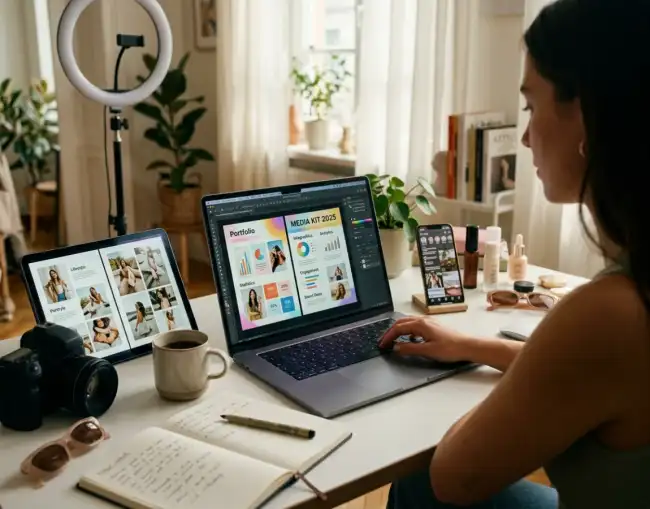
The digital sponsorship landscape has undergone a seismic shift. Gone are the days when a creator could coast on follower counts, aesthetic grid layouts, and vague promises of viral reach to secure lucrative partnerships. In 2025, modern brands—armed with sophisticated attribution software, ROI-obsessed marketing directors, and tighter budgets—demand empirical proof of performance. They are no longer buying vanity metrics; they are investing in conversion velocity, authentic audience trust, and measurable equity. For content creators navigating this hyper-competitive terrain, the traditional PDF resume stuffed with generic screenshots is no longer just ineffective—it is a fast track to being ghosted by brand marketing teams.
At the Influencers Collaboration Network, our investigative analysis of over 500 brand-creator transactions reveals a stark reality: creators who treat their media kit as a dynamic, data-driven business proposal close deals at a rate 4.2 times higher than those relying on static portfolios. Your influencer media kit is not merely a summary of who you are; it is a high-stakes commercial pitch document designed to de-risk an investment for a brand manager. It must articulate your unique value proposition with surgical precision, showcasing demographic alignment, historical campaign performance, and creative capability in a format that reads instantly on both desktop monitors and mobile devices.
This comprehensive guide dismantles the anatomy of a high-converting creator portfolio. We will walk you through the structural architecture of a brand deals template that commands respect, explore the psychological triggers that compel procurement officers to sign, and provide a masterclass in how to pitch to brands with absolute confidence. Whether you are an emerging nano-influencer carving out your first revenue streams or a multi-platform macro-creator scaling your enterprise, mastering this asset will permanently transform your commercial leverage.
Understanding the Modern Creator Economy and Sponsorship Landscape
To build an elite influencer media kit, you must first understand the macroeconomic forces governing digital marketing budgets in 2025. Brand marketing departments are operating under intense scrutiny. Economic fluctuations and the maturation of social commerce have forced a pivot away from awareness-only campaigns toward full-funnel marketing strategies. When a brand allocates capital to an influencer, they are calculating customer acquisition cost (CAC), return on ad spend (ROAS), and lifetime value (LTV). Your media kit must mirror this corporate language if you want to be taken seriously as a media enterprise.
The Death of Vanity Metrics and the Rise of Audience Quality
For years, follower count served as the primary currency of the influencer economy. Brands would filter creators through broad brackets—10k to 50k, 50k to 100k, 100k+—and price partnerships accordingly. Today, this methodology is largely obsolete. Savvy influencer marketing managers look past the follower total to examine engagement quality, comment sentiment, save rates, and share velocity. A creator with 25,000 highly engaged followers in a hyper-niche vertical like sustainable home remodeling often commands higher rates and delivers better conversions than a lifestyle generalist with 500,000 unengaged followers.
Your media kit must proactively address this paradigm shift. Instead of leading with a massive, unverified follower number, your opening sections should highlight audience authenticity, geographical concentration, and niche specificity. Brands want to know that your community views you not just as an entertainer, but as a trusted peer and advisor. By integrating third-party analytics verification and qualitative community sentiment into your portfolio, you eliminate doubt and position your audience as a pre-qualified, ready-to-buy market segment.
Data Transparency and Performance-Driven Partnerships
Another defining characteristic of the 2025 sponsorship ecosystem is the demand for verifiable data transparency. Brands are increasingly utilizing creator management platforms that pull real-time audience insights, meaning discrepancies between your claimed metrics and your actual profile data are instantly exposed. Your media kit must be a beacon of absolute honesty and professional transparency. Including updated screenshots of analytics dashboards, historical click-through rates (CTR) from affiliate links, and verified conversion data builds immediate trust.
Furthermore, modern brand deals frequently incorporate hybrid compensation structures—base fees combined with performance bonuses tied to affiliate sales or discount code usage. A forward-thinking media kit acknowledges this reality by showcasing your historical performance in driving commercial action. If you have previously generated $50,000 in tracked sales for a skincare brand through a dedicated YouTube integration, that statistic belongs front and center in your portfolio. It signals to prospective partners that you understand their business objectives and share their commitment to measurable outcomes.
Anatomy of a High-Converting Influencer Media Kit
Constructing a media kit that consistently closes brand deals requires a meticulous blend of visual hierarchy, persuasive copywriting, and hard data. Think of your media kit as a landing page where the product is *you*. Every section must serve a specific psychological purpose, guiding the brand manager from initial curiosity to enthusiastic conversion. Let us examine the essential structural pillars that every elite brand deals template must possess.
The Cover Page and Professional Brand Identity
First impressions are formed in milliseconds. The cover page of your influencer media kit must instantly communicate your brand identity, niche, and professionalism. It should feature a high-resolution, professionally styled headshot or action photo that aligns with the visual aesthetic of your content channels. Avoid overly stylized or heavily filtered imagery that obscures your face; brand managers want to see the human being they are partnering with.
In addition to your visual branding, the cover page must display your primary handle, primary platform, contact email, and a concise tagline that defines your value proposition. For example, instead of a generic title like "Media Kit 2025," use an informative headline such as "Jane Doe | Sustainable Living & Zero-Waste Creator | Media Kit & Partnership Portfolio." This immediate clarity lets the recipient know precisely what industry you operate in and what value you offer.
Audience Demographics and Psychographic Profiling
Brand marketing teams do not care about your content simply because it is entertaining; they care about who is watching it and whether those viewers match their ideal customer profile (ICP). Your demographics section must go far beyond a simple pie chart of age and gender. While age brackets, gender distribution, and top-tier geographic locations (countries and major cities) are non-negotiable baseline data points, elite media kits dig deeper into psychographics.
Incorporate data points regarding your audience’s interests, purchasing behaviors, income brackets, and core pain points. If your content focuses on personal finance for millennials, your psychographic profile should highlight that your audience is actively seeking debt-consolidation solutions, retirement planning tips, and affordable investment tools. When a fintech brand reads your media kit and sees that your audience's psychographic profile mirrors their target market with pinpoint accuracy, the friction in closing the deal disappears.
Showcasing Case Studies and Proven Past Collaborations
Nothing builds commercial confidence quite like a proven track record. Brand managers are inherently risk-averse; hiring a new creator involves a degree of uncertainty regarding reliability, content quality, and audience reception. You can systematically dismantle this apprehension by dedicating a prominent section of your media kit to detailed case studies of past successful brand partnerships.
Structuring Compelling Success Stories
A poorly executed case study simply lists the names of brands you have worked with, accompanied by their logos. While brand logos are important for social proof, logos alone do not explain *how* you drove value. An elite case study tells a concise, three-part story: the challenge or campaign objective, your creative execution, and the tangible results achieved.
For instance, if you partnered with an athletic apparel brand, your case study should detail the objective (launching a new running shoe line), your execution (a three-part Instagram Reel series and a dedicated YouTube review video highlighting durability and comfort), and the results (generating over 450 direct purchases via swipe-up links and achieving a 6.8% engagement rate, well above category benchmarks). Use visual mockups, screenshots of high-performing comments, and clean typography to make these stories instantly digestible.
Leveraging Testimonials from Brand Marketing Managers
Social proof from your peers holds immense weight in corporate decision-making. Including direct quotes and testimonials from marketing directors, public relations agencies, and brand founders you have previously collaborated with adds an unassailable layer of credibility. These testimonials should specifically address your professionalism, communication speed, content quality, and ability to hit brief requirements without endless revisions.
When selecting testimonials for your creator portfolio, choose quotes that highlight the *experience* of working with you as much as the results. Phrases like "Jane delivered the assets two days ahead of schedule and incorporated all feedback flawlessly" or "Her campaign generated our highest ROAS of the quarter" provide brand managers with the psychological safety they need to present your name to their superiors for budget approval.
Packaging Your Services, Deliverables, and Rate Cards
One of the most debated topics in the creator economy is whether to include pricing directly in the media kit. Through our extensive industry analysis at the Influencers Collaboration Network, we strongly advocate for a transparent, well-structured rate card or tiered partnership packages within your media kit, provided you maintain the flexibility to customize custom enterprise solutions.
Designing Value-Based Partnership Tiers
Rather than presenting a confusing à la carte menu of individual prices for a single story or a single tweet, package your deliverables into cohesive, value-driven tiers. This approach anchors the brand’s perception of your value and encourages them to purchase comprehensive multi-asset campaigns rather than isolated placements.
Consider structuring your offerings into three distinct tiers:
- The Starter Integration: Designed for emerging brands testing the waters; typically includes one dedicated TikTok/Reel video and cross-platform story mentions with swipe-up links.
- The Omnichannel Campaign: Our most popular tier; features integrated video content across YouTube and Instagram, multi-day story coverage, and usage rights for paid media advertising.
- The Long-Term Brand Ambassadorship: A multi-month retainer model that positions you as the ongoing face of the brand, including monthly content drops, exclusive event appearances, and white-labeled content creation.
Navigating Usage Rights and Exclusivity Fees
Professional creators understand that content creation is only part of the commercial equation. Usage rights—allowing a brand to repurpose your organic content for their own paid social ads (Whitelisting/Spark Ads)—and category exclusivity—preventing you from working with competing brands for a specified period—carry immense commercial value that must be explicitly accounted for in your media kit.
Clearly state your base policies regarding usage and exclusivity in your pricing section. For example, specify that standard rates include organic posting rights only, while paid advertising usage requires a multiplier fee (typically an additional 50% to 100% of the content fee per 30-day window). Educating brand managers on these terms within your media kit establishes you as an experienced media professional who protects intellectual property rights.
Mastering the Art of the Pitch: How to Approach Brands
An extraordinary media kit is only as powerful as the outreach strategy driving it. Even the most beautifully designed brand deals template will sit gathering digital dust if you do not know how to land it in front of the right decision-maker with a compelling pitch. Cold emailing and LinkedIn outreach require a refined methodology that respects the brand manager's time while immediately highlighting mutual commercial benefit.
Identifying and Contacting the True Decision-Maker
Sending your pitch to a generic `[email protected]` or `[email protected]` inbox is a recipe for low conversion. These general inboxes are flooded daily with low-effort pitches and are rarely monitored by marketing decision-makers. Your first step in any pitching campaign is thorough reconnaissance to identify the exact person managing influencer partnerships or PR budgets.
Utilize platforms like LinkedIn to search for titles such as "Influencer Marketing Manager," "Social Media Director," "Brand Partnerships Lead," or "PR Coordinator" within your target company. Once you identify the individual, use email-finding tools or pattern analysis (e.g., `[email protected]`) to secure their direct corporate email address. Personalization at this discovery stage dramatically increases your open and response rates.
Anatomy of a High-Converting Outreach Email
Your pitch email must be concise, punchy, and utterly devoid of self-centered fluff. Brand managers do not care about how long you have dreamed of working with their company; they care about how your audience can help them solve a marketing challenge or hit their quarterly sales targets.
A winning pitch email follows a structured formula:
- The Hook: Open with a personalized compliment or a specific observation about a recent campaign or product launch the brand executed. This proves you have done your homework.
- The Value Proposition: In one sentence, explain who you are, the exact demographic you reach, and why your community aligns perfectly with their target customer.
- The Concept Proposal: Pitch a concrete, creative content concept tailored specifically to their product line, rather than asking them what they want you to do. Show initiative.
- The Call to Action (CTA) and Attachment: Politely invite them to review your attached media kit and ask a low-friction question to prompt a reply, such as, "Are you currently finalizing budgets for Q3, or would it make sense to connect next week?"
Real-World Case Studies: Successful Execution vs. Common Failures
To truly master the mechanics of influencer media kits and brand pitching, examining real-world execution provides invaluable clarity. Let us analyze two contrasting scenarios from our research files at the Influencers Collaboration Network, highlighting the stark differences between a failed outreach campaign and a highly successful partnership closure.
Scenario A: The Generic Mass-Blast (Failure)
Creator X, a lifestyle vlogger with 80,000 YouTube subscribers, decided to pitch 50 direct-to-consumer skincare brands in a single afternoon. Using a generic email template, Creator X attached a 12-page PDF media kit that had not been updated in over a year. The email opened with, "Dear Marketing Team, I love your products and want to work together. Here are my rates and my subscriber count." The attached media kit featured outdated follower screenshots, no demographic breakdown beyond a vague pie chart, and no case studies or past brand examples.
The Outcome: Out of 50 emails sent, Creator X received zero responses, save for one automated reply. The media kit failed because it lacked personalization, failed to demonstrate audience value, provided no proof of performance, and treated the brand manager like a faceless ATM rather than a strategic business partner.
Scenario B: The Targeted Value-First Approach (Success)
Creator Y, a sustainable fashion and lifestyle creator with 35,000 highly engaged followers on Instagram and TikTok, targeted five eco-friendly apparel brands that aligned precisely with her values. Before pitching, Creator Y studied each brand’s active Instagram ad campaigns to understand their creative style. She then customized her media kit to feature a dedicated case study highlighting a previous campaign where she drove a 5.2% engagement rate and 300 direct checkouts for a similar sustainable brand.
Her outreach email praised a specific new fabric line released by the brand and proposed a three-part TikTok series demonstrating how to style the pieces for different capsule wardrobes. She attached her sleek, 4-page interactive media kit containing verified analytics and transparent pricing tiers.
The Outcome: Within 48 hours, the Influencer Marketing Manager responded enthusiastically, praising the specific creative concept. A phone call was scheduled, and Creator Y successfully closed a $4,500 partnership deal that included usage rights and a recurring monthly retainer. The success was driven by meticulous targeting, verified performance data, and a solution-oriented pitch.
Critical Mistakes to Avoid in Your Creator Portfolio
Even seasoned creators occasionally fall into traps that undermine their commercial credibility. Avoiding these five critical mistakes will immediately elevate your media kit above 90% of your competition.
- Mistake 1: Relying Solely on Vanity Metrics. Leading your media kit with a massive follower number while ignoring engagement rate, audience demographics, and conversion data signals amateurism to modern brand managers. Countermeasure: Dedicate equal or greater space to audience quality metrics, geographic concentration, and verified conversion case studies.
- Mistake 2: Designing for Desktop While Ignoring Mobile. Over 70% of brand marketing managers will review your media kit on their smartphones while traveling, in meetings, or between calls. If your PDF is formatted in a landscape orientation with microscopic text, it will be instantly abandoned. Countermeasure: Always design your media kit in a clean vertical (portrait) format or build a mobile-optimized web landing page.
- Mistake 3: Overwhelming the Reader with Clutter. Packing every single brand logo you have ever worked with, every press mention, and walls of dense text creates visual fatigue. Countermeasure: Curate ruthlessly. Feature your top 4-5 best brand partnerships and use concise, bulleted copy with plenty of white space.
- Mistake 4: Failing to Update Analytics Regularly. Presenting audience statistics or pricing rates from two years ago destroys trust the moment a brand manager cross-references your profile with third-party tracking tools. Countermeasure: Schedule a mandatory calendar reminder to refresh your media kit data, screenshots, and case studies at the start of every single quarter.
- Mistake 5: Neglecting Clear Contact Information and Social Links. Astonishingly, many creators build stunning media kits but forget to include clickable hyperlinks to their active social channels or a direct, professional email address. Countermeasure: Ensure every social handle, website URL, and email address is embedded with active hyperlinks on every single page of your digital kit.
- Audit Your Current Assets: Pull your latest platform analytics, verify your audience demographics, and select your top three most successful past brand collaborations to serve as case studies.
- Redesign for Mobile and Impact: Build or update your media kit using a clean 3-to-5 page structure (or a mobile-optimized web landing page) that prioritizes readability, data transparency, and clear value propositions.
- Craft Tailored Outreach Campaigns: Ditch generic mass-blasting. Identify specific marketing decision-makers at brands that align with your niche, personalize your pitches, and link directly to your newly polished media kit.
Comprehensive Creator Portfolio Tools and Strategy Comparison
Choosing the right format and hosting method for your media kit is a foundational technical decision. The table below compares the four most popular approaches utilized by professional creators in 2025, evaluating design flexibility, mobile responsiveness, cost, and conversion impact.
| Media Kit Format | Design Flexibility | Mobile Responsiveness | Cost & Maintenance | Conversion Impact |
|---|---|---|---|---|
| Custom Web Landing Page (Webflow/Notion) | Maximum (Full brand control and interactivity) | Flawless across all screen sizes | Low to Medium; easy to update instantly | Highest (Professional, modern, and easily shareable via link) |
| Canva PDF Template | High (Extensive template library and styling) | Variable (Depends on export settings and device) | Free to Low; requires manual re-upload when updated | High (Visually striking if structured with clean hierarchy) |
| Adobe InDesign PDF | Maximum (Print-grade professional typography) | Variable (Can be clunky on mobile screens) | Medium (Requires Adobe subscription and design skill) | Moderate to High (Favored by traditional luxury and fashion brands) |
| Link-in-Bio Aggregator (Linktree/Beacons) | Low to Moderate (Restricted by platform layout) | Flawless (Built natively for mobile viewing) | Free to Low; zero friction to access | Low for Initial Pitching (Too brief for detailed brand proposals) |
Frequently Asked Questions (FAQ)
How often should I update my influencer media kit?
You should perform a comprehensive review and data update of your media kit at the beginning of every single fiscal quarter (every three months). Social media algorithms shift rapidly, audience demographics evolve, and your follower counts and engagement rates fluctuate. Presenting outdated metrics that do not match your current profile analytics is a red flag for brand managers. Furthermore, adding your most recent and successful brand campaigns each quarter ensures your portfolio continually highlights your growing expertise and evolving creative capabilities.
Should I include exact pricing in my media kit or negotiate on a case-by-case basis?
This is one of the most debated strategies in the creator economy. Our recommendation at the Influencers Collaboration Network is to provide structured partnership tiers and baseline pricing ranges rather than rigid, unalterable numbers. Providing baseline pricing anchors the conversation and filters out brands operating on micro-budgets that cannot afford your services. However, always include a note stating that custom enterprise packages, long-term ambassadorships, and specific usage rights are quoted individually following a discovery call.
What is the ideal length for a professional influencer media kit?
For a PDF media kit, the sweet spot is strictly between 3 to 5 pages. Page one should feature your cover, personal introduction, and value proposition. Page two should showcase audience demographics, psychographics, and platform reach. Page three should highlight your top case studies, past brand logos, and client testimonials. Page four should outline your partnership packages and contact information. If you are using a web-based landing page, keep the scroll length concise and digestible, avoiding endless walls of text that cause reader fatigue.
How do I handle pitching brands if I am a nano-influencer with under 10,000 followers?
Nano-influencing is one of the fastest-growing segments in digital marketing because smaller audiences consistently exhibit extraordinary trust and hyper-targeted engagement. When pitching as a nano-influencer, lean heavily into your niche specificity and engagement rate rather than your follower count. Frame your pitch around community intimacy, high comment-to-follower ratios, and cost-effective authentic content creation. Many emerging direct-to-consumer brands actively seek out nano-influencers to build content libraries for paid social advertising, making your engagement quality your strongest commercial selling point.
What software should I use to design my media kit if I lack professional graphic design skills?
You do not need an advanced degree in graphic design to create a stunning, professional portfolio. Platforms like Canva offer hundreds of modern, highly polished influencer media kit templates optimized for both aesthetic appeal and readability. Alternatively, tools like Notion allow you to build clean, minimalist, web-based media kits that load instantly on mobile devices and can be updated with a single click. The most critical factor is not advanced graphic design wizardry, but clean visual hierarchy, legible typography, and accurate data presentation.
Strategic Roadmap and Final Takeaway
As the creator economy matures through 2025 and beyond, the era of casual sponsorships and unstructured negotiations is officially over. Brands are demanding rigorous accountability, transparent data, and professional execution from every partner they invite into their marketing ecosystem. Your influencer media kit is no longer a simple decorative accessory—it is the central commercial document that dictates your revenue potential, your professional reputation, and your long-term viability as a digital enterprise.
To capitalize on this environment, execute the following actionable roadmap immediately:
By treating your creator business with the rigor of a media agency and backing your creative talent with undeniable data, you will consistently close high-value brand deals and future-proof your career in the modern digital landscape.
Be the first creator to share your take on this story.